

AI now does the entry-level work that trained a generation of professionals, and the hiring data show it. Here is what the evidence says about who gets hired, who survives, and what students should do.
The entry-level job is the first casualty of artificial intelligence, and the payroll data now show it. Among American workers aged 22 to 25 in the occupations most exposed to AI, employment fell about 11% between November 2022 and June 2026, while employment of the same age group in the least exposed occupations grew about 10%. That leaves the young workers in exposed jobs 19% below where they would be had they kept pace, a gap that was 15% a year earlier and is widening. Experienced workers in the same occupations show no comparable gap. The decline comes through hiring, not layoffs, and it is concentrated where AI substitutes for human tasks rather than complements them.1 Recent US graduates had an unemployment rate of about 5.6% and an underemployment rate of 42% in the second quarter of 2026, and computer science, long sold as the safe degree, now carries a 7.0% unemployment rate for recent graduates, against 2.1% for nursing.2
Seventy years ago this was a ten-man summer project. Today 88% of organizations report using AI, more than half of the world’s population has tried a generative AI tool, and official statistics offices from Washington to Riyadh count a fifth to a third of all businesses as users (Exhibit 1). This article traces that arc, sets out what AI already does in finance, marketing, design, software, and customer service, maps what the official business surveys say about small and medium-sized enterprises (SMEs) in forty countries, and then answers, without varnish, the question behind all of it: what happens to the students of today, what the job market looks like over the next three to ten years, and who survives.
Exhibit 1
In seventy years AI went from a ten-man summer study to a technology that 88% of organizations say they use.
Milestones and scale of artificial intelligence, 1955 to 2030, people, users, dollars, and shares as stated
| Year | What happened | How many |
|---|---|---|
| 1955 to 1956 | John McCarthy, Marvin Minsky, Nathaniel Rochester, and Claude Shannon propose a “2 month, 10 man study” of artificial intelligence; the Dartmouth workshop runs in summer 1956 and coins the term. | About 20 people attended; only three stayed the full eight weeks. |
| 1958 to 2017 | Rosenblatt’s perceptron (1958), IBM’s Deep Blue beats Kasparov (1997), AlexNet wins ImageNet and starts the deep-learning era (2012), the transformer architecture is published (2017). | Research communities of thousands; two long “AI winters” in between. |
| November 2022 | ChatGPT is released to the public. | About 100 million monthly users within two months, then the fastest consumer adoption on record. |
| October 2025 | OpenAI reports ChatGPT usage at its developer conference. | 800 million weekly users; 4 million developers. |
| 2025 | Investment and corporate adoption, per the Stanford AI Index 2026. | $344.7 billion of private AI investment worldwide, $285.9 billion of it in the US; 1,953 newly funded US AI companies; 88% of organizations using AI. |
| 2026 | Generative AI reaches more than half the world’s population within three years of launch; agents complete multi-hour tasks; a no-code app builder passes $600 million of annual revenue. | 53% population adoption (Singapore 61%, UAE 54%, US 28%). |
| 2030 | World Economic Forum employer survey projection and McKinsey Global Institute technical estimate. | 170 million jobs created, 92 million displaced, 22% of jobs churned; 57% of US work hours technically automatable with today’s technology. |
| 2031 to 2036 | No quantified forecast from an official body exists. Anthropic’s chief executive expects half of entry-level white-collar jobs to go within one to five years; the Yale Budget Lab and the AI pioneer Yann LeCun see no macro-level disruption yet. | Open. |
Note: The 2030 figures are employer expectations (WEF, more than 1,000 employers, 14 million workers, 55 economies) and a technical-potential estimate (MGI), not forecasts of job losses. Population adoption is the AI Index measure of people who have used generative AI.
Source: Dartmouth proposal, 1955; Wikipedia, “Dartmouth workshop”; Rosenblatt, 1958; IBM; Krizhevsky, Sutskever, and Hinton, 2012; Vaswani et al., 2017; Reuters, February 2023 (UBS); TechCrunch, October 2025; Stanford HAI, AI Index Report 2026; METR, 2025 and 2026; TechCrunch, September 2026; World Economic Forum, Future of Jobs Report 2025; McKinsey Global Institute, November 2025; Fortune, January 2026; Reeve Hayward analysis
From ten men to a general-purpose technology
The 1955 proposal to the Rockefeller Foundation asked for ten people and two months. Its conjecture, that every feature of intelligence can in principle be described precisely enough for a machine to simulate it, took seventy years and two funding collapses to pay off.3 What changed in 2012 was scale: a neural network trained on a million labeled images beat every hand-built system, and from then on progress came from more data and more computing rather than cleverer rules. The transformer architecture of 2017 made language the next target, and the public release of ChatGPT in November 2022 turned a research curiosity into the fastest consumer adoption ever measured, about 100 million monthly users in two months, against nine months for TikTok and two and a half years for Instagram.4, 5
The count today is not ten men. The Stanford AI Index 2026 records $344.7 billion of private AI investment in 2025, 1,953 newly funded AI companies in the United States alone, organizational adoption of 88%, and four in five university students using generative AI.6 ChatGPT passed 800 million weekly users in October 2025.7 On capability, the best way to track the trend is the length of task an AI agent can finish on its own: METR measured that length doubling roughly every seven months from 2019 to 2024, and its January 2026 update put frontier models at more than ten hours of expert work at a 50% success rate, with recent doubling faster than the long-run rate.8 Read those two curves together, adoption and task length, and the next three to ten years need no exotic assumption: the machines will do longer and more complex pieces of office work, and more firms will let them.
What AI already does, and why most of it is unlicensed work
The work AI has absorbed first shares one property: no law requires a human to do it. Writing marketing copy, editing a video, bookkeeping entries, first-pass research, basic design, a customer chat, or a web application are all unlicensed activities, judged only by whether the output is good enough. In software, a platform called Lovable, which lets non-programmers build applications by describing them, went from $100 million of annual run-rate revenue in July 2025 to $600 million in September 2026 with 146 employees in March.9 In advertising, the Wall Street Journal reported in June 2025 that Meta aims to let brands automate the creation and targeting of ads fully by the end of 2026, from a product image and a budget.10 In customer service, Klarna said in February 2024 that its assistant handled 2.3 million conversations in a month, the work of 700 agents, and in May 2025 reversed course and began hiring people again after service quality fell.11 Microsoft’s study of 200,000 Copilot conversations found the highest AI applicability in media and communication work, services sales, and information and record clerks, and the lowest among forestry workers, plant operators, grounds maintenance, home health aides and nursing assistants, and extraction workers.12
The people doing this work describe the shift plainly. A writer on r/Upwork who earned $4,000 to $5,000 a month in 2021 asked in August 2026 where the jobs went; the first reply was that clients now write with ChatGPT and are happy with it. A Dubai advertising agency wrote in October 2025 that it had shut its copywriting division of six writers in English and Arabic. A video editor working out a notice period in August 2026 was told the firm would build an editing system instead of hiring a replacement. A real estate investor who let go a $25-an-hour assistant for a $1,000-a-month set of agents wrote that the assistant had done nothing wrong; the owner had simply found something cheaper. And an owner who replaced three roles, a support agent, a data-entry clerk, and a junior marketing writer, reported $132,000 of annual savings and a 14% fall in customer satisfaction in three months.13 The pattern is consistent with the research on freelance platforms: after ChatGPT, postings for writing and coding work fell 21% relative to manual work within eight months, and freelancers in affected occupations saw fewer jobs and lower earnings.14
What the official surveys say about SMEs, country by country
To measure the effect on SMEs we went to the statistics offices rather than to vendor surveys, whose definitions of “using AI” vary with what they sell. Eurostat’s enterprise survey, the US Census Bureau’s Business Trends and Outlook Survey, and their counterparts in the United Kingdom, Canada, Australia, Brazil, Singapore, and Saudi Arabia all ask a version of the same question to a representative sample of businesses. Three findings hold everywhere (Exhibit 2).
First, adoption has roughly tripled in two years. In the European Union, 20% of enterprises with ten or more employees used at least one AI technology in 2025, up from 8% in 2023; among small firms of 10 to 49 staff the share went from 6 to 17%.15 In Canada the share tripled from 6.1% in the second quarter of 2024 to 19.2% in the second quarter of 2026.16 In the United Kingdom it rose from about 12% in late 2023 to about 35% of businesses with ten or more employees in June 2026.17 Across the OECD, firm-level use grew 42% in 2025 alone, from 14.2 to 20.2%.18 Second, the gap between large and small firms is wide and persistent: 55% of large EU firms against 17% of small ones, 37% of US firms with 250 or more staff against under 20% of those with four or fewer, 70% of large Singapore enterprises against 23% of SMEs, 50% of large Brazilian companies against 15% of small ones.15, 19, 20, 21 Third, use is still shallow: only 10% of adopting UK businesses describe it as extensive, and the most common technology is a large language model.17
Exhibit 2
AI use among small EU firms nearly tripled in two years, but large firms still use it more than three times as often.
Enterprises using at least one AI technology, EU-27, by size class, 2021–25, % of enterprises
| Year | Small, 10–49 staff | Medium, 50–249 staff | Large, 250+ staff | All, 10+ staff |
|---|---|---|---|---|
| 2021 | 6.1 | 12.6 | 28.4 | 7.7 |
| 2023 | 6.4 | 13.1 | 30.5 | 8.1 |
| 2024 | 11.2 | 21.0 | 41.2 | 13.5 |
| 2025 | 17.0 | 30.4 | 55.0 | 20.0 |
Note: The survey was not run in 2022. Covers enterprises with ten or more persons employed in all activities except agriculture, mining, and finance.
Source: Eurostat, “Artificial intelligence by size class of enterprise” (isoc_eb_ai), updated June 15, 2026; Reeve Hayward analysis
Put on a map, the official figures show where SMEs are in the race (Exhibit 3). Denmark leads at 42% of enterprises, Finland at 38, the United Kingdom and Sweden at 35, and Saudi Arabia, whose statistics authority counted 33.1% of establishments using AI in 2025, up from 27.6% in 2024, sits among the leaders.22 The United States and Canada are at about a fifth, Brazil at 17%, Australia at 12%, and Romania at 5%.15, 16, 19, 21, 23 We found no published Qatari business survey of AI use; the nearest official evidence is the AI Index’s population measure, which puts the UAE among the highest in the world at 54% of people having used generative AI.6
Exhibit 3
Official surveys put AI use at a fifth of businesses in the US and Canada, a third in Saudi Arabia and the UK, and two-fifths in Denmark.
Share of enterprises using AI, latest official business survey, 40 countries, 2024–26, % of enterprises; prism height and shade proportional to the share
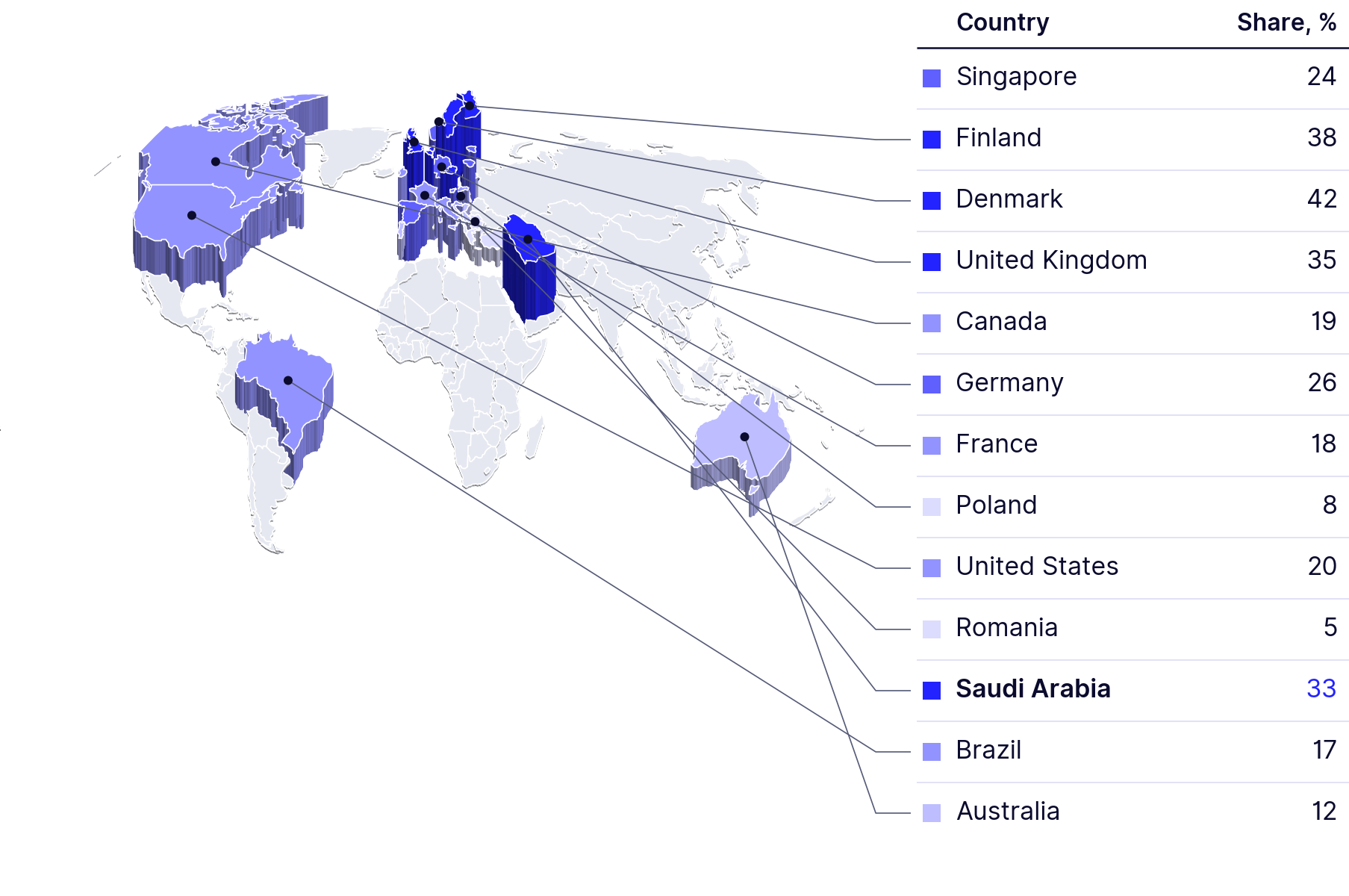
Note: Bases differ and the map is indicative. Europe (Eurostat 2025), the UK (June 2026), and Brazil (2025) cover enterprises with ten or more employees; the US (period ending May 3, 2026), Canada (second quarter 2026), Australia (2024–25), Singapore (2025), and Saudi Arabia (2025) cover all businesses or establishments, where micro firms pull the share down. The US question was widened in November 2025 to AI use in any business function. Japan, Korea, and other countries with sample or opinion surveys only are left grey.
Source: Eurostat; UK Office for National Statistics; US Census Bureau; Statistics Canada; Australian Bureau of Statistics; Cetic.br; IMDA Singapore; General Authority for Statistics, Saudi Arabia; Natural Earth map data; Reeve Hayward analysis
For an SME owner the useful number is the size gap, because it shows how much is still to come. In every country with a size breakdown, large firms use AI two to eight times as often as small ones (Exhibit 4). Large firms adopt first because they have the data, the IT staff, and the legal cover; small firms adopt when the tool arrives inside software they already pay for. That second wave is now under way, and it is why the Reddit threads from small business owners in 2026 are about agents handling intake, scheduling, invoicing, and social posts rather than about pilots.13
Exhibit 4
Small firms trail large firms everywhere: the gap is two to one in Denmark and eight to one in Poland.
Enterprises using at least one AI technology, by size class, selected countries, 2025, % of enterprises
| Country | Small, 10–49 staff | Medium, 50–249 staff | Large, 250+ staff |
|---|---|---|---|
| Denmark | 37.5 | 58.3 | 74.5 |
| Finland | 33.5 | 51.4 | 79.4 |
| Sweden | 30.7 | 49.6 | 71.9 |
| Netherlands | 28.8 | 46.6 | 67.6 |
| Germany | 23.1 | 35.6 | 57.0 |
| Spain | 17.2 | 30.1 | 57.5 |
| EU-27 | 17.0 | 30.4 | 55.0 |
| France | 15.0 | 30.8 | 58.0 |
| Brazil | 15.0 | 50.0 | |
| Italy | 14.2 | 27.6 | 53.1 |
| Czechia | 13.4 | 28.8 | 54.1 |
| Poland | 5.8 | 14.8 | 45.8 |
| Romania | 4.1 | 7.8 | 20.8 |
Note: Brazil’s survey (Cetic.br, TIC Empresas 2025) does not publish a medium-size figure. The UK, the US, Canada, Singapore, and Australia use different size bands and are described in the text.
Source: Eurostat, isoc_eb_ai, 2025 data; Cetic.br, TIC Empresas 2025; Reeve Hayward analysis
What it means for the students of today
Here is the honest reading of the evidence (Exhibit 5). The economy as a whole has not shed jobs to AI: the Stanford team finds no widespread displacement, the Yale Budget Lab finds the occupational mix shifting only modestly, and employers surveyed by the National Association of Colleges and Employers in spring 2026 planned to hire 5.6% more new graduates than the year before.1, 24, 25 But the entry rung of the ladder in exposed fields is being removed. US entry-level postings fell 7.5% in the year to May 2026 while senior postings rose 14.7%.26 New-graduate hiring at the twelve largest US technology companies is down about 65% from 2019, with design down 48% and even engineering down 11%.27 In the United Kingdom, 8,383 graduate vacancies were advertised in July 2026, down 45.6% in a year and the lowest since the count began in 2016.28 The Dallas Fed finds the mechanism is fewer young people moving from outside the labor force into a first job, not layoffs.29 And the AI Index records that employment of software developers aged 22 to 25 has fallen nearly 20% since 2024.6
Exhibit 5
The economy is not shedding jobs to AI, but the entry rung in exposed fields is being removed.
Evidence on entry-level and graduate employment, United States and United Kingdom, as of October 2026, % and counts as stated
| Measure | Reading | Source and date |
|---|---|---|
| Employment of 22- to 25-year-olds in the most AI-exposed occupations, US payroll data | −11% from November 2022 to June 2026, against +10% in the least exposed; 19% below the kept-pace path | Stanford Digital Economy Lab (ADP), August 2026 |
| Recent US graduates aged 22 to 27 | Unemployment about 5.6%; underemployment 42% | New York Fed, second quarter 2026 |
| Recent US graduates by major (2024 data) | Computer engineering 7.8%, computer science 7.0%, nursing 2.1%, special education 0.7% unemployed | New York Fed, as reported February 2026 |
| US job postings by level | Entry-level −7.5% and senior +14.7% in the year to May 2026 | Indeed Hiring Lab, July 2026 |
| New-graduate hiring at the 12 largest US tech companies | −65% versus 2019; engineering −11%, design −48% | SignalFire, 2026 |
| UK graduate vacancies advertised | 8,383 in July 2026, −45.6% in a year, lowest since 2016 | Adzuna via The Guardian, October 2026 |
| US employers’ hiring plans for the class of 2026 | +5.6% (185 respondents, spring survey) | NACE, April 2026 |
| Economy-wide displacement | None found; occupational mix shifting modestly; unemployment duration for exposed workers unchanged | Stanford, August 2026; Yale Budget Lab, February 2026 |
Note: The Stanford gap is descriptive, not a causal estimate; the authors note it shrinks when education is controlled for and some trends predate generative AI. Postings, payroll employment, hires, and survey intentions measure different things and are not additive.
Source: As listed in the table; Reeve Hayward analysis
Why the entry level? Because the junior job was made of exactly the tasks AI does best: checkable, codified, screen-based work that senior staff used to hand down. The Stanford authors put it precisely: AI substitutes for the digitized and codified knowledge that is the core of formal education, and complements the tacit knowledge that experienced staff hold.1 That is the trap for a graduate. A degree certifies codified knowledge. The thing employers now pay for, judgment built on experience, was acquired by doing the junior work that is disappearing. The CPAs asking on r/Accounting how a firm trains the next generation when AI does the workpapers and reconciliations are describing a broken apprenticeship, not a productivity gain.13 A graduate on r/resumes with a 3.5 grade average, a ten-month internship, three deployed applications, and 1,300 applications had no full-time offer in September 2026.13
A degree certifies codified knowledge. The thing employers now pay for, judgment built on experience, was acquired by doing the junior work that is disappearing.
The next three to ten years, and who survives
The forecasts split into three camps, and we think readers should see all three. The employer camp, in the World Economic Forum survey, expects 170 million jobs created and 92 million displaced by 2030, with 41% of employers planning to reduce their workforce where AI can replicate the work; the roles expected to decline fastest are postal clerks, bank tellers, data-entry clerks, cashiers, and administrative assistants, and the roles growing fastest in number are farmworkers, delivery drivers, construction workers, salespeople, nurses, teachers, and care workers.30 The engineering camp, McKinsey Global Institute, estimates that today’s technology could already do 57% of US work hours, 44% through software agents and 13% through robots, and stresses that this is technical potential, not a forecast.31 The alarm camp, led by Anthropic’s chief executive, expects half of entry-level white-collar jobs to go within one to five years; the skeptics, including the AI pioneer Yann LeCun and the Yale Budget Lab, answer that the aggregate data do not yet show it.32, 24 The IMF’s own estimate is that 40% of jobs worldwide and 60% in advanced economies are exposed, with roughly half of those exposed likely to benefit and half to lose.33
Our reading is that the alarm camp is right about the entry level and the skeptics are right about the aggregate, for now. If firm adoption across the OECD kept growing at 2025’s rate of 42% a year, more than half of firms would be users within three years, and the task length agents can handle is doubling in well under a year. Together those two trends mean the shortage of junior roles in exposed fields is a structural change, not a cycle. Who survives it is already visible in the data and the threads. The work that holds is work where a license requires a human signature, where the body has to be present, where a client relationship or an accountability is the product, or where tacit judgment is needed to decide what the machine should do and to check what it did. Audit, law, medicine, engineering sign-off, nursing, the trades, construction, logistics, and frontline sales sit there; so do the senior roles whose postings are rising. What does not hold is the unlicensed, codified, screen-based task done for a fee, and the junior job that consisted of it. Licensing slows substitution inside a profession, but it does not stop a firm doing the same work with fewer juniors per partner.
Qatar and the Gulf start from a different place, and the difference cuts both ways. Of 127,477 employed Qataris in 2024, 66,701 worked in public administration and a further 25,041 in education and health, together 72%, so for a Qatari graduate the entry rung is set by government hiring and the state’s own digitization choices rather than by the market.34 The 2.1 million non-Qatari workers, including almost all of the private-sector finance, marketing, administration, and technology staff, have the direct exposure, and for them a lost job is also a lost residency. Saudi Arabia’s 33% business adoption and the UAE’s 54% population adoption show how fast the region’s employers are moving.6, 22
For students, graduates, and the SMEs that will or will not hire them, the evidence supports a short list. It is also the basis of the workforce and operating-model work we do in strategy consulting in Qatar.
- Choose fields where the license, the body, or the relationship is part of the product. Nursing at 2.1% unemployment and computer science at 7.0% are the same labor market read correctly. Health, education, engineering with professional sign-off, the trades, and client-facing sales are where the official growth lists point.
- Treat the degree as the floor and the portfolio as the proof. Employers are hiring judgment, and judgment is shown by finished work: a business run, a product shipped to real users, a problem solved for a real client. One commenter on r/jobsearchhacks noted freshmen shipping products to 50,000 users with coding agents and getting the internships that applications alone did not.13
- Learn to direct and verify the machine in your own field. The accountant who maps a year of bank transactions with an agent and then checks it is more valuable than either the agent or the clerk it replaced. Every discipline now has this layer, and it is where the junior role is being rebuilt.
- Take the first job for the tacit knowledge, not the title. Seek employers that still put juniors next to seniors. A firm that has automated its workpapers and kept no one to learn from them is a worse first employer than one that pays less and trains.
- If you own an SME, cut tasks, not the pipeline. The owners who report savings also report falling satisfaction scores, escalations that humans used to absorb, and no one left who understands the process. Automate the intake, the invoicing, and the first draft, and keep one person who can judge the output and grow into the next.
- Do not wait for the data to settle. By the time economy-wide statistics show displacement, the students now choosing majors will have graduated. The entry-level signal is already clear.
Seventy years after ten men met at Dartmouth, the machine does the junior work, and the record shows it in payroll data, graduate vacancies, and the threads where owners count their savings. The economy will keep most of its jobs for some years yet. The question for a student is narrower and harder: whether the job they are training for still has a first rung. For many of the unlicensed, screen-based professions it does not, and the honest advice is to choose work the machine cannot sign, touch, or be blamed for, and to build the judgment that employers will pay for before anyone hands it to you.
About this article
This article draws on public sources checked on October 14, 2026: official business surveys from Eurostat, the UK Office for National Statistics, the US Census Bureau, Statistics Canada, the Australian Bureau of Statistics, Cetic.br, IMDA Singapore, and Saudi Arabia’s General Authority for Statistics; the Stanford AI Index 2026; payroll, posting, and vacancy studies by Stanford, the New York and Dallas Feds, Indeed, SignalFire, and Adzuna; and posts by business owners, freelancers, and graduates on Reddit between October 2025 and September 2026, quoted in paraphrase. Country survey bases differ and are described in the notes to Exhibit 3. It is for information only and is not investment advice.
Sources
- Erik Brynjolfsson, Bharat Chandar, and Ruyu Chen, “Canaries in the Coal Mine? Six Facts about the Recent Employment Effects of Artificial Intelligence,” Stanford Digital Economy Lab, August 2026 (ADP payroll data through June 2026).
- Federal Reserve Bank of New York, “The Labor Market for Recent College Graduates,” second quarter 2026; outcomes by major (2024 data) as reported by Forbes, February 23, 2026, and NewsNation.
- John McCarthy, Marvin Minsky, Nathaniel Rochester, and Claude Shannon, “A Proposal for the Dartmouth Summer Research Project on Artificial Intelligence,” August 31, 1955; Wikipedia, “Dartmouth workshop,” on attendance.
- Frank Rosenblatt, “The Perceptron,” Psychological Review, 1958; IBM, “Deep Blue”; Alex Krizhevsky, Ilya Sutskever, and Geoffrey Hinton, “ImageNet Classification with Deep Convolutional Neural Networks,” NeurIPS 2012; Ashish Vaswani et al., “Attention Is All You Need,” 2017.
- Reuters, “ChatGPT sets record for fastest-growing user base,” February 2, 2023, citing UBS and Similarweb.
- Stanford Institute for Human-Centered AI, “The 2026 AI Index Report” and “Inside the AI Index: 12 Takeaways from the 2026 Report,” April 13, 2026.
- TechCrunch, “Sam Altman says ChatGPT has hit 800M weekly active users,” October 6, 2025.
- METR, “Measuring AI Ability to Complete Long Tasks,” March 2025 (arXiv 2503.14499), and “Time Horizon 1.1,” January 2026.
- TechCrunch, “Lovable says it added $100M in revenue last month alone, with just 146 employees,” March 11, 2026, and “Lovable’s annualized revenue crosses $600M as vibe coding takes off,” September 24, 2026.
- Wall Street Journal via Yahoo Finance, “Meta looking to fully automate ad creation by 2026-end,” June 2, 2025.
- Klarna, “Klarna AI assistant handles two-thirds of customer service chats in its first month,” February 27, 2024; Forbes, “Klarna Reverses AI Push, Says Customers Prefer Human Support,” May 18, 2025.
- Kiran Tomlinson, Sonia Jaffe, Will Wang, Scott Counts, and Siddharth Suri, “Working with AI: Measuring the Applicability of Generative AI to Occupations,” Microsoft Research, arXiv 2507.07935, July 2025, revised December 2025.
- Reddit threads, read October 14, 2026: r/Upwork, “Im a writer, but jobs have disappeared on Upwork,” August 14, 2026; r/dubai, “Dubai is moving to AI and low paid employees,” October 13, 2025; r/VideoEditors, “Quit my job, told I’ll be replaced by AI,” August 16, 2026; r/smallbusiness, “I replaced a $25/hr virtual assistant with AI,” March 19, 2026; r/Entrepreneurs, “Replaced 3 employees with AI workflows 8 months ago,” May 14, 2026; r/Accounting, “CPAs: If AI takes over junior-level work, how should firms train the next generation?,” September 13, 2026; r/resumes, “1,300+ applications, 3 deployed production apps, still no full-time offer,” September 22, 2026; r/jobsearchhacks, “Graduating in Fall 2026 with CS, why am I not getting any interviews,” August 21, 2026; r/EntrepreneurRideAlong, “I replaced 3 employees with AI agents,” March 3, 2026.
- Ozge Demirci, Jonas Hannane, and Xinrong Zhu, “Who Is AI Replacing? The Impact of Generative AI on Online Freelancing Platforms,” Management Science, 2025; Xiang Hui, Oren Reshef, and Luofeng Zhou, “The Short-Term Effects of Generative Artificial Intelligence on Employment,” Organization Science, 2024.
- Eurostat, “Artificial intelligence by size class of enterprise” (isoc_eb_ai), 2021 to 2025 data, updated June 15, 2026.
- Statistics Canada, “Analysis on artificial intelligence use by businesses in Canada, second quarter of 2026,” Catalogue 11-621-M, 2026, as reported by The Hub, June 26, 2026.
- UK Office for National Statistics, “Artificial intelligence in UK businesses: 2023 to 2026,” July 20, 2026 (BICS wave 159, June 2026).
- OECD, “AI use by individuals surges across the OECD as adoption by firms continues to expand,” January 28, 2026.
- US Census Bureau, “Large Firms With at Least 20 Employees Biggest AI Users,” May 26, 2026 (Business Trends and Outlook Survey, December 2025 to May 2026).
- Infocomm Media Development Authority, Singapore Digital Economy Report 2025, October 5, 2026, as reported by People Matters, October 7, 2026.
- Cetic.br, “TIC Empresas 2025,” June 2026 (4,174 companies, fieldwork February 2025 to January 2026).
- General Authority for Statistics, Saudi Arabia, Establishments’ ICT Access and Usage Survey 2025, as reported by Arab News, June 14, 2026, and Sharikat Mubasher.
- Australian Bureau of Statistics, “Business adoption of Artificial Intelligence accelerates in 2024–25,” June 25, 2026.
- Yale Budget Lab, as reported by Fortune, “Yale Budget Lab says companies may be ‘AI-washing’ layoffs,” February 2, 2026.
- National Association of Colleges and Employers, “Outlook Brightens for College Class of 2026 Entry-Level Hiring,” April 2026.
- Felix Aidala and Sneha Puri, “The Labor Market Is Tilting Toward Seniority,” Indeed Hiring Lab, July 23, 2026.
- SignalFire, “State of Tech Talent Report 2026,” as reported by F1Jobs, September 8, 2026.
- Adzuna graduate vacancy data via The Guardian, as reported by VnExpress International, October 6, 2026.
- Tyler Atkinson and Shane Yamco, “Young workers’ employment drops in occupations with high AI exposure,” Federal Reserve Bank of Dallas, January 6, 2026.
- World Economic Forum, “Future of Jobs Report 2025,” January 8, 2025, press release and digest.
- McKinsey Global Institute, “Agents, robots, and us: Skill partnerships in the age of AI,” November 2025, as reported by Fortune, November 25, 2025.
- Axios, “Behind the Curtain: A white-collar bloodbath,” May 28, 2025; Fortune, “At Davos, CEOs said AI isn’t coming for jobs as fast as Anthropic CEO Dario Amodei thinks,” January 27, 2026; Implicator.ai on Yann LeCun’s response, 2026.
- Kristalina Georgieva, “AI Will Transform the Global Economy. Let’s Make Sure It Benefits Humanity,” IMF, January 14, 2024.
- National Planning Council, Qatar, Annual Bulletin of Labour Force Sample Survey 2024, employed population by nationality and sector of economic activity, via the Gulf Labour Markets and Migration programme.
To discuss what this means for your business, speak with our team. Initial conversations are confidential and without obligation.
Speak with our team


