

Sixteen AI companies listed or filed in the US, Hong Kong and mainland China in 2026 as China's AI shares fell 43%. We read their filings for debt, cash, commitments and the ability to pay.
Most of the artificial intelligence (AI) companies that came to market in 2026 owe their banks very little. Of the sixteen that listed shares or filed a prospectus in the United States, Hong Kong and mainland China this year, fourteen carried little bank or bond debt on their latest balance sheets, and the two large borrowers, SpaceX and the Chinese memory maker CXMT, held more cash than debt.1 The burden sits elsewhere. Anthropic, the maker of the Claude models, has no drawn borrowings but has named $637 billion of commitments to buy computing capacity, 4.8 times its cash.2 Nscale, a builder of AI data centers, has signed about $9.0 billion of loan and lease facilities since February, and the two listed Chinese developers of large language models, Z.AI and MiniMax, issued zero-coupon convertible bonds that fall due in 2027.3
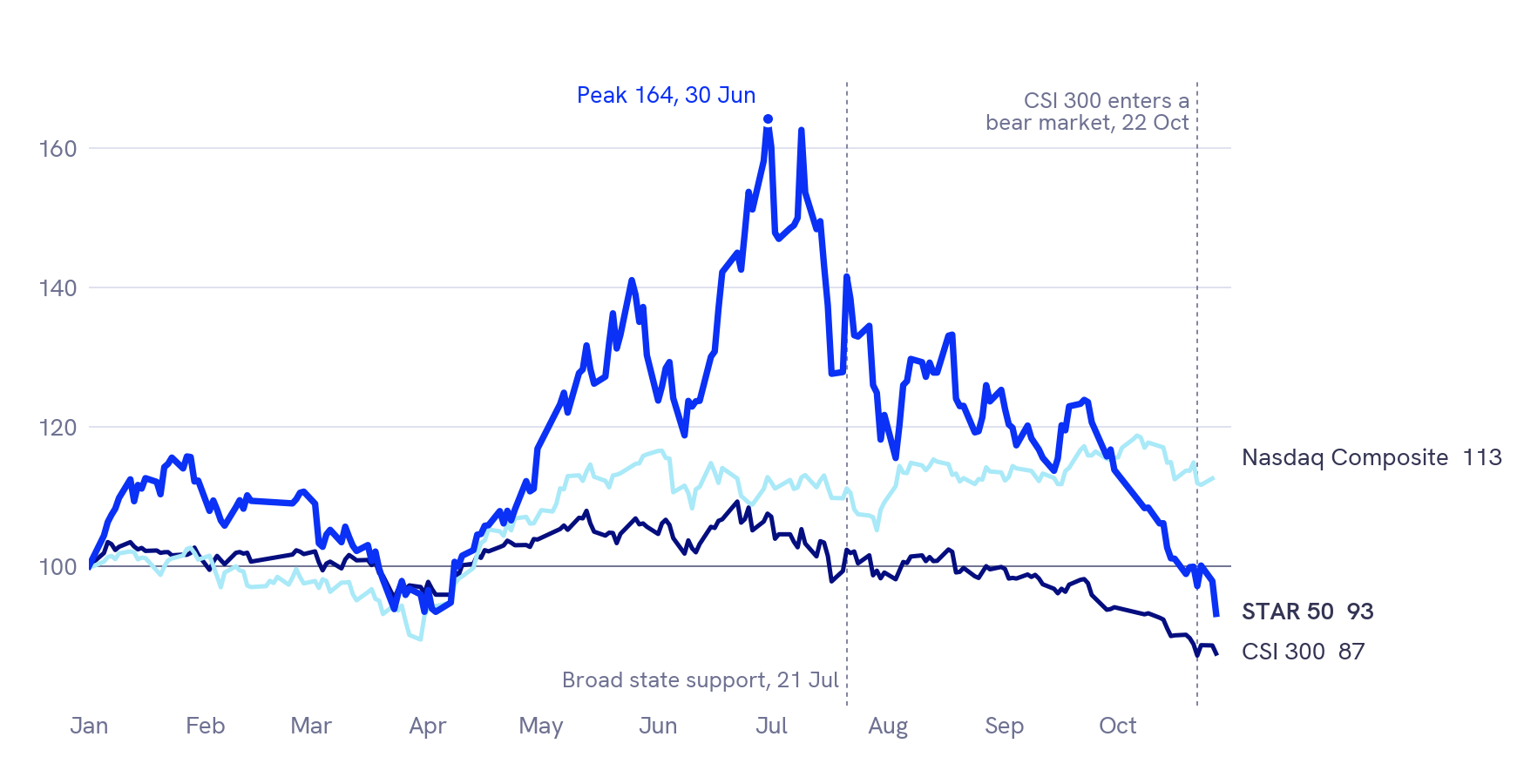
The listings came during a sharp turn in Chinese technology shares. The STAR 50 index of Shanghai’s technology board rose 64% in the first half of 2026 and then fell 43% from its June 30 peak to October 27, erasing the gain, while the Nasdaq Composite stood only 5.2% below its October record.4
This report reads the filings to answer three questions: how much these companies owe and in what form, what their operating measures show, and whether they can repay. It also sets out who sold Chinese AI shares and why, tests five common claims about AI finance, and lists the signposts we will follow. It does not value any company or recommend any security (see sidebar, “About the research”).
Sixteen companies, about $108 billion raised
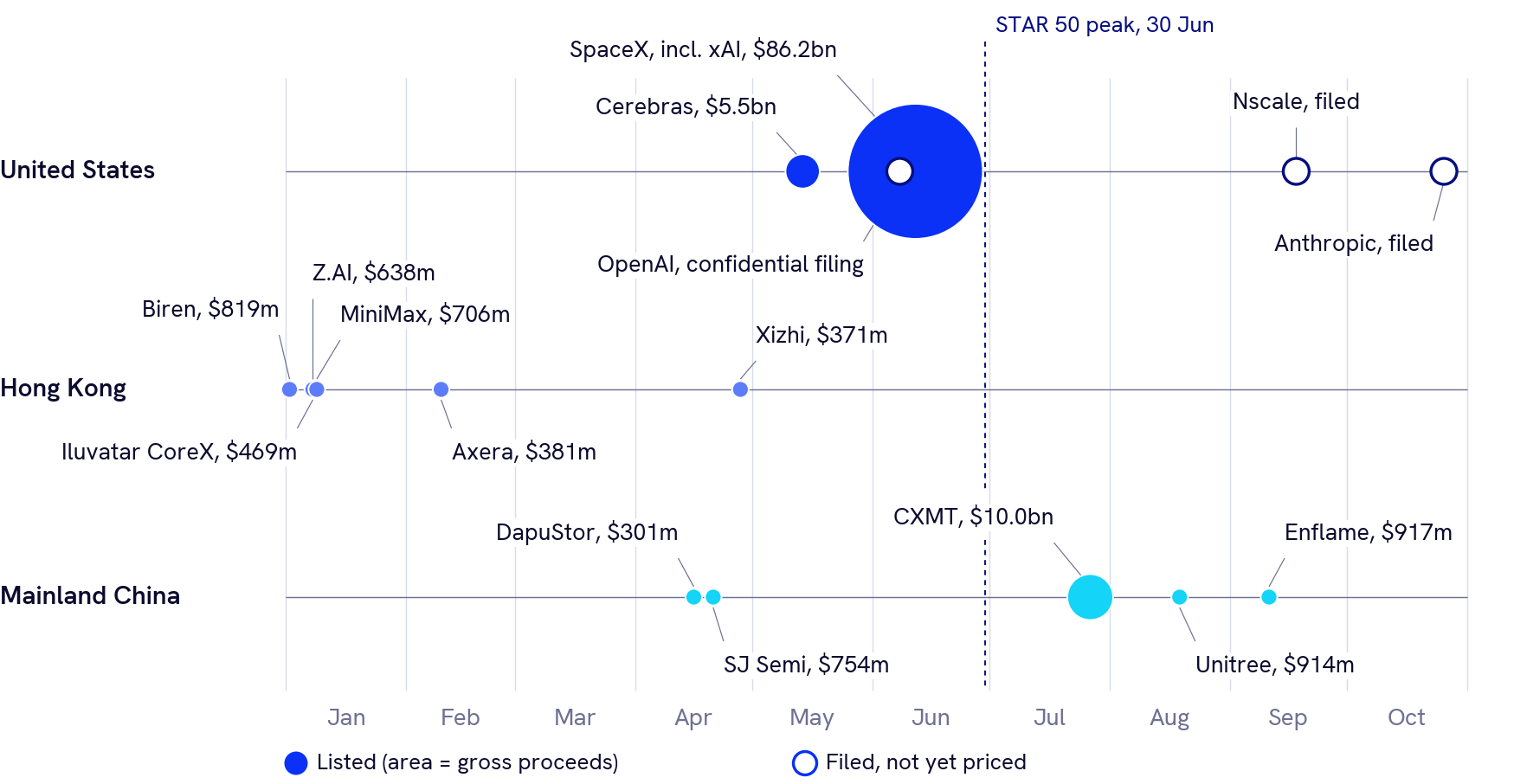
The thirteen companies that priced their offerings raised about $108 billion of gross proceeds, $86.25 billion of it in the June offering of SpaceX, which now includes the AI developer xAI (Exhibit 1).5 The eleven Chinese listings raised about $16 billion between them. Four Chinese chip and model companies listed in Hong Kong in the first ten days of January; the two largest mainland deals, CXMT and the robot maker Unitree, came after the STAR 50 had peaked. Anthropic filed its registration statement publicly on October 26, Nscale on September 18, and OpenAI has submitted only a confidential draft.6 Kunlunxin, Baidu’s chip unit, and the model developer StepFun have filed or are reported to be preparing to file in Hong Kong but have not listed.7
Exhibit 1
Sixteen AI companies listed or filed in 2026; SpaceX alone raised four-fifths of the money.
AI listings and public filings by market, January to October 2026, circle area = gross proceeds, $
Note: Gross proceeds include over-allotment shares where exercised; SpaceX includes the underwriters’ option as reported by LSEG. Converted at FRED rates of October 23, 2026. Kunlunxin, StepFun and Denglin, which have filed in Hong Kong but not listed, are not shown.
Source: SEC EDGAR filings; HKEXnews allotment results; cninfo listing announcements; LSEG; Reeve Hayward analysis
The question for lenders, suppliers and investors is whether these companies can meet what they owe. The filings answer it more directly than share prices do, because they set out cash, debt, leases, purchase commitments, customer concentration and the terms of each instrument. Several of the companies are also each other’s customers, suppliers and shareholders, so a shortfall at one could pass to others. Companies that listed before 2026, such as CoreWeave, Moore Threads and MetaX, appear here as context only.
China’s AI shares gave back their 2026 gains in four months
A rally built on chips and models
The rally ran on expectations for domestic chips and models. The STAR 50 rose 64.3% in the first half of 2026.8 On June 30 the AI chip designer Cambricon became the first company on the STAR Market valued at more than RMB1 trillion,9 and electronics overtook banking as China’s largest listed sector, worth RMB27.6 trillion against RMB14.6 trillion.10 Goldman Sachs estimates that AI-related stocks account for 42% of market value and 57% of turnover across China’s onshore and Hong Kong markets. At its peak the STAR 50 traded at nearly 250 times trailing earnings; by late October the multiple had fallen to about 100, against about 30 for the Nasdaq 100.11
The reversal came in two waves (Exhibit 2). In the week to July 17 the STAR 50 fell 16.9% as leveraged traders sold, the fastest unwind of borrowed positions since 2015 to 2016. State-backed buyers then put a record RMB13.8 billion into one STAR 50 exchange-traded fund on July 20, and the index rose 10.7% the next day (Exhibit 3).12 The second wave began in mid-October. US consumer prices rose 3.7% in the year to September, markets priced further rate rises, and a global sell-off in technology shares followed; South Korea’s Kospi fell 7.57% on October 15.13 The CSI 300 posted a record ten-week losing streak and entered a bear market on October 22; Bloomberg estimates that Chinese stocks lost $2.4 trillion of value from their May peak.14 On October 27 the STAR 50 fell 4.8% and the CSI Semiconductor index 5.8%, and the Shanghai Composite closed at its lowest level since August 2025.15
Exhibit 2
The STAR 50 gave back its first-half rally; the Nasdaq held most of its gain.
Index level, January 1 to October 27, 2026, December 31, 2025 = 100
Note: Daily closes. The Nasdaq Composite runs to October 26, the latest value in FRED. The dotted lines mark the state support of July 21 and the CSI 300’s entry into a bear market on October 22.
Source: China Securities Index; Federal Reserve Bank of St. Louis (FRED), NASDAQCOM; Reeve Hayward analysis
Exhibit 3
Leveraged traders and buyers of Hong Kong shares sold; state funds bought.
Investor groups in Chinese equities, January to October 2026, as reported
| Investor group | What they did | Amount | Period |
|---|---|---|---|
| Margin traders | Cut borrowing, mostly in chip stocks | −RMB577bn (−19%) | Jun 25–Oct 22 |
| Financing balance only | Kept falling | Down RMB140bn+, to RMB2.397trn | Sep 30–Oct 26 |
| State funds, led by Central Huijin | Sold ETFs, then bought | Sold $231bn; bought $43bn | H1; since Jul |
| Buyers of broad-based ETFs | Record weekly inflow | +RMB153.4bn | Oct 19–23 |
| Mainland buyers of Hong Kong shares | Net sellers | −HK$17.0bn | Oct 20–23 |
| Foreign active funds | Sold; still overweight | Not published | Aug–Oct |
| Insurers | Told not to lock in losses | Not published | From Oct 15 |
| Wealthy individuals | Raised cash for trust tax | Not published | From Oct 22 |
Note: Amounts are as reported by each source; they measure different things and cannot be added. Southbound figures are compilations of HKEX data.
Source: Cailian Press; Xinhua Finance; Bloomberg Intelligence via Mint; Caixin Global; NewTimeSpace; Reuters; The Business Times (Bloomberg); Financial Times
Individual stocks fell further. Robot maker Unitree’s shares closed on October 15 at 52% below their first-day close. Memory maker CXMT fell more than 25% in a month, and the optical-module makers Innolight and Eoptolink fell about 60% from their June and July highs.16 Reuters estimates that about $480 billion of value was wiped off the STAR 50 alone.
Who sold, and who bought
Domestic traders who had borrowed to buy were the largest sellers. Margin financing and securities lending fell from RMB3.03 trillion on June 25 to RMB2.46 trillion on October 22, a drop of RMB577 billion or 19%, led by hardware and semiconductor stocks.17 Mainland investors who buy Hong Kong shares through the Stock Connect sold a net HK$17.0 billion in the week to October 23.18 Foreign active funds in Asia sold over three months while remaining overweight China, according to HSBC research cited by Reuters. Wealthy individuals had their own reason to raise cash: a 20% tax on income from offshore trusts, collected from October 22.19
The state was on the other side, after selling earlier in the year. Central Huijin, the main vehicle of the “national team” of state-backed investors, sold about $231 billion of exchange-traded funds (ETFs) in the first half to cool the rally and has bought back about $43 billion since July, according to Bloomberg Intelligence, which estimates that about $188 billion of buying capacity remains.20 Broad-based ETFs took in RMB153.4 billion in the week of October 19 to 23, the largest weekly inflow of 2026,21 and regulators asked insurers to report their holdings and not to lock in losses.22 Equity ETFs drew more than RMB310 billion of net subscriptions in October to the 26th, even as margin financing fell by more than RMB140 billion.23
Why investors sold
No single event caused the sell-off. Reuters reporting points to high valuations, doubts about profits, tax bills and the threat of US curbs on Chinese data center equipment. US interest rates mattered. The Federal Reserve raised its target range to 3.75% to 4.00% in September, its first rise in three years,24 and the US ten-year Treasury yield reached 5.31% on October 5.25 So did US restrictions. A Senate bill introduced in September names the optical-module makers InnoLight and Eoptolink, although it covers only federal national-security systems and allows five years to comply.26 On July 28 the US Federal Communications Commission added foreign-made advanced robots to its Covered List, which bars authorization of new models.27 Analysts cited by The Guardian expect no broad stimulus from Beijing before the 21st Party Congress in 2027.28
How this sell-off compares with 2015, 2007 and 2000
Measured by the technology board alone, the fall matches the first leg of China’s 2015 crash: the Shanghai Composite fell 43.3% between June 12 and August 26, 2015, the same as the STAR 50’s fall from its 2026 peak (Exhibit 4). The broad market has fallen much less, 20.0% for the CSI 300 and 14.0% for the Shanghai Composite, against 72.0% for the Shanghai Composite in 2007 and 2008 and 77.9% for the Nasdaq from 2000 to 2002.29
Exhibit 4
The tech board’s fall matches the first leg of 2015; the broad market has fallen far less.
Peak-to-trough change in selected indices, %
| Index and period | Peak-to-trough change |
|---|---|
| Nasdaq, Mar 2000–Oct 2002 | -77.9 |
| Shanghai Composite, Oct 2007–Nov 2008 | -72.0 |
| Shanghai Composite, Jun–Aug 2015 | -43.3 |
| STAR 50, Jun 30–Oct 27, 2026 | -43.3 |
| CSI 300, Jun 22–Oct 27, 2026 | -20.0 |
| Shanghai Composite, May 13–Oct 27, 2026 | -14.0 |
| Nasdaq, Oct 6–26, 2026 | -5.2 |
Note: Closing prices. 2026 figures run to the latest close and are not confirmed troughs. The 2015 fall deepened to −48.6% by January 2016.
Source: China Securities Index; FRED; Reeve Hayward analysis
Three facts set 2026 apart from 2015 so far. Margin debt equals 2.73% of tradable market value, against 4.39% at the 2015 peak, and the average collateral ratio of 251% sits well above the 130% to 150% levels at which brokers must sell; the selling has been voluntary.30 The yuan touched 6.6682 per dollar on October 26, its strongest level since June 2022.31 And on October 26 the People’s Bank of China (PBoC) created a facility that lets systemically important bank wealth-management subsidiaries and fund managers raise cash against central-bank bills if redemptions surge, to be used only in extreme bond-market stress.32 The International Monetary Fund (IMF) judges that advanced Asian markets with the highest sensitivity to AI would suffer most in a correction and that most emerging markets are less exposed.33
US filers owe little to banks and much to their suppliers
The four US filings describe four ways of paying for computing power. Anthropic rents most of it under long contracts. SpaceX, through its AI unit, builds it with bond money and cash from its satellite business. Cerebras sells it, with a loan from its main customer. Nscale builds it with loans secured on each site. OpenAI, the other large US developer preparing to list, has not published financial statements.
Anthropic owes banks nothing and its suppliers hundreds of billions of dollars.
Anthropic: Fast growth, no drawn debt, $637 billion of commitments
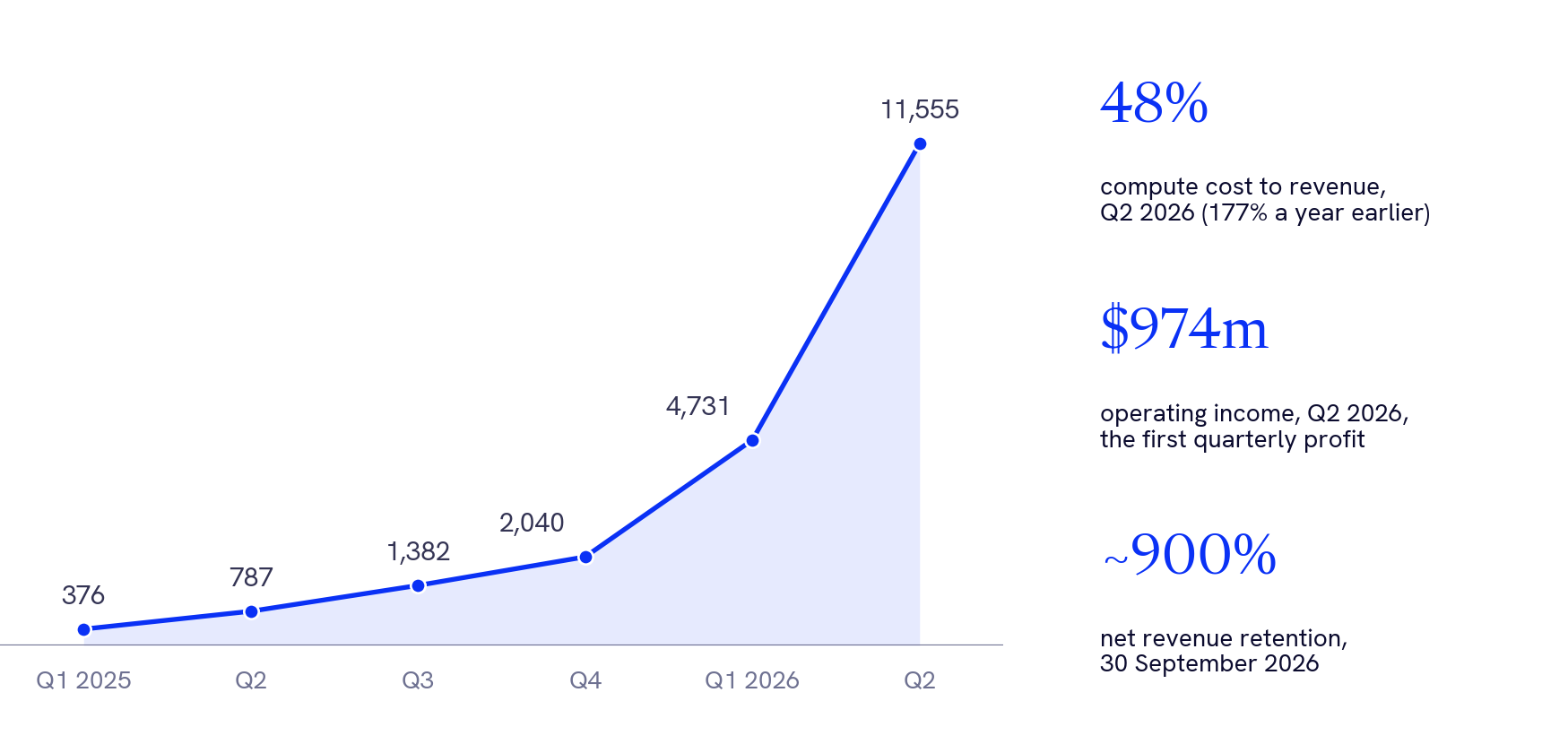
Anthropic’s revenue reached $16.3 billion in the first half of 2026, 14 times the $1.2 billion of a year earlier, and $11.6 billion in the second quarter alone (Exhibit 5). Its costs fell as a share of revenue: computing and infrastructure absorbed 48% of revenue in the second quarter, against 177% a year earlier, and the company earned operating income of $974 million in the quarter, its first quarterly profit. Operating cash flow was $3.9 billion in the half and capital spending $0.5 billion. Customers paying more than $100,000 a year rose from more than 950 to more than 11,900 in the year to September, and net revenue retention, a measure of how much more existing customers spend, was about 900%. The five largest customers provide about 25% of revenue.34 Reuters has reported third-quarter revenue of $16.8 billion, which would mean slower growth than in the second quarter; the S-1 does not include third-quarter figures.35
Exhibit 5
Anthropic’s revenue grew 31-fold in six quarters as compute costs fell below half of revenue.
Anthropic quarterly revenue, first quarter of 2025 to second quarter of 2026, $ million
Note: Compute share is compute and infrastructure expense divided by revenue. Net revenue retention as defined in the S-1.
Source: Anthropic, PBC, Form S-1, October 26, 2026; Reeve Hayward analysis
One measure deserves attention. Almost half of first-half revenue, 48%, came through the cloud marketplaces of Amazon, Google and Microsoft, and Anthropic records those sales at their full value because it acts as the seller. The same three companies are Anthropic’s largest suppliers of computing capacity, and Amazon and Google are also its investors.
The balance sheet carries almost no conventional debt. Anthropic had $131.7 billion of cash and short-term investments on June 30 and had not drawn on its revolving credit facility, which it enlarged to $15 billion in September. The facility runs to 2031, is secured until the company holds investment-grade ratings from two agencies, and requires at least $5 billion of liquidity at each quarter end from December 2026. The $108.6 billion of convertible notes on the balance sheet is the fair value of $6.2 billion of non-interest-bearing notes held by Amazon, which convert into shares. The rising value of these notes and related instruments accounted for $72.4 billion of the $80.7 billion first-half net loss, a charge that uses no cash. Anthropic also has $77 billion of undrawn note facilities from Google, Amazon and Broadcom. The Broadcom notes, up to $42 billion, carry 9% interest paid in kind, rising to 13% if revenue tests are missed, and may be used only to pay rent on Broadcom equipment.36
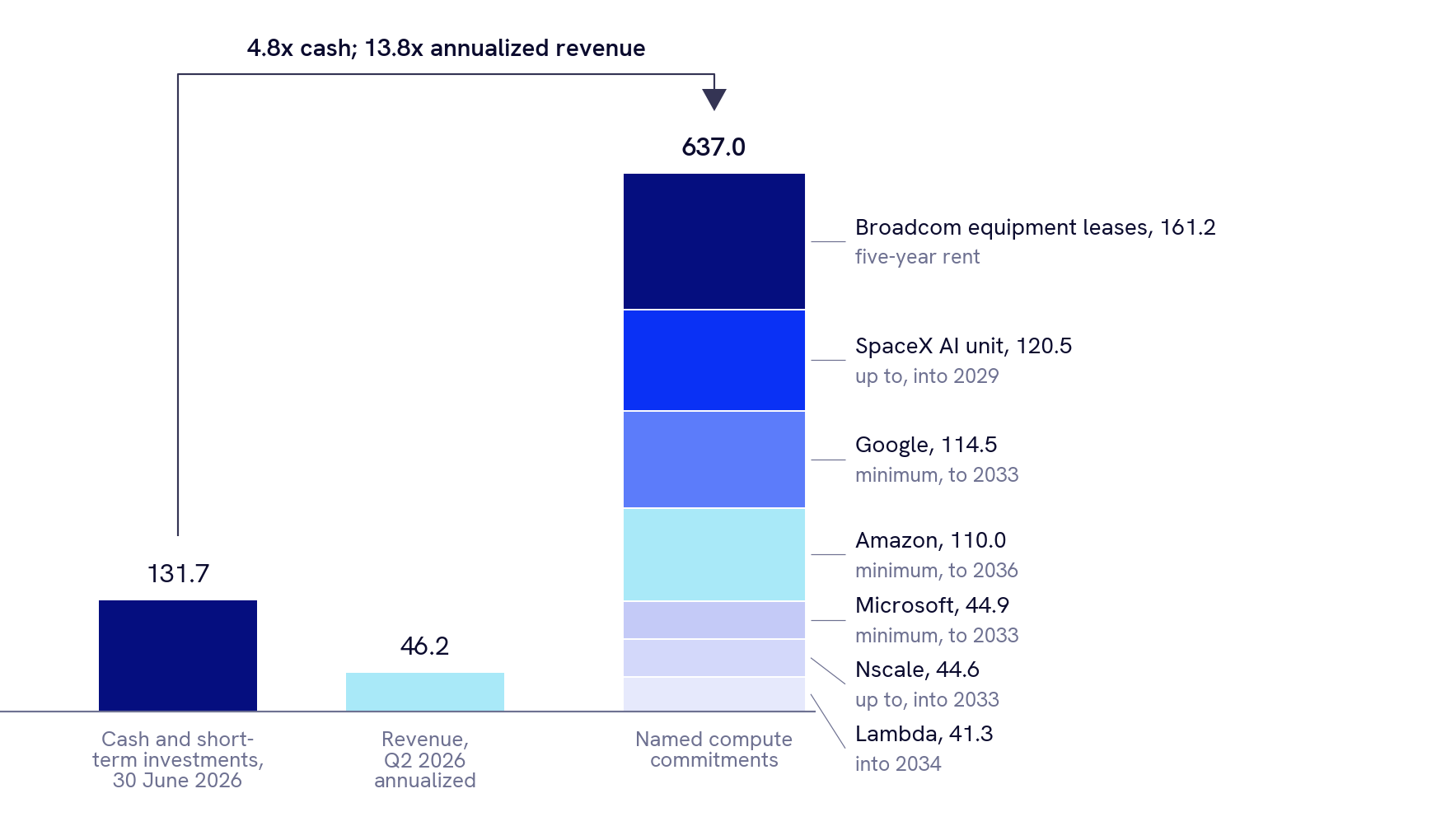
The commitments are where the obligation lies (Exhibit 6). Anthropic has agreed to spend at least $114.5 billion with Google to 2033, at least $110 billion with Amazon to 2036 and at least $44.9 billion with Microsoft to 2033; up to $120.5 billion with SpaceX’s AI unit into 2029; up to $44.6 billion with Nscale and $41.3 billion with Lambda; and $161.2 billion of rent over five years under equipment leases with Broadcom. These named contracts total $637 billion, 4.8 times cash and 13.8 times second-quarter revenue at an annual rate. The company also estimates $125 billion to $150 billion for further Google TPU capacity from 2028 to 2031 and more than $20 billion for AMD systems, neither of them in its commitments table, and it reports $417 billion of new obligations signed since the end of 2025.37
Exhibit 6
Anthropic’s named compute commitments are 4.8 times its cash.
Anthropic cash, annualized revenue and named compute commitments, 2026, $ billion
Note: Annualized revenue is second-quarter 2026 revenue times four. Commitments as described in the S-1: minimum spend (Google, Amazon, Microsoft), maximum spend (SpaceX AI unit, Nscale), aggregate spend (Lambda) and lease rent excluding interest (Broadcom). Excludes an estimated $125 billion to $150 billion of further Google TPU capacity and more than $20 billion of AMD systems.
Source: Anthropic, PBC, Form S-1, October 26, 2026; Reeve Hayward analysis
Timing matters more than the totals. Two contracts alone, the Broadcom leases at a straight-line $32 billion a year and the SpaceX contract at its full rate of about $3.1 billion a month, would cost about $69 billion a year, 1.5 times second-quarter revenue at an annual rate; the S-1 does not yet give a payment schedule.38 Some commitments are softer than others. The Nscale and Lambda fees accrue only when capacity is delivered, and the SpaceX contracts can be cancelled on 90 days’ notice after their initial terms end in January and March 2027. The Broadcom leases cannot be cancelled and carry cross-default clauses. Our reading is that Anthropic can meet its obligations for the next two years from cash, provided revenue keeps growing well ahead of the fixed payments; slower growth would bring forward the need for the note facilities or new capital. Investors have discussed a valuation of about $1.5 trillion for the listing, against $965 billion in the May private round, according to reporting cited by PitchBook.39
SpaceX and xAI: Bond-funded building, carried by satellite cash flow
SpaceX, which merged with xAI and X before its June listing, replaced the AI unit’s expensive debt before going public. In March a $20 billion bridge loan repaid xAI’s 12.5% secured notes and floating-rate loans and X’s term loans, at a cost of $646 million in prepayment penalties. In June, $25 billion of senior unsecured notes with coupons of 5.35% to 6.65% repaid the bridge. At September 30, SpaceX had $38.0 billion of debt, including $12.9 billion recorded for sale-and-leaseback deals on AI equipment with a party related to a director, against $89.9 billion of cash and marketable securities. Only $2.9 billion falls due before the end of 2027.40
The AI segment, now called SI, is still absorbing capital. It earned $7.6 billion of revenue and $431 million of operating income in the third quarter but lost $3.3 billion over nine months, and its third-quarter capital spending of $16.4 billion was 2.2 times its revenue. One SI customer provided 34.5% of group revenue in the quarter. The filing does not name it, but Anthropic’s S-1 discloses a contract with SpaceX’s AI unit that ramps to about $3.1 billion a month.41 Group operating income covered interest 4.1 times in the third quarter. The shares closed at $148.58 on October 27, 10% above the $135 offer price and 30% below their June 16 peak.42 SpaceX can service its debt from its satellite business and its listing cash; the AI unit’s returns depend on a few large customers.
Cerebras: A backlog that rests on one customer
Cerebras listed in May at $185 a share. Its first-half revenue was $374 million, its operating loss $492 million, and it spent $549 million on equipment. It holds $7.9 billion of cash and investments against a single loan: $918 million outstanding of about $1.0 billion that OpenAI lent in January to fund capacity for OpenAI itself, at 6% interest and repayable mainly through services. Its $25.4 billion of contracted future revenue, 34 times first-half revenue at an annual rate, is mostly a 750-megawatt contract with OpenAI. The filing names OpenAI, G42, the Mohamed bin Zayed University of Artificial Intelligence and Amazon Web Services among its significant customers; the largest provided 34% of second-quarter revenue.43 The shares closed at $119.31 on October 27, 36% below the offer price.44 Cerebras’s own debt is small; its credit risk is OpenAI’s ability to fund its commitments (Exhibit 7).
Exhibit 7
The US filers combine very different mixes of cash, debt and contracts.
US AI filers of 2026, latest reported figures, $ billion unless stated
| Company | Status | Revenue | Cash | Debt | Largest fixed claim | Shares vs offer |
|---|---|---|---|---|---|---|
| Anthropic | S-1 filed Oct 26 | 16.3 (H1) | 131.7 | None drawn | 637 of compute commitments | n/a |
| SpaceX, with xAI | Listed Jun 12 | 27.1 (9M); AI unit 7.6 (Q3) | 89.9 | 38.0 | Notes at 5.35–6.65% | +10% |
| Cerebras | Listed May 14 | 0.37 (H1) | 7.9 | 0.9, loan from OpenAI | 25.4 backlog, mostly OpenAI | −36% |
| Nscale | S-1 filed Sep 18 | 0.14 (H1) | 1.5 | 0.1, plus 9.0 of new facilities | 2.6 of leases; 6.5 of prepayments | n/a |
| OpenAI | Confidential draft | 5.7 (Q1, reported) | Not public | 0.5 credit line (reported) | Not public | n/a |
Note: Cash includes short-term investments and marketable securities. Balance sheets at June 30, 2026, except SpaceX (September 30). OpenAI figures are press reports, not filings. Share prices at the October 27 close.
Source: SEC EDGAR filings; Reuters; Yahoo Finance; Reeve Hayward analysis
Nscale: The most leveraged model
Nscale, which builds and runs AI data centers in Norway, Portugal, Iceland and the United States, filed in September. First-half revenue was $140.6 million, against a net loss of $1.02 billion and negative adjusted EBITDA of $199 million. Net interest expense equaled 68% of revenue, mostly interest accrued on customer prepayments. On June 30 it had $1.5 billion of cash, $137 million of debt, $2.6 billion of lease liabilities and $6.5 billion of deferred revenue, most of it prepayments from customers. Since February it has signed about $9.0 billion of facilities, among them GPU loans in Texas and North Carolina at 2.375 percentage points over the secured overnight financing rate (SOFR), a Dell equipment-leasing program and a Macquarie loan in Iceland at 5.5 points over SOFR.45
Its contracted backlog is $103.4 billion, and its largest customer provided 52% of first-half revenue. The auditors’ going-concern note records that reliance on uncommitted financing “raised substantial doubt” about the company’s ability to continue, a doubt management resolved by showing it could defer, reduce or cancel capital spending.46 Of the US filers, Nscale is the one whose repayment depends most on new financing.
OpenAI: The largest developer, without public accounts
OpenAI submitted a confidential draft registration in June and has not set a date. Press reports give a partial picture: revenue of $5.7 billion and cash burn of $3.7 billion in the first quarter, according to The Information as reported by Reuters;47 annualized revenue approaching $50 billion, according to the Financial Times;48 and $278 billion of projected cash burn from 2026 to 2030, according to a company presentation seen by the FT.49 OpenAI itself borrows little; Bank of America extended a $520 million credit line in July.50 The leverage sits with its backers. SoftBank took a $40 billion bridge loan in March and sold $11.1 billion of bonds in September, at coupons of 8.625% to 9.75%, to fund its OpenAI stake.51 OpenAI is now seeking about $30 billion, with investors in the UAE reported among those leading the round.52
Many of these companies are each other’s customers, suppliers and owners
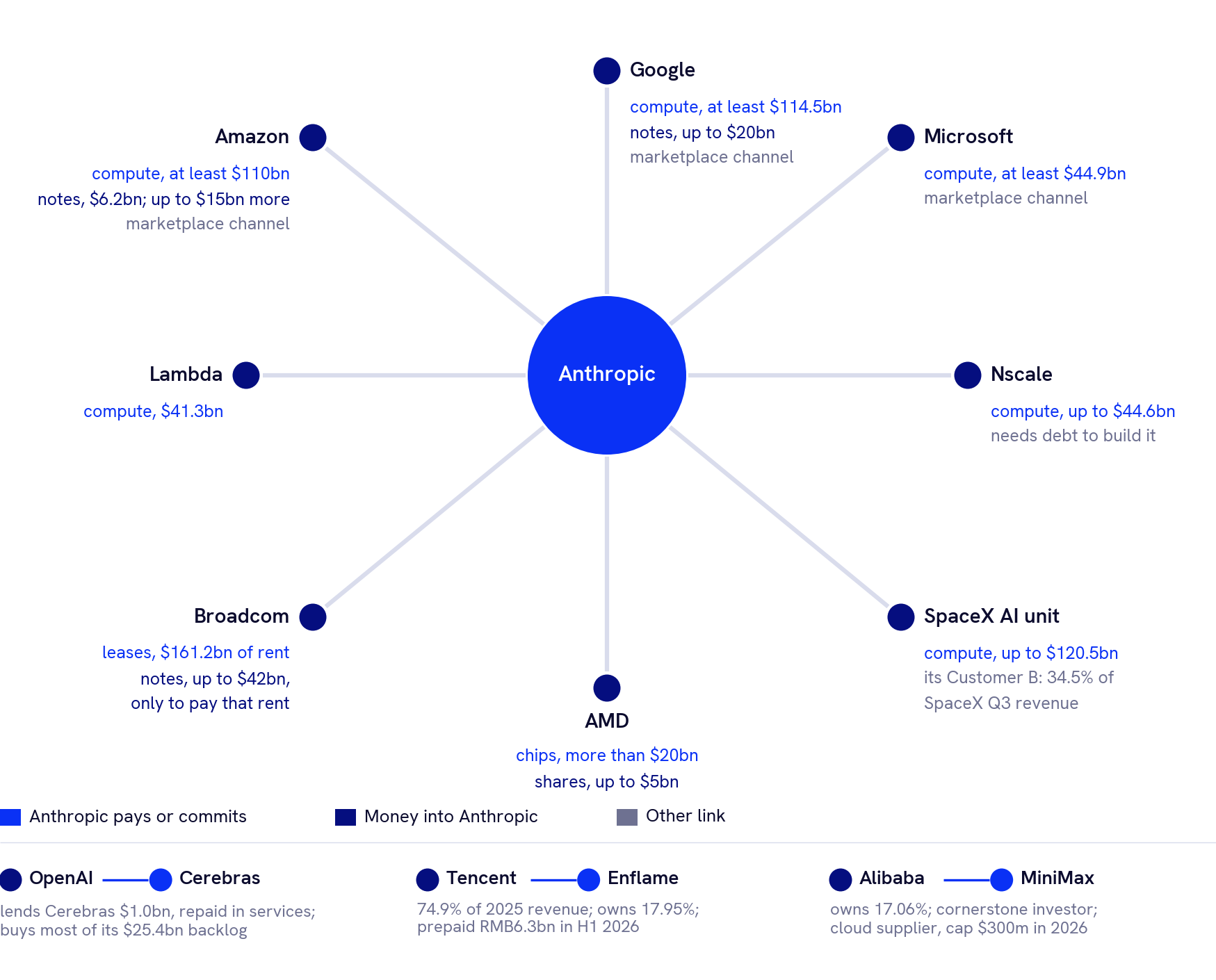
The filings document a web of relationships in which the same companies buy from, sell to, lend to and own each other (Exhibit 8). Anthropic sits at the center of the largest. Amazon and Google hold or may buy its notes, sell it computing capacity under minimum-spend contracts and resell its models in their marketplaces. Broadcom leases it equipment and may lend it the money to pay the rent. AMD will buy up to $5 billion of its shares as AMD chips are deployed. Anthropic’s spending with SpaceX’s AI unit appears in SpaceX’s accounts as its largest AI customer, and its contract with Nscale depends on Nscale first raising the debt to build the capacity.53
Exhibit 8
Several of the largest AI suppliers are also their customers’ investors and sales channels.
Documented links between Anthropic and its suppliers, and three other pairs, 2026, amounts as disclosed
Note: Amounts are commitments, facilities or holdings as described in the filings; “up to” amounts are maximums. SpaceX does not name its Customer B.
Source: Anthropic S-1; SpaceX Form 10-Q; Cerebras Form 10-Q; Enflame prospectus and KPMG review report; MiniMax 2026 interim report and HKEX announcements; Reeve Hayward analysis
The pattern recurs elsewhere. OpenAI lent Cerebras $1.0 billion and accounts for most of its backlog. Tencent bought 74.9% of Enflame’s output in 2025, owns 17.95% of the company and prepaid RMB6.3 billion in the first half of 2026.54 Alibaba owns 17.06% of MiniMax’s Class A shares, was a cornerstone investor in its listing and supplies its cloud computing under a cap of $300 million for 2026.55
These arrangements are disclosed and accounted for under the usual rules; their effect shows up in risk. When a company’s investor, supplier and sales channel are the same firm, a slowdown at one reaches the others through several routes at once: lower purchases, unused capacity, weaker collateral and lower equity values.
China’s filers borrow cheaply and raise equity quickly
The Chinese filers fund themselves differently from their US peers. Their bank loans are cheap and mostly unsecured, high share prices have allowed large follow-on placements, and the two model developers have turned to zero-coupon convertible bonds.
The model developers: Z.AI and MiniMax
Z.AI, the developer formerly known as Knowledge Atlas or Zhipu, grew revenue fivefold to RMB954 million in the first half of 2026, but its gross margin fell from 50.0% to 26.4% as sales shifted to its application programming interface (API), now 86.5% of revenue. It used RMB3.4 billion in operations in the half, against RMB1.3 billion a year earlier, and its bank loans of RMB2.2 billion cost about 2.1% to 2.2% (Exhibit 9).56 After June it raised about RMB60 billion: two share placings that netted HK$47.0 billion and a RMB20.1 billion zero-coupon convertible bond due September 16, 2027. The bond converts at HK$892.50, 56% above the October 28 close of HK$571.50, so at today’s price it would be repaid in cash; the placings cover it.57 Z.AI’s shares stand 392% above their January offer price but 64% below the July placing price. The company has been on the US Entity List since January 2025.
Exhibit 9
Chinese AI chip makers borrow from banks at about 1.5% to 6%; US AI credit has cost 5% to 15%.
Interest rates on selected AI-company debt, 2025–26, % a year
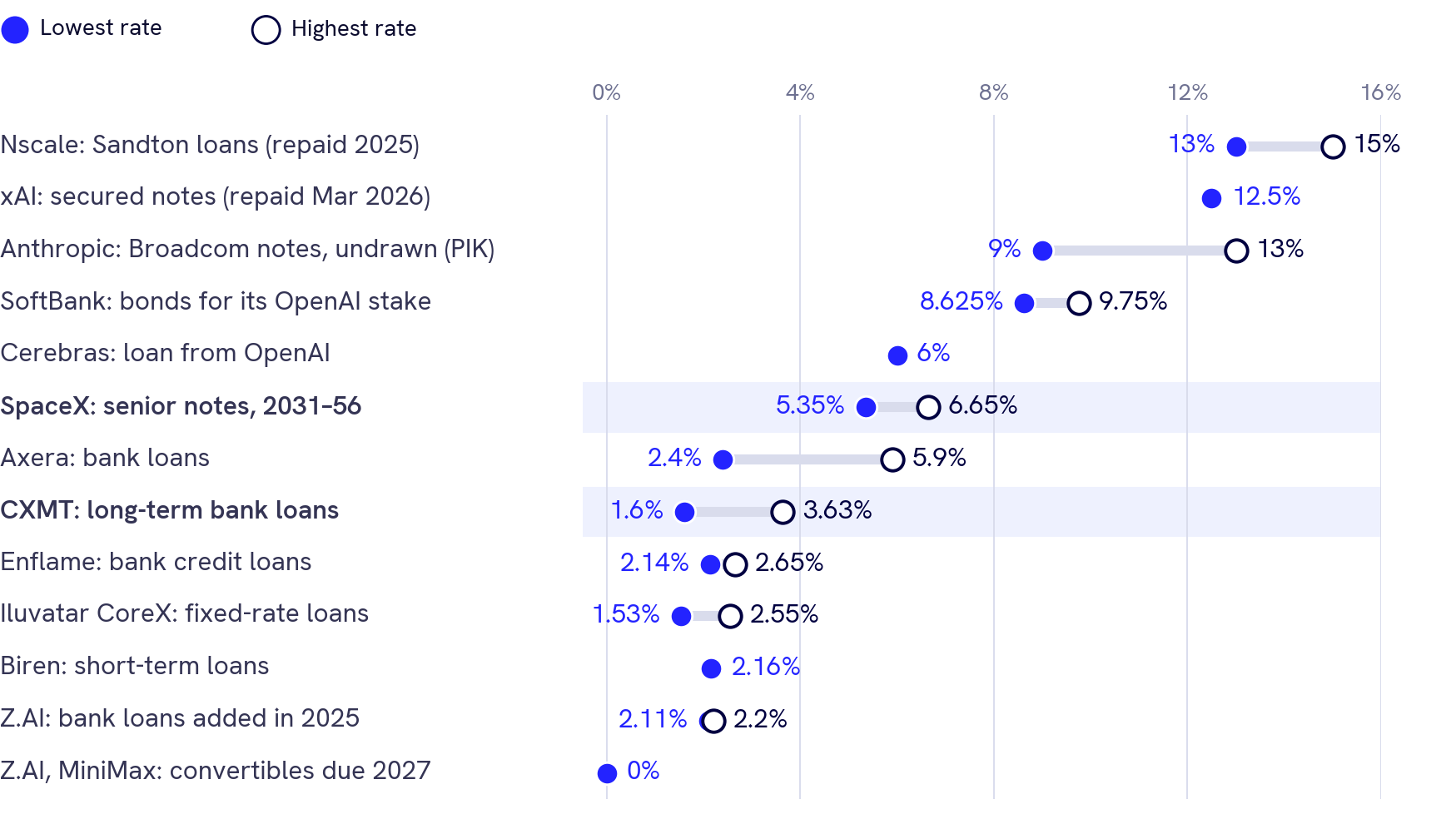
Note: Fixed or stated rates as disclosed; floating-rate facilities priced over SOFR are excluded. The Broadcom notes are undrawn; their interest would be paid in kind, at 13% if revenue tests are missed. Repaid instruments are shown for comparison.
Source: Company filings (SEC EDGAR, HKEXnews, cninfo); Reuters; Reeve Hayward analysis
MiniMax earned $116.6 million of revenue in the first half, 61% of it outside mainland China, and lost $358 million. Its cash outflow, including $188 million of its own equipment, ran at about $84 million a month, three times the $28.1 million the prospectus assumed for 2025.58 It had $1.3 billion of cash and $134 million of bank loans at June 30. In July it sold shares for a net HK$9.4 billion and issued a HK$6.5 billion zero-coupon convertible bond due in July 2027 that converts at HK$335, 86% above the October 28 close. The Abu Dhabi Investment Authority was a cornerstone investor in its January listing.59
The chip designers: Cheap loans, fast-growing working capital
The Hong Kong-listed chip designers carry little debt but need large amounts of working capital, because they buy wafers and components ahead of sales (Exhibit 10). Biren’s revenue rose to RMB1.24 billion in the first half from RMB59 million and it held RMB5.8 billion of net cash, but it used RMB2.0 billion in operations and had collected only 23.3% of RMB1.1 billion of receivables by the report date.60 Iluvatar CoreX raised its bank borrowings from RMB1.0 billion to RMB2.7 billion in six months as inventories rose to RMB2.0 billion, and its first-half profit of RMB106 million rested on a RMB760 million unrealized gain on shares in SJ Semi.61 Axera, which designs chips for cameras and cars, has RMB1.1 billion of bank loans at rates of up to 5.9% and a RMB467 million liability that accrues 6% a year if a subsidiary does not complete a listing.62
Exhibit 10
Placements after June lengthened most Chinese runways; Axera has not raised new money.
Months of liquidity at the first-half 2026 rate of cash use, Hong Kong and STAR listings, months
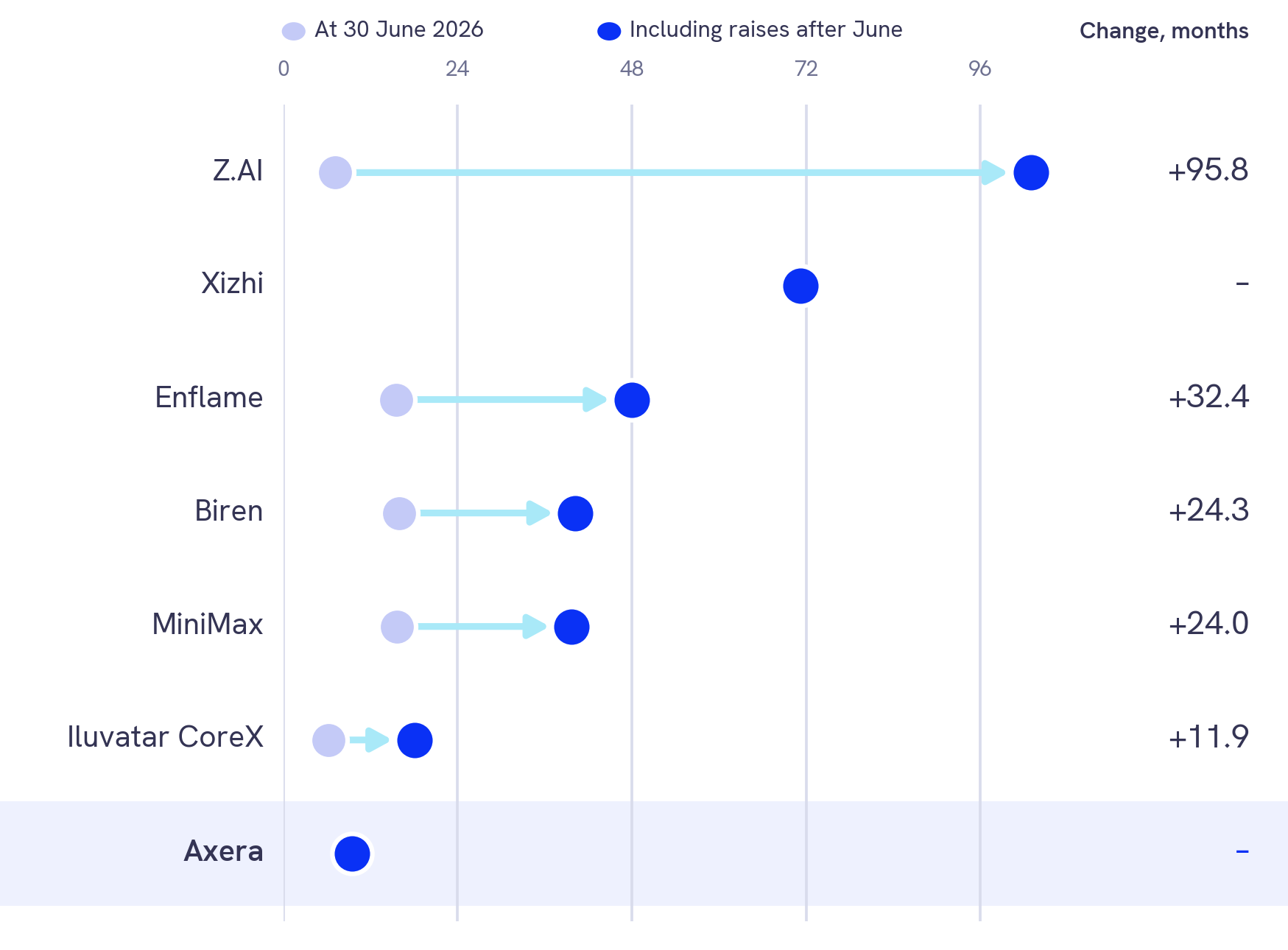
Note: Liquidity at June 30, 2026, divided by monthly free cash outflow in the first half (operating cash flow less capital spending, divided by six). Raises after June are net placing, listing and convertible proceeds at FRED rates of October 23, 2026; convertible proceeds must be repaid or converted in 2027. Xizhi and Axera raised no new money after June.
Source: HKEXnews interim reports and announcements; cninfo; Reeve Hayward analysis
At their first-half rate of cash use, liquidity at June 30 covered six to sixteen months for most of these companies. Share placings after June lengthened that for all except Axera and Xizhi. Xizhi, which makes optical computing chips, needed no new money because it holds RMB2.9 billion against small cash use; Axera has not raised since its listing and its shares trade 33% below the offer price. Iluvatar CoreX also has banking facilities of more than RMB12 billion, over 80% of them unused.63
The mainland listings: One large borrower, flush with cash
CXMT, China’s largest maker of DRAM memory chips, is the only large conventional borrower in the group. Its revenue rose to RMB150.3 billion in the first half of 2026 from RMB15.4 billion a year earlier, with a gross margin of 84.7%, as AI demand lifted memory prices, and net profit attributable to shareholders reached RMB77.6 billion. At June 30 it had RMB141.1 billion of borrowings and leases against RMB182.3 billion of cash and trading assets, a net cash position of RMB41.2 billion, before RMB66.3 billion of net listing proceeds arrived in July. At the end of 2025 its net debt had been 1.98 times earnings before interest, taxes, depreciation and amortization (EBITDA). Its long-term loans cost 1.60% to 3.63%, RMB82.0 billion of them fall due after five years, and it has RMB39.7 billion of undrawn facilities.64 The prospectus itself warns that the rise in memory prices may not last, and in June the US Department of Defense added a CXMT subsidiary to its list of Chinese military companies.
Unitree has no bank debt and positive free cash flow, and it held RMB7.4 billion of cash after its listing. Its profit before one-off items fell 19% in the first half, and its US sales, 13.3% of 2025 revenue, face the FCC restriction.65 Enflame, an AI chip designer, shows how customer money can stand in for debt. Its debt-to-assets ratio rose from 30.4% to 78.7% in the first half, largely because a Tencent entity prepaid RMB6.3 billion, which Enflame used to prepay its own suppliers RMB7.5 billion; RMB5.8 billion of listing proceeds arrived in September.66 SJ Semi, a chip-packaging company, and DapuStor, a maker of data center storage drives, carry modest debt. DapuStor’s operating cash flow was negative despite a first-half profit of RMB1.33 billion, and both companies’ shares are about 61% below their May peaks.67
The state is a shareholder across the group. The second phase of the China Integrated Circuit Industry Investment Fund owns 7.86% of CXMT and 3.89% of Enflame, social security and pension portfolios bought RMB7.5 billion of CXMT shares in its listing, and investors linked to local governments in Beijing, Shanghai and other cities hold stakes in Z.AI, Biren and Iluvatar CoreX.68
Which companies can repay
We grouped the companies by the cash they hold, the cash they generate, and the size and timing of their largest fixed claims (Exhibit 11). The grouping is our judgment from the filings, not a credit rating. In order of repayment capacity:
Exhibit 11
Four companies look strong, one is cash-rich with large claims, and four need watching.
Repayment capacity of the 2026 AI listings and filers, $ billion
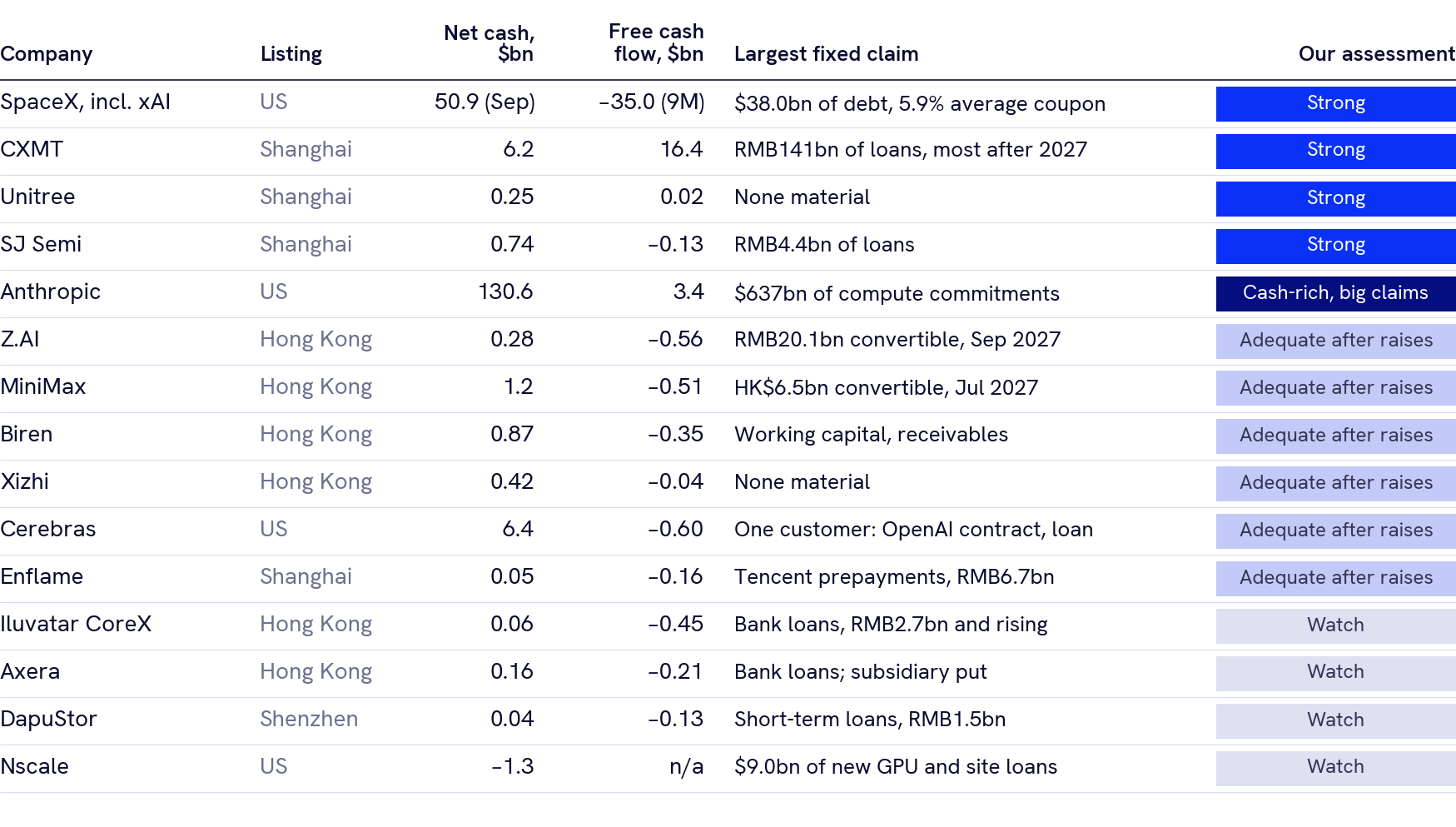
Note: Net cash is cash and short-term investments less borrowings and leases at June 30, 2026 (SpaceX: September 30). Free cash flow is operating cash flow less capital spending in the first half of 2026 (SpaceX: nine months). Nscale does not report capital spending separately in its summary data. Chinese figures converted at FRED rates of October 23, 2026. The assessment is Reeve Hayward’s judgment, not a credit rating.
Source: Company filings; Reeve Hayward analysis
- Strong. SpaceX with xAI, CXMT, Unitree and SJ Semi hold more cash than debt or generate enough cash to service it, and their largest claims fall due after 2027.
- Cash-rich, with large claims. Anthropic holds $130.6 billion of net cash and generates cash from operations, but its commitments are many times its revenue. Its position holds if growth stays well ahead of the fixed payments.
- Adequate after raises. Z.AI, MiniMax, Biren, Xizhi, Cerebras and Enflame use cash, but placements, listing proceeds or customer prepayments cover their needs and their 2027 maturities. Cerebras and Enflame each depend on one customer.
- Watch. Iluvatar CoreX, Axera, DapuStor and Nscale combine cash use with rising or short-term debt. Nscale’s auditors recorded a going-concern doubt that management resolved through its ability to defer spending.
Five claims about AI finance, tested against the filings
Commentary on AI finance often rests on five claims. The filings support some of them more than others:
- AI hardware wears out in three to five years. The accounts partly agree. Anthropic and Cerebras depreciate equipment over three to five years, but the two companies with the most equipment debt, Nscale and SpaceX, use five to six years for GPUs and servers.69 Longer accounting lives at the borrowers lower reported depreciation; if the equipment loses value faster, collateral would fall faster than book values suggest.
- Debt outlasts the chips it pays for. The evidence is mixed. Nscale’s Texas GPU loan runs to February 2033 and its North Carolina loan to December 2031, at or beyond the equipment’s accounting life, while its Iceland loan amortizes over 46 months and Anthropic’s Broadcom leases run for five years.
- The largest platforms pay from their own cash flow. Less so in 2026. SpaceX refinanced its AI unit’s debt with $25 billion of bonds, Meta announced a $95 billion share sale, SoftBank borrowed to fund its OpenAI stake, and Anthropic is taking $161 billion of equipment on finance leases.70
- Circular deals inflate revenue. The loops are real and disclosed. Revenue from them is recognized under normal accounting rules; the concern is concentration, because the same few counterparties appear on both sides of the ledger.
- Cheaper models could strand the build-out. The IMF warns that low-cost open-source models such as Moonshot’s Kimi could squeeze margins along the AI value chain. Anthropic states that lower costs per task drive greater usage, citing a 40% cut with its latest model. Both can hold: falling prices help the developers that win volume and hurt owners of capacity sold by the hour.
What could change the picture
Three sets of forces will decide whether these companies meet their obligations over the next twelve months, against a calendar of dated tests (Exhibit 12).
Exhibit 12
The first hard tests come in 2027, when contracts become cancellable and convertibles mature.
Scheduled and expected events, October 2026 to September 2027, dates as disclosed or reported
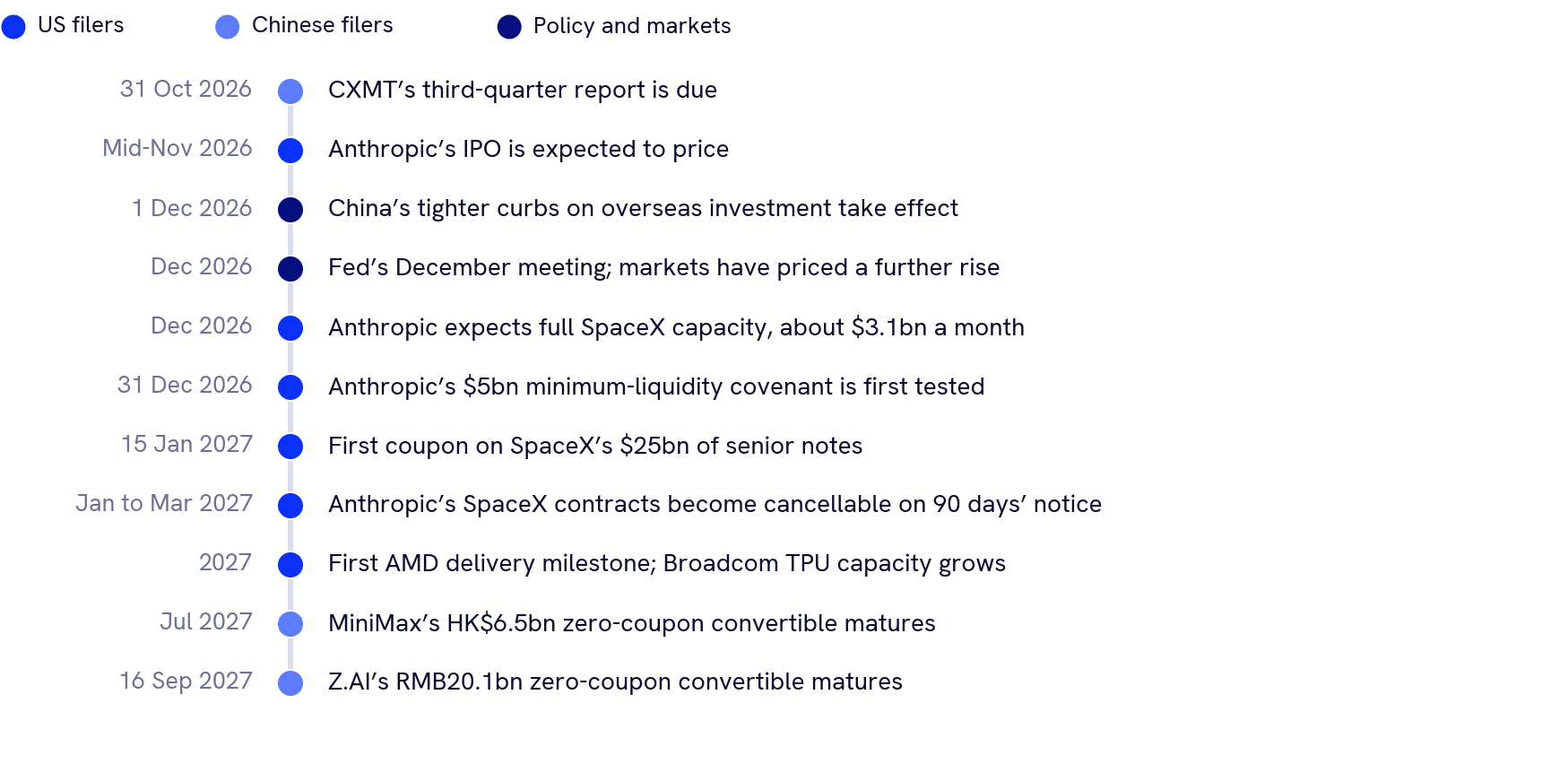
Note: Anthropic’s pricing date and the Fed’s December decision are expectations, not scheduled company events. The SpaceX contract dates are the ends of the initial non-cancellable periods.
Source: Anthropic S-1; SpaceX Form 10-Q; HKEXnews announcements; cninfo; Reuters; The Guardian; Reeve Hayward analysis
Geopolitical. US restrictions on Chinese chips, robots and data center equipment, and limits on China’s access to US chips, shape costs on both sides. Reuters reported that ByteDance, Alibaba and Tencent ordered more than $35 billion of Nvidia chips but may receive only 5% to 10% of what they asked for.71 Oil near $101 a barrel, held up by the conflict in the region, feeds US inflation and interest rates.72
International. Interest rates set the cost of the debt and the value of the equity that funds these companies. Most economists in CNBC’s survey expect a further Fed rise in December, and the hyperscalers’ capital spending, about $800 billion this year, sets demand for chips and capacity.73
Domestic China. Beijing has shown it will support the market: the national team has about $188 billion of buying capacity, the PBoC has built a bond-market backstop, and a RMB60 billion state AI fund began investing in October. Tighter curbs on overseas investment take effect on December 1.74
Our view rests on three assumptions: that US rates stay near current levels, that no new US measure cuts a major customer off, and that Chinese policy keeps supporting the market without broad stimulus. On those assumptions, our analysis suggests that the next twelve months will test most the companies that need new money: Nscale, Axera and Iluvatar CoreX among the filers, and suppliers whose backlogs rest on one developer. The larger tests come in 2027, when Anthropic’s SpaceX contracts become cancellable, Broadcom capacity and AMD deliveries ramp up, and the Z.AI and MiniMax convertibles mature.
The 2026 listings show an industry that has moved much of what it owes out of loans and into contracts. Anthropic owes banks nothing and its suppliers hundreds of billions of dollars. The Chinese developers owe little to banks and have used high share prices to raise more equity and convertible debt than they now need. CXMT, the one heavy borrower, has turned a memory boom into net cash.
For lenders, the useful measures are the ones the filings now disclose: commitments against cash and revenue, the share of revenue from a few counterparties, and the date of the first payment that cannot be cancelled. For companies and investors in the Gulf, where state-linked investors and customers appear in several of these deals, among them the Abu Dhabi Investment Authority in MiniMax’s listing and G42 as a Cerebras customer, and where data center projects worth more than $93 billion are active or planned across the GCC,75 the same tests apply to every lease, offtake and capacity contract.
The sell-off in China has so far been a repricing of shares, absorbed by voluntary deleveraging and state buying. Whether it stays that way depends on revenue growth at a handful of developers, the path of US rates, and policy in Washington and Beijing. We will update this analysis as Anthropic prices its offering and the first 2027 payments approach.
About this report
This report draws on published filings, official statistics and press reports read between October 26 and 28, 2026: registration statements, prospectuses and quarterly reports filed with the US Securities and Exchange Commission; Hong Kong prospectuses, allotment results and 2026 interim reports on HKEXnews; mainland prospectuses, listing announcements and 2026 half-year reports on cninfo; index data from China Securities Index and FRED; and reporting from Reuters, Bloomberg, the Financial Times, Caixin and other outlets, as cited. OpenAI, which has not published accounts, is described from press reports. Market prices change daily. The repayment assessment is an analytical judgment, not a credit rating, and statements about what could happen are not forecasts. The report does not value any company or recommend any security, and it is not investment advice.
For companies weighing how to fund growth, our capital and debt advisory work starts from the same questions this report asks: cash against commitments, the cost and tenor of debt, and reliance on a few counterparties.
The Research team at Reeve Hayward prepared this report in Doha. To discuss the findings, contact the team at info@reevehayward.com or +974 5577 4811.
Sources
- Reeve Hayward analysis of the companies’ prospectuses, interim reports and quarterly filings; see sidebar, “About the research.”
- Anthropic, PBC, Form S-1 registration statement, October 26, 2026; Reeve Hayward analysis.
- Nscale Ltd, Form S-1, September 18, 2026; Z.AI Co., Ltd. and MiniMax Group Inc., placing and convertible bond announcements, HKEXnews, September 13 and July 10, 2026.
- China Securities Index, STAR 50 (000688) daily closes; Federal Reserve Bank of St. Louis, FRED, NASDAQCOM; retrieved October 28, 2026; Reeve Hayward analysis.
- LSEG Deals Intelligence, “Global Equity Capital Markets Review, First Half 2026”; company allotment results and listing announcements; Reeve Hayward analysis at FRED exchange rates of October 23, 2026.
- OpenAI, “Confidential submission of draft S-1 to the SEC,” June 8, 2026.
- Reuters, “Baidu’s AI chip arm Kunlunxin files confidentially for Hong Kong listing,” January 1, 2026 (headline); The Wall Street Journal, “Chinese AI Startup StepFun Set to File for Hong Kong IPO,” June 8, 2026 (headline).
- China Securities Index, STAR 50 daily closes; Reeve Hayward analysis.
- Yicai via Shanghai Stock Exchange, “Chinese AI Chip Startup Cambricon Is First Star Market Stock to Hit CNY1 Trillion Market Cap,” June 30, 2026.
- Caixin Global, “AI Frenzy Crowns Electronics as China’s Biggest Stock Sector,” July 2, 2026.
- Reuters, “In China, the AI bubble has already burst,” via The Straits Times, October 27, 2026, citing Goldman Sachs.
- The Straits Times (Bloomberg), “China unleashes broad state support to halt tech stock selloff,” July 21, 2026; China Securities Index daily closes.
- CNA, “Asian markets sell off after US inflation fuels rate hike bets,” October 15, 2026; Reuters, “South Korea’s KOSPI closes at 6-month low as chipmakers slump on AI worries,” October 15, 2026.
- Bloomberg via Yahoo Finance, “China State Funds Active as Stocks Post Record Weekly Losing Run,” October 19, 2026; Bloomberg, “China Shares Enter Bear Market as Fears Over AI Bubble Grow,” October 22, 2026 (newsletter).
- Reuters, “China stocks fall as tech shares extend slide,” via Business Recorder, October 27, 2026.
- Tencent Finance quote feed, Unitree (688836) daily closes, retrieved October 28, 2026; Reuters, “In China, the AI bubble has already burst,” October 27, 2026.
- Cailian Press, report on four months of margin-financing outflows (in Chinese), October 25, 2026, citing exchange data.
- NewTimeSpace, “HK Stock Connect Weekly: HSI Falls 4.52%… Southbound Outflows Reach HK$17.046 Billion,” October 26, 2026, compiling HKEX data.
- Financial Times, “The taxman comes for China’s offshore riches,” October 7, 2026 (headline); Reuters, “China’s super-rich scramble to exit offshore trusts, raise cash as taxman knocks,” October 16, 2026.
- Mint (Bloomberg), “China Stock Rescue May Need More State Buying to Work, Bloomberg Intelligence Says,” October 22, 2026.
- Caixin Global, “China ETFs Draw Billions After Stock-Market Selloff,” October 27, 2026.
- The Business Times (Bloomberg), “China moves to prop up equity market with selling curbs, buybacks,” October 16, 2026.
- Xinhua Finance via Sina, report on margin balances and ETF inflows in October (in Chinese), October 27, 2026.
- Morningstar, “What to Expect from the October 2026 Fed Meeting,” October 27, 2026.
- FRED, DGS10 series, retrieved October 28, 2026.
- Office of Senator Ruben Gallego, “Gallego, Colleagues Introduce Legislation to Prevent Chinese Optical Transceiver Usage in the United States,” September 28, 2026.
- Unitree Robotics, prospectus, cninfo, August 13, 2026, risk factors.
- The Guardian, “Chinese markets lose trillions as race for AI supremacy with US takes its toll,” October 27, 2026.
- China Securities Index, SSE Composite (000001) daily closes, 2007–08 and 2015; FRED, NASDAQCOM; Reeve Hayward analysis.
- Cailian Press, October 25, 2026, citing exchange data and Zheshang Securities.
- Reuters, “China’s yuan climbs to fresh 4-year high ahead of key policy meetings,” October 26, 2026.
- People’s Bank of China, Open Market Operations Announcement [2026] No. 12, via Xinhua, October 26, 2026; Caixin Global, “China Launches Swap Facility to Support Nonbanks During Bond-Market Stress,” October 27, 2026.
- IMF, Global Financial Stability Report, October 2026, chapter 1 and Background Analysis 1.1, October 13, 2026.
- Anthropic, PBC, Form S-1, October 26, 2026.
- Reuters via Investing.com, “Exclusive: OpenAI seeks to accelerate fundraising ahead of Anthropic IPO, sources say,” October 19, 2026.
- Anthropic, PBC, Form S-1, “Liquidity and Capital Resources.”
- Anthropic, PBC, Form S-1, “Contractual Obligations” and note 17; Reeve Hayward analysis.
- Reeve Hayward analysis of Anthropic, PBC, Form S-1. The contractual obligations table in the October 26 filing is blank and is expected in an amendment.
- PitchBook, “Anthropic’s IPO: the who, what and why?,” October 26, 2026, citing Reuters.
- Space Exploration Technologies Corp., Form 10-Q for the quarter ended September 30, 2026, October 22, 2026, note 9.
- Space Exploration Technologies Corp., Form 10-Q, October 22, 2026; Anthropic, PBC, Form S-1.
- Space Exploration Technologies Corp., Prospectus (Form 424B4), June 12, 2026; Yahoo Finance daily closes, retrieved October 28, 2026.
- Cerebras Systems Inc., Form 10-Q for the quarter ended June 30, 2026, August 12, 2026, notes 3 and 10.
- Cerebras Systems Inc., Prospectus (Form 424B4), May 14, 2026; Yahoo Finance daily closes, retrieved October 28, 2026.
- Nscale Ltd, Form S-1, September 18, 2026, “Indebtedness”; Reeve Hayward analysis.
- Nscale Ltd, Form S-1, notes to the consolidated financial statements, “Going Concern.”
- Reuters, “OpenAI burned $3.7 billion in first quarter of 2026, The Information reports,” June 16, 2026.
- TechCrunch, “OpenAI’s revenue is reportedly $20 billion less than previously projected,” October 8, 2026, citing the Financial Times.
- Reuters, “OpenAI forecasts cash burn near $280 billion by 2030, FT reports,” September 18, 2026.
- Reuters, “BofA extends first $520 million loan to OpenAI ahead of IPO, source says,” July 8, 2026.
- Reuters, “SoftBank secures $40 billion loan to boost OpenAI investments,” March 27, 2026; Reuters, “SoftBank issues $11.1 billion in bonds in OpenAI financing push,” September 24, 2026.
- TechCrunch, “OpenAI working on new $30B raise at $1.25T valuation ahead of IPO,” October 22, 2026, citing CNBC.
- Anthropic, PBC, Form S-1; Space Exploration Technologies Corp., Form 10-Q, October 22, 2026.
- Enflame Technology, prospectus, cninfo, September 7, 2026; prospectus appendix with KPMG review report on the first half of 2026, August 24, 2026.
- MiniMax Group Inc., 2026 Interim Report, HKEXnews, September 30, 2026; “Revision of Annual Caps,” HKEXnews, August 26, 2026.
- Z.AI Co., Ltd., 2026 Interim Report, HKEXnews, September 24, 2026; Knowledge Atlas, prospectus, HKEXnews, December 30, 2025.
- Z.AI Co., Ltd., placing completion announcements, HKEXnews, July 13 and September 18, 2026; Tencent Finance quote feed, October 28, 2026; Reeve Hayward analysis.
- MiniMax Group Inc., 2026 Interim Report; MiniMax Group Inc., prospectus, HKEXnews, December 31, 2025; Reeve Hayward analysis.
- MiniMax Group Inc., “Final Offer Price and Allotment Results,” HKEXnews, January 8, 2026; completion of placing and bond issue, HKEXnews, July 16, 2026.
- Shanghai Biren Technology, 2026 Interim Report, HKEXnews, September 17, 2026.
- Shanghai Iluvatar CoreX Semiconductor, 2026 Interim Report, HKEXnews, September 29, 2026.
- Axera Semiconductor, 2026 Interim Report, HKEXnews, September 16, 2026.
- Shanghai Iluvatar CoreX Semiconductor, “Aggregate Banking Facilities,” HKEXnews, October 26, 2026.
- CXMT (ChangXin Memory Technologies), 2026 half-year report, cninfo, August 28, 2026; prospectus, July 21, 2026; greenshoe results announcement, August 28, 2026; Reeve Hayward analysis.
- Unitree Robotics, listing announcement with first-half 2026 annex, cninfo, August 17, 2026; 2026 third-quarter report, October 28, 2026.
- Enflame Technology, prospectus appendix with KPMG review report, August 24, 2026; listing announcement, cninfo, September 9, 2026.
- SJ Semi, 2026 half-year report, cninfo, August 19, 2026; DapuStor, 2026 half-year report, cninfo, August 24, 2026; Tencent Finance quote feed, October 28, 2026.
- CXMT, listing announcement, cninfo, July 23, 2026; Enflame, listing announcement, September 9, 2026; Z.AI, Biren and Iluvatar CoreX prospectuses, HKEXnews, December 2025.
- Property and equipment accounting policies in Anthropic, PBC, Form S-1; Cerebras Systems Inc., Prospectus (424B4); Nscale Ltd, Form S-1; and Space Exploration Technologies Corp., Prospectus (424B4).
- Semafor, daily briefing, October 27, 2026 (Meta share sale).
- Reuters, “ByteDance, Alibaba, Tencent place over US$35 billion worth of Nvidia chip orders,” via BNN Bloomberg, October 20, 2026.
- CNBC, “Federal Reserve rate hikes are coming, but not this week: CNBC survey,” October 27, 2026; CNA, October 15, 2026.
- Reuters, “Earnings flood, Fed meeting will test rickety AI market rally,” October 25, 2026.
- The Guardian, October 27, 2026.
- Kamco Invest, “GCC Projects Market Update,” October 2026, citing MEED Projects.
To discuss what this means for your business, speak with our team. Initial conversations are confidential and without obligation.
Speak with our team


