

Bank lending to Qatari businesses has more than tripled since 2015, and loan rates have eased from their 2024 high. Approval still turns on four things a company can prepare.
Bank credit in Qatar is plentiful, and more of it goes to businesses than a decade ago. Total credit from Qatar’s commercial banks reached QAR 1.490 trillion in September 2026, 4.8% more than a year earlier, according to Qatar Central Bank’s (QCB) latest monthly bulletin.1 Lending to trade, services, industry, and contractors has more than tripled since 2015, from QAR 178 billion to QAR 576 billion, and its share of bank credit to the private sector has risen from 42% to 61%.2,1 Qatar Development Bank (QDB) added QAR 2 billion of direct disbursements in 2025, 30% more than a year earlier.3
Yet a company that asks for a loan is not judged on the market. It is judged on its file. A credit team works through the same four questions every time: who is borrowing and who may sign, whether the company and its owners have repaid before, whether cash flow can carry the repayments, and what the lender can hold if plans slip (Exhibit 1). This article explains what lenders in Qatar look for in each of those four areas, what borrowing costs, which routes are open, from a plain bank facility to QDB’s guarantee and direct financing programs, and what a company can prepare before it applies.
Exhibit 1
A credit team tests four areas, and a company can prepare each of them before it applies.
Areas a lender reviews in a business loan application, the question asked and what to have ready
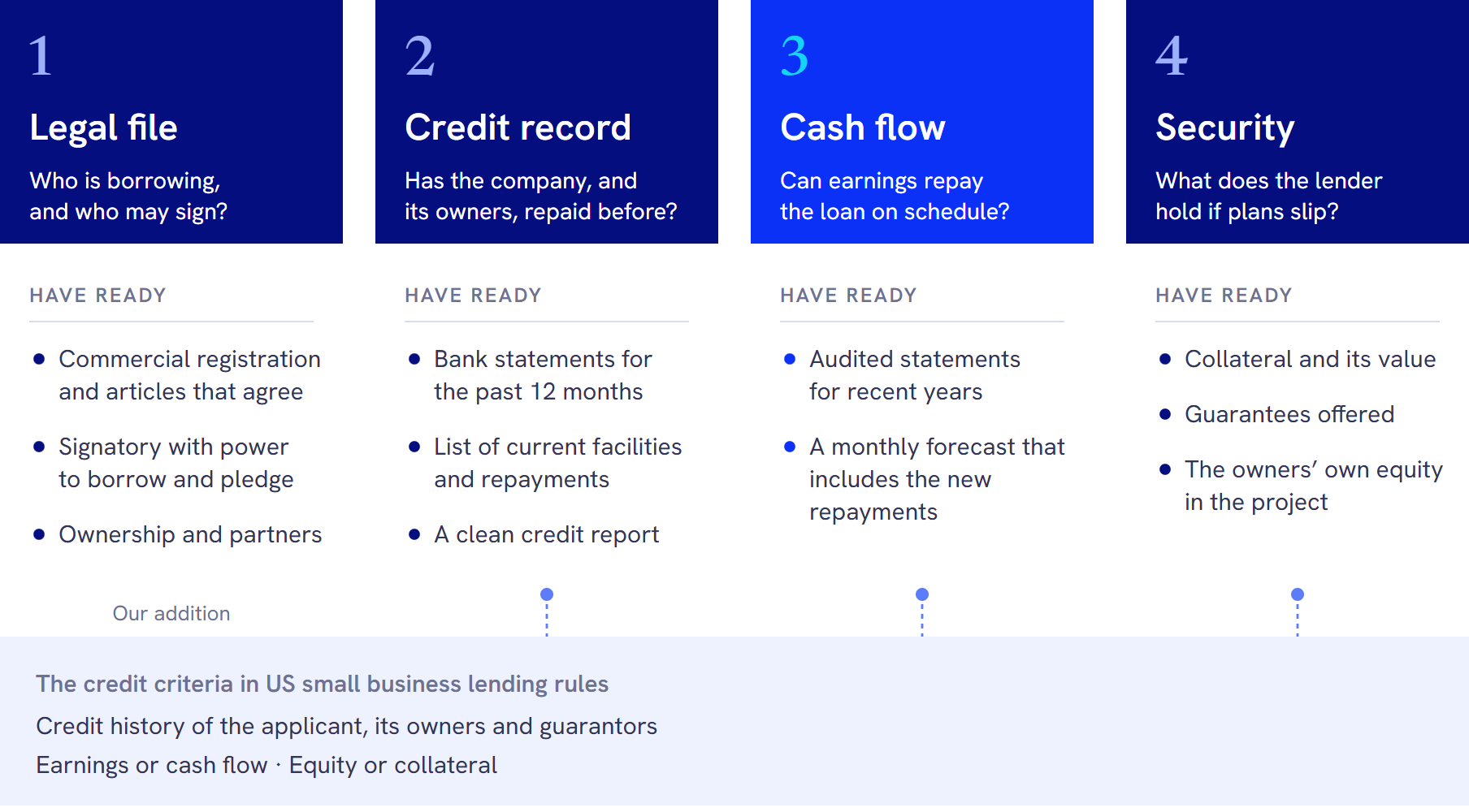
Note: Columns 2 to 4 follow the criteria in US federal rules for small business lending, which allow lenders to consider credit history, earnings or cash flow, and equity or collateral. The legal file and the lists of what to have ready are our summary of common practice.
Source: 13 CFR 120.150; Reeve Hayward analysis
Where business credit stands: More of it, at a lower price than in 2024
Two facts shape any loan conversation in Qatar in late 2026: there is a deep pool of bank credit, and its price has come down from the peak. Both work in the borrower’s favor, provided the company can show it is a sound risk.
A banking sector with room to lend
Qatar’s banks entered the final quarter of 2026 with a large and stable balance sheet. Total assets were QAR 2.194 trillion in August, up 2.3% from the end of 2025, and deposits from companies and institutions had grown 3.3% over the same period.4 Asset quality improved: loan provisions fell to 3.8% of gross loans from 4% at the end of 2025.4 By September, credit to the private sector stood at QAR 951 billion, 2.9% more than a year earlier, and private sector deposits at QAR 499 billion, up 2.2%.1 In its annual report for 2025, QCB described the banking sector as strong and solid, with robust capital and liquidity buffers, in a year when the economy grew 2.9%, led by non-hydrocarbon activity.5
QAR 1.49tn
Total credit from Qatar’s commercial banks in September 2026, up 4.8% on a year earlier
QAR 951bn
Bank credit to the private sector in September 2026, up 2.9% on a year earlier
61%
Share of private sector credit that went to trade, services, industry, and contractors in September 2026
The longer record shows where that lending has gone. Between the end of 2015 and September 2026, bank credit to the private sector grew 2.3 times, from QAR 422 billion to QAR 951 billion. The fastest growth was in lending to businesses: credit to services rose 4.7 times and credit to trade 3.6 times, against 1.5 times for real estate and 1.7 times for consumer lending (Exhibit 2).2,1 Services alone accounted for 32% of private sector credit in September 2026, more than any other activity. Lending to industry and contractors, at QAR 52 billion, was close to its 2015 level, and QCB has moved to support it: in 2025 it removed risk reserve requirements on new direct credit facilities that banks grant to the industrial sector, to encourage more bank financing for manufacturers.1,5
Exhibit 2
Lending to services and trade led the growth, and business credit is now three-fifths of private sector lending.
Bank credit to the private sector by economic activity, Qatar, end-2015 and September 2026, QAR billion
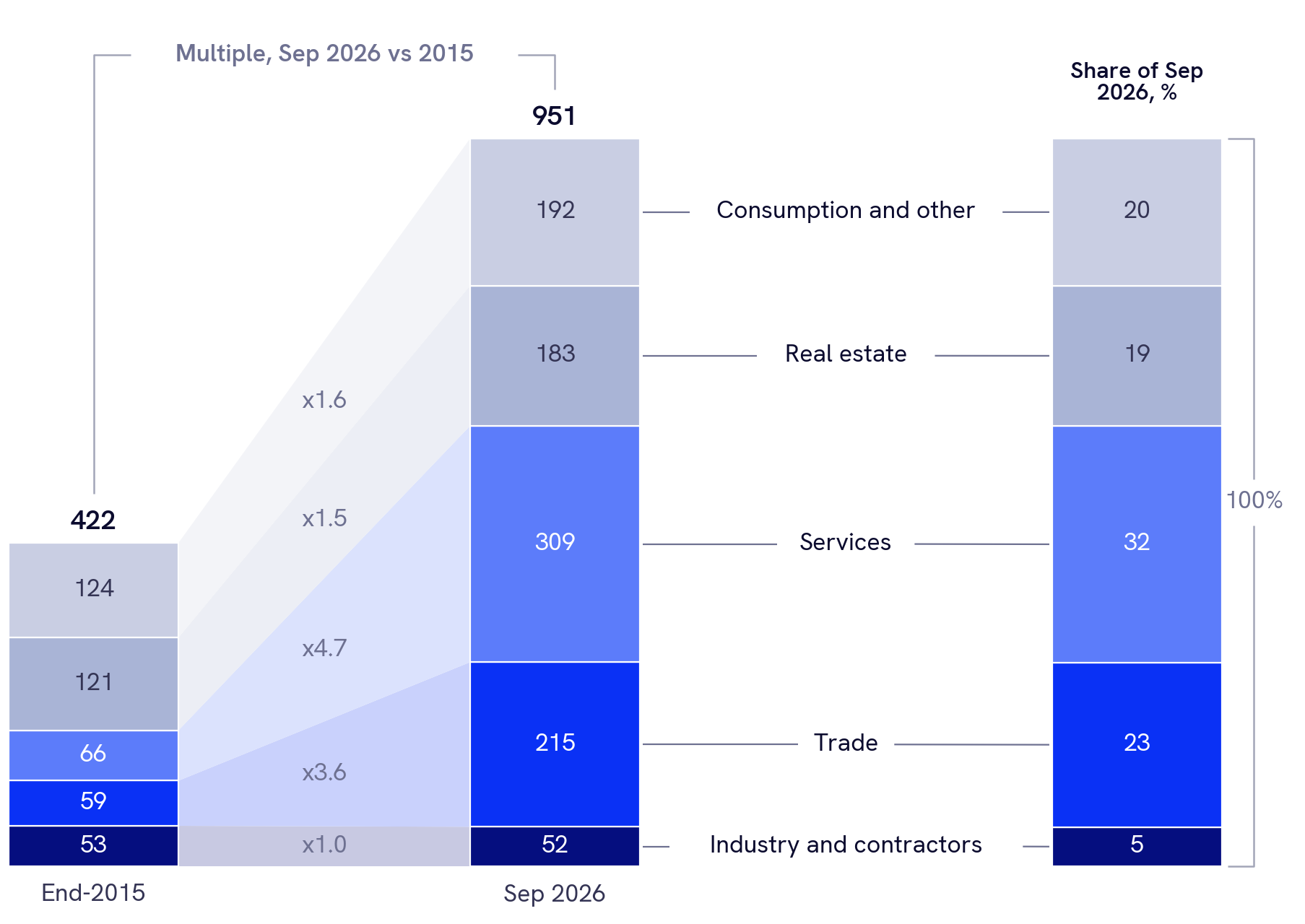
Note: Private sector credit is all activities except the public sector; credit outside Qatar is excluded. “Consumption and other” combines consumption (QAR 116 billion at end-2015, QAR 191 billion in September 2026) with other activities (QAR 8 billion and QAR 1 billion); “Industry and contractors” combines industry (QAR 15 billion and QAR 13 billion) with contractors (QAR 38 billion and QAR 39 billion). End-2015 figures come from the National Planning Council series, which matches QCB’s bulletin exactly where they overlap (December 2022). Figures may not sum because of rounding.
Source: Qatar Central Bank, Monthly Monetary Bulletin, September 2026, Table 17; National Planning Council, Local Banks Credit by Economic Activity, Qatar Open Data Portal (data.gov.qa), CC BY 4.0; Reeve Hayward analysis
For a company owner, the implication is that Qatari banks are set up to lend to operating businesses. The banks have the balance sheet, and business lending is a large and established part of what they do. The question a bank asks is not whether it lends to companies like yours, but whether it should lend to yours.
Borrowing costs have eased from the 2023–24 peak
The price of business credit has moved with policy rates. QCB lowered its key rates by a cumulative 75 basis points in the second half of 2025, to support liquidity and credit conditions,5 taking its lending rate to 4.35% in December 2025.6 In September 2026 it raised its rates by 25 basis points, setting the lending rate at 4.60%, the deposit rate at 4.10%, and the repo rate at 4.35%,7 and it held them at those levels in October.8
What banks charge companies has followed that path with a lag. QCB publishes monthly weighted average rates on credit facilities in Qatari riyals by type of facility, and the averages for each year show a clear arc (Exhibit 3).9,1 Loans of three years and more averaged 4.3% in 2021, rose to 7.1% in both 2023 and 2024, and eased to 5.9% in 2025 and 5.7% in the first nine months of 2026 (Exhibit 4).9,1 Short-term loans of less than a year averaged 4.5% from January to September 2026, against 6.2% in 2024, and bills discounted 5.6%, against 7.9%.9,1
Exhibit 3
Every main type of business credit cost less in the first nine months of 2026 than in 2024.
Average interest rate on credit facilities in Qatari riyals, by type, 2024 and January to September 2026, %
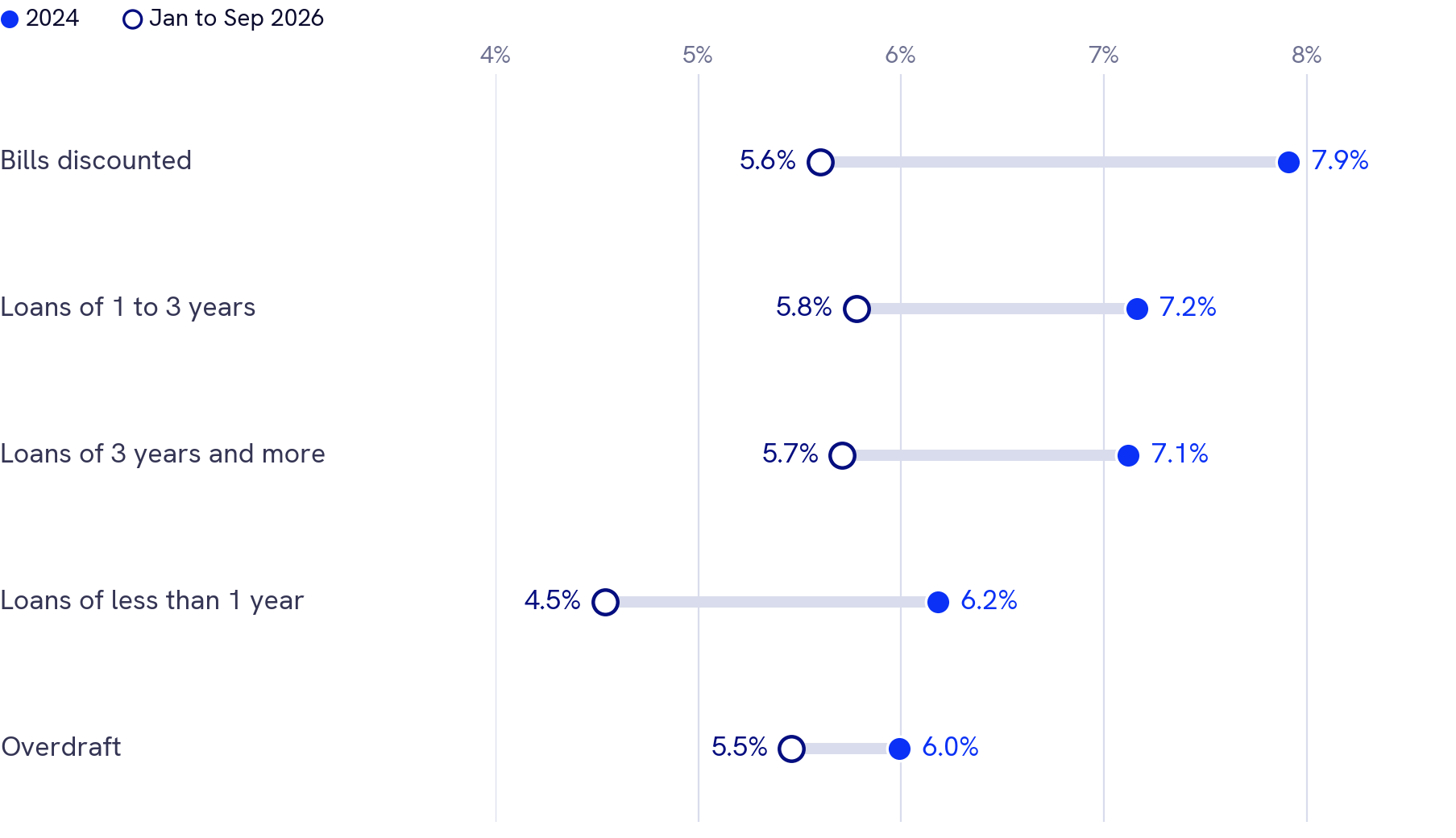
Note: Each figure is the simple average of QCB’s monthly weighted average rates for that facility type; 2026 covers January to September, the latest month published, which includes the month of the 25 basis point increase in QCB rates. Rates are averages across all borrowers; the rate a company pays depends on its risk and security. 2021 averages, for comparison: overdraft 3.7%, bills discounted 3.6%, loans of less than one year 3.8%, one to three years 4.2%, three years and more 4.3%.
Source: Qatar Central Bank, Monthly Weighted Average Interest Rates on Credit Facilities in Qatari Riyal, Qatar Open Data Portal (data.gov.qa), CC BY 4.0, to 2024; Qatar Central Bank, Monthly Monetary Bulletin, September 2026, Table 27; Reeve Hayward analysis
Exhibit 4
Rates on long-dated business loans have eased by about 1.4 percentage points from their 2024 high.
Average interest rate on loans of three years and more in Qatari riyals, 2015–26, %
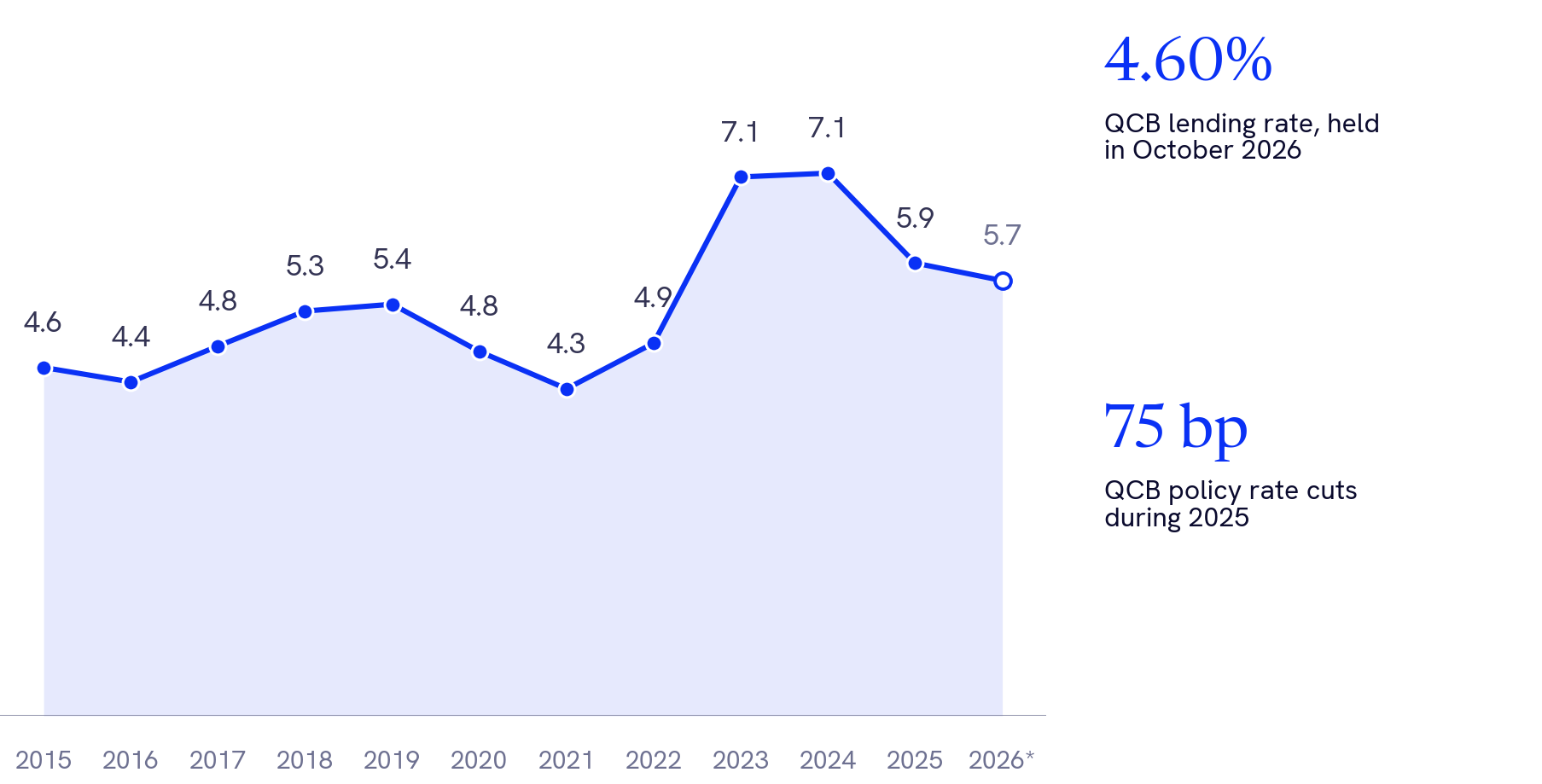
Note: Each year is the simple average of QCB’s monthly weighted average rates; 2026 covers January to September, the latest month published, which includes the month of the 25 basis point increase in QCB rates.
Source: Qatar Central Bank, Monthly Weighted Average Interest Rates on Credit Facilities in Qatari Riyal, Qatar Open Data Portal (data.gov.qa), CC BY 4.0, to 2024; Qatar Central Bank, Monthly Monetary Bulletin, September 2026, Table 27; Qatar Central Bank, Annual Report 2025; The Peninsula, September 16 and October 28, 2026; Reeve Hayward analysis
Two cautions apply. These are averages across all borrowers, so a given company may pay more or less depending on its risk, its security, and its relationship with the bank. And QCB’s latest bulletin runs to September 2026, the month of the rate increase; the decision is likely to feed through to new loans over the following months. A company that is planning a facility should model its repayments at a range of rates rather than at the most recent average.
What lenders check: Four areas a company can prepare
Credit teams vary in how they present their requirements, but the questions underneath are consistent. Small business lending rules in the United States, which are published in full, give a useful summary: a borrower must be creditworthy, a loan must be sound enough to reasonably assure repayment, and lenders may weigh the credit history of the applicant, its owners and any guarantors, the applicant’s earnings or cash flow, and any equity or collateral.10 In Qatar, we add a fourth area that comes first in practice: the legal file. The four areas below follow Exhibit 1.
1. Legal file: Show who is borrowing and who may sign
Before a bank looks at the numbers, it confirms that the company exists in the form it claims, that the people signing can commit it, and who owns it. Mismatches between the commercial registration and the articles of association, an expired registration, or minutes that do not give the signatory power to borrow and to pledge assets are among the simplest reasons for delay. They are also the easiest to fix in advance.
- Reconcile the documents. Partners, shareholdings, and activities should read the same in the commercial registration, the articles, and any amendments. Renew anything that will expire during the application.
- Prepare the authority to borrow. A partners’ or board resolution should name who may sign the facility, the security, and any guarantees, with powers wide enough for each.
- Map the owners. Lenders want to know who stands behind the company, because owners are often asked to guarantee its debts.
2. Credit record: Show that the company, and its owners, repay
A credit team reads the past as evidence of the future. It will look at how the company has used and repaid existing facilities, at its bank statements, and at the credit reports of the company and, often, its principal owners and guarantors.10 A record of late payments or of limits stretched to the full is not necessarily fatal, but it needs an explanation that the bank hears from the company first.
- List every facility. A schedule of current loans, overdrafts, guarantees, and leases, with limits, balances, maturities, and monthly payments, saves the analyst time and shows control.
- Read your own reports first. Check the company’s and the owners’ credit reports before the bank does, and correct or explain anything unusual.
- Keep one main banking relationship. Twelve months of statements through one account make turnover and cash patterns easy to verify.
3. Cash flow: Show that earnings can carry the repayments
This is where most applications are won or lost. The lender’s core question is whether the business will generate enough cash, after its own costs, to pay interest and principal on time, with room to spare if sales or margins disappoint. Audited statements show what the company has done; a forecast shows what it expects, and the bank will test the link between the two.
The rate environment matters here. A five-year loan priced at the 2024 average for long-dated facilities, 7.1%, costs noticeably more each year than the same loan at the 5.7% average of January to September 2026.9,1 A forecast that shows repayments covered at several rates is more convincing than one built on a single number.
- Build the forecast monthly for the first year. Include the new repayments, seasonal swings in receivables and inventory, and the timing of any capital spending.
- Explain every assumption. Growth, prices, margins, and collection periods should each have a reason the analyst can check.
- Show a downside case. Demonstrate that the company can still pay if revenue is lower or collections slower than planned.
For a new project or an expansion, the forecast often rests on a feasibility study. A study that a lender can test, with sourced market data and a model whose formulas can be traced, is part of the credit file, not an attachment to it. Our work on debt advisory for Qatari companies starts from that file. Banks and QDB have also worked together to offer companies advisory support in financial planning, feasibility studies, restructuring, and risk management.11
4. Security: Show what stands behind the loan
Collateral and guarantees do not replace cash flow; they protect the lender if the forecast proves wrong. The rules quoted above list equity and collateral as one of the factors a lender may weigh.10 In practice, banks look at the assets a company can pledge, the guarantees its owners will give, and how much of their own money the owners have put in.
Security is also where public programs make the biggest difference for smaller companies. A business with sound cash flow but limited assets to pledge can ask whether part of the bank’s risk can be shared with QDB, which is the subject of the next section.
- List the assets you can pledge. Equipment, receivables, deposits, and property each carry different weight with a lender.
- Decide on guarantees early. Owners should know before the first meeting what personal or corporate guarantees they are willing to give.
- Show your own stake. Equity invested by the owners tells the lender who bears the first loss.
Where to borrow: Four routes, ordered by who carries the risk
A company in Qatar can approach credit through four broad routes. They differ in who carries the risk, and that changes what the lender needs to see (Exhibit 5).
Exhibit 5
Four routes to business credit differ mainly in how much of the risk the bank carries.
Routes to business credit in Qatar, ordered from more of the risk with the bank to more with QDB
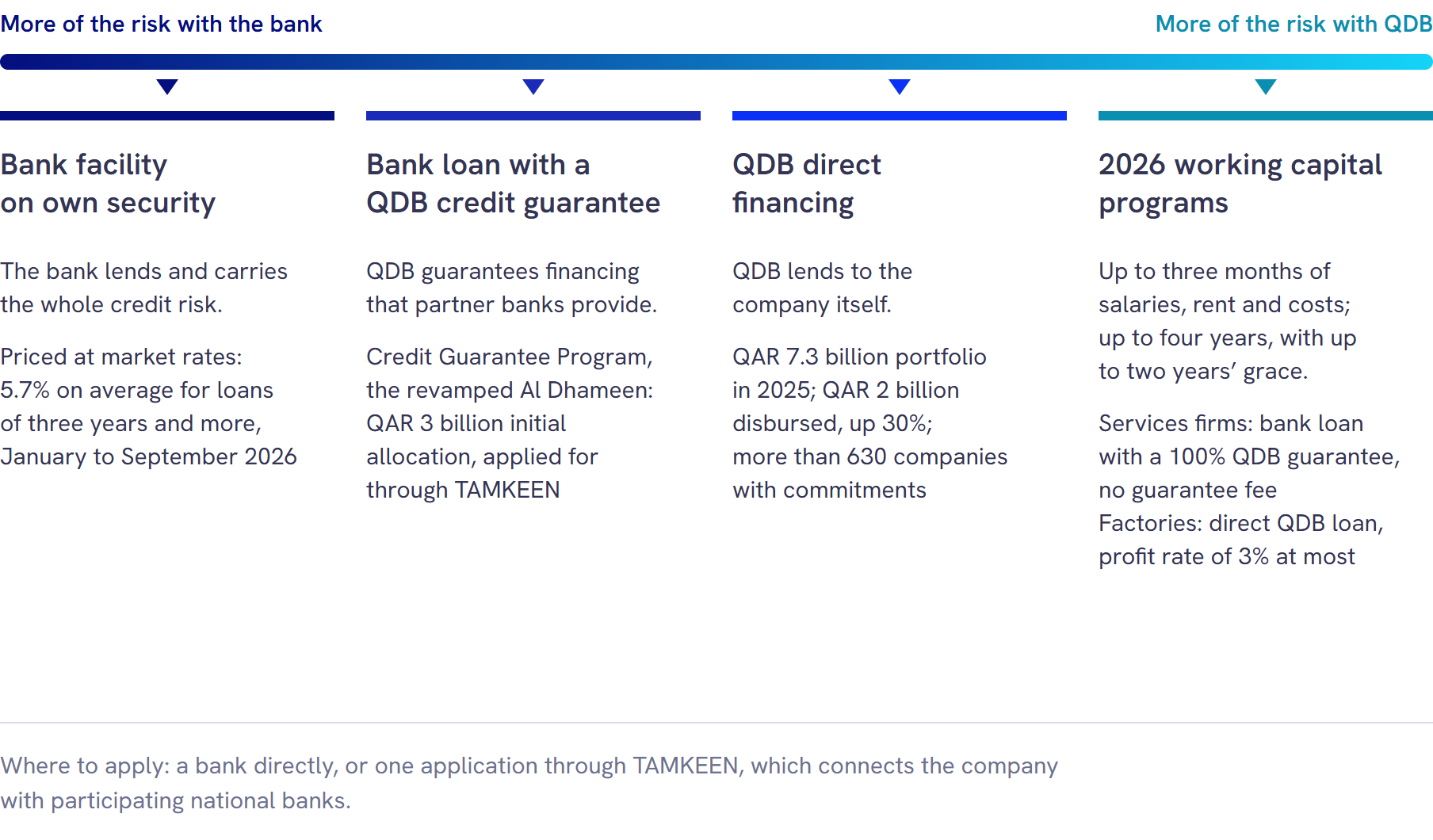
Note: The order is indicative. Under the 2026 services program QDB guarantees 100% of the principal; terms under the Credit Guarantee Program are set by QDB and the partner bank. Banks still review every borrower under their own credit policies.
Source: Qatar Tribune, November 4, 2025, January 5, 2026, and May 21, 2026; The Peninsula, May 21, 2026; Qatar Central Bank, Monthly Monetary Bulletin, September 2026; Reeve Hayward analysis
Bank facilities on the company’s own security
The most common route is a direct facility from a bank: an overdraft or short-term loan for working capital, bills discounting for receivables, or a medium- or long-term loan for equipment and expansion. The bank carries all of the risk, so all four areas in Exhibit 1 count in full. Prices follow the averages in Exhibits 3 and 4, adjusted for the company’s risk.
Bank loans with a QDB credit guarantee
When a company’s cash flow is sound but its security is thin, a guarantee can close the gap. In November 2025, QDB launched the Credit Guarantee Program, a revamped version of its Al Dhameen program, which issues guarantees to partner banks that lend to Qatar-based companies, with an initial allocation of QAR 3 billion.12 QDB’s chief executive described the program as risk-sharing with partner banks.12
The program sits inside the National Funding Gate, known as TAMKEEN, launched at the same time. TAMKEEN is a single digital platform that connects companies seeking finance with participating national banks, so that one application can reach several lenders. It was developed by QDB under the guidance of QCB and in coordination with partner banks.12 For a borrower, the practical consequence is that one well-prepared file can be read by several banks at once, which raises the value of getting the file right.
QDB direct financing
QDB also lends directly. In 2025 its total financing commitments rose 5% to more than 630 companies, its portfolio reached QAR 7.3 billion, and direct disbursements totaled QAR 2 billion, up 30%.3 It provided nearly QAR 650 million of short-term working capital funding at zero profit rates to more than 600 companies that had used an earlier guarantee program, and export financing of QAR 778 million, up 18%.3 In all, nearly 2,100 companies used QDB’s financial and advisory services during the year.3
QAR 7.3bn
QDB’s total financing portfolio in 2025
+30%
Growth in QDB’s direct disbursements in 2025, to QAR 2 billion
630+
Companies with QDB financing commitments in 2025, up 5%
The 2026 working capital programs
In response to regional developments, QDB activated a Situation Room in early March 2026 to identify urgent private sector needs, and in May it launched two working capital programs.13 The Working Capital Stabilization Guarantee Program offers financing through partner banks to companies in selected services sectors, including accommodation, food and hospitality, arts and entertainment, professional and technical services, and administrative services, with QDB guaranteeing 100% of the principal and charging banks no guarantee fee. The Working Capital Stabilization Program offers direct QDB financing to Qatar-based factories at a profit rate of no more than 3%.13 Both cover salaries, rent, and other operating costs for up to three months, with repayment over up to four years, including up to two years’ grace.13
QCB directed all banks operating in Qatar to cooperate with the guarantee program for the sectors QDB identified, in a way consistent with each bank’s credit policies and QCB’s instructions.14 That last point matters: even with a full guarantee, the bank still reviews the borrower.
How an application moves: From first conversation to drawdown
Whichever route a company chooses, an application moves through broadly the same six steps, from choosing the route to drawing the first funds (Exhibit 6). In our experience, most delays trace back to the second step, when the file is built. A missing year of statements, a forecast without notes, or a resolution that does not cover the security will each send questions back to the company, and every round of questions adds time.
Exhibit 6
A business loan moves through six steps, and most delays trace back to the second.
Steps in a business loan application, what happens and what slows it down
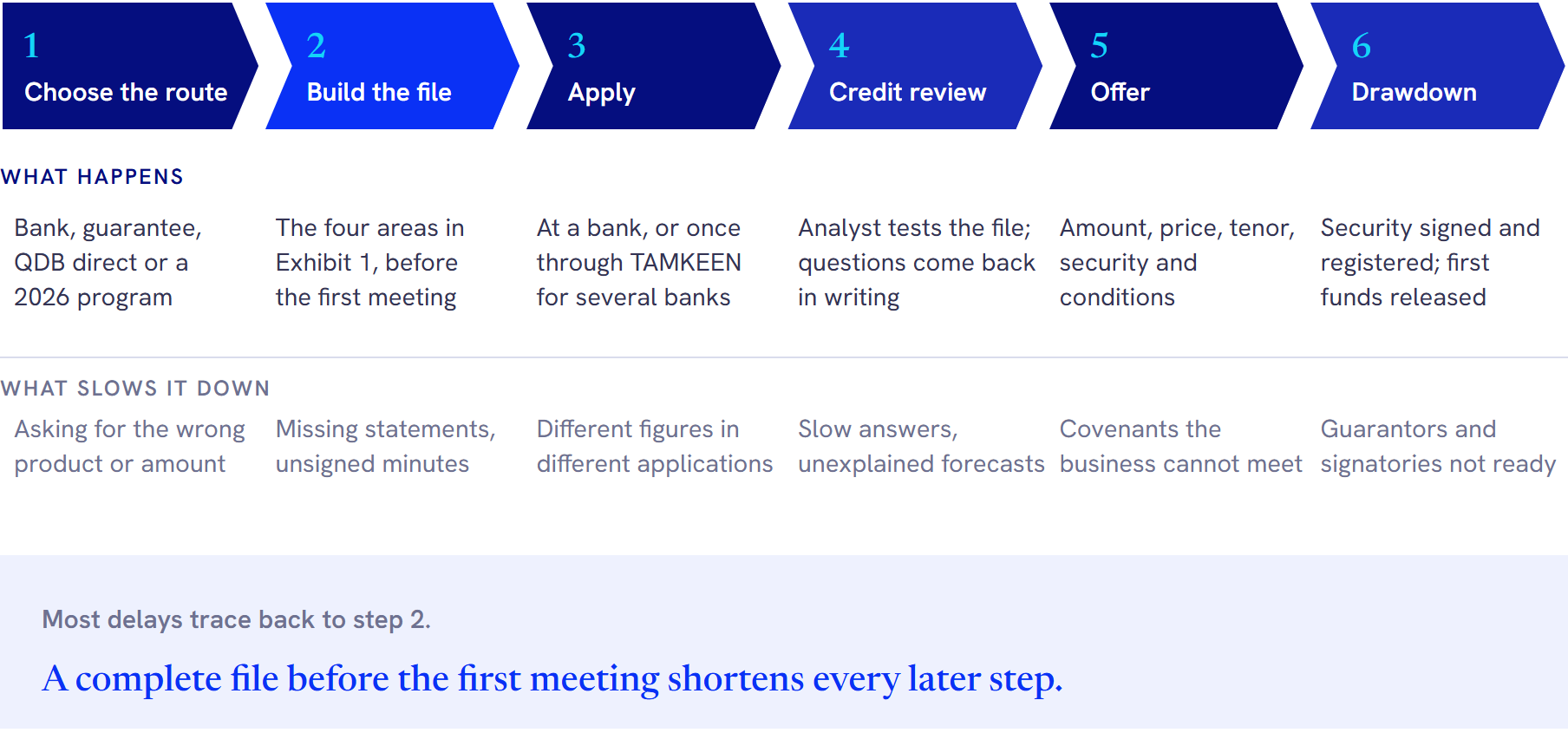
Note: Our framework, based on common practice in business lending; individual banks and programs order and name the steps differently.
Source: Qatar Tribune, November 4, 2025; Reeve Hayward analysis
Demand for business credit is likely to keep growing with the number of companies. About 28,000 new commercial registrations were issued in 2025, 57% more than in 2024,15 and 6,328 in the first quarter of 2026, up 18.5% on a year earlier.16 More applicants mean that a clear, complete file is one of the simplest ways to stand out.
What this means for borrowers
- Start with the purpose, then the product. Working capital, equipment, and expansion call for different facilities and tenors. A short-term need financed with a long-term loan, or the reverse, is a common reason for a counteroffer.
- Prepare the file once, for every lender. With TAMKEEN able to send one application to several banks,12 the same documents and figures will be read side by side. Make them consistent.
- Price the loan at more than one rate. Business lending rates have moved by close to three percentage points between 2021 and 2024.9 Test repayments at today’s average and at a higher rate.
- Ask about risk-sharing when security is thin. If the business case is sound but collateral is limited, the Credit Guarantee Program is built to share that risk with partner banks.12
- Check whether a 2026 program fits. Services companies in the listed sectors and Qatar-based factories may qualify for working capital support on longer terms with a grace period.13
- Treat the feasibility study as credit evidence. For new projects, the study and model are what the lender tests. Build them to be checked, not only to be read.
The question a bank asks is not whether it lends to companies like yours, but whether it should lend to yours.
Qatar’s banks have the capacity to lend, business credit has grown faster than any other part of their private sector lending over the past decade, and the price of a long-dated business loan in early 2026 was well below its 2024 peak. Public programs now share risk where security is thin and support working capital where it is under pressure. What remains in the company’s hands is the file. Companies that arrive with a clean legal record, a clear credit history, a cash flow forecast that holds up under testing, and a plain answer on security are likely to hear yes sooner, and on better terms.
About this article
This article draws on Qatar Central Bank’s Monthly Monetary Bulletin (latest issue, September 2026, and the December 2023 issue) for credit by economic activity, total and private sector credit, and interest rates on credit facilities by type, and on QCB’s Annual Report 2025. Earlier years come from two datasets on the Qatar Open Data Portal, published under a CC BY 4.0 licence: the National Planning Council’s local banks credit by economic activity (to 2021) and QCB’s monthly weighted average interest rates on credit facilities (to 2024). The two credit series match exactly for December 2022, where they overlap. Banking sector, policy rate, QDB program, and company registration figures are as reported by The Peninsula and Qatar Tribune. The lending criteria quoted come from US federal regulations on small business lending (13 CFR 120.150), a public domain source. Annual rates are simple averages of the monthly figures; multiples, shares, and the grouping of activities are our calculations. Exhibits 1, 5, and 6 combine these sources with our own framework and experience. It is for information only and is not investment advice.
Sources
- Qatar Central Bank, Monthly Monetary Bulletin, September 2026, Tables 1, 17, and 27, accessed November 29, 2026.
- National Planning Council, “Local Banks Credit by Economic Activity,” Qatar Open Data Portal (data.gov.qa), CC BY 4.0, accessed November 24, 2026.
- Qatar Tribune, “QDB records exceptional year in empowering private sector,” January 5, 2026.
- Qatar Tribune, “Qatar’s banking assets rise 2.3% to QR2.194 trn in Aug,” October 15, 2026.
- Qatar Central Bank, Annual Report 2025, accessed November 29, 2026.
- The Peninsula, “QCB lowers current interest rates,” December 10, 2025.
- The Peninsula, “QCB increases interest rates,” September 16, 2026.
- The Peninsula, “Qatar Central Bank keeps interest rates unchanged,” October 28, 2026.
- Qatar Central Bank, “Monthly Weighted Average Interest Rates on Credit Facilities in Qatari Riyal,” Qatar Open Data Portal (data.gov.qa), CC BY 4.0, accessed November 24, 2026.
- US Code of Federal Regulations, 13 CFR 120.150, “What are SBA’s lending criteria?” (88 FR 21085, April 10, 2023), eCFR, public domain, accessed November 24, 2026.
- The Peninsula, “Commercial Bank, QDB sign cooperation agreement to support SMEs in Qatar,” July 8, 2025.
- Qatar Tribune, “QDB introduces unified digital platform for business funding,” November 4, 2025.
- Qatar Tribune, “QDB launches two programmes to support private sector, factory stability,” May 21, 2026.
- The Peninsula, “Qatar Central Bank launches working capital stabilisation programme for private sector,” May 21, 2026.
- The Peninsula, “Meeting reviews MoCI’s key achievements, qualitative initiatives in fourth quarter of 2025,” February 18, 2026.
- The Peninsula, “Minister of Commerce and Industry chairs Ministry’s first quarterly performance review meeting,” May 22, 2026.
- Qatar Central Bank, Monthly Monetary Bulletin, December 2023, Table 17, accessed November 29, 2026.
To discuss what this means for your business, speak with our team. Initial conversations are confidential and without obligation.
Speak with our team


