

Oil through the Strait of Hormuz rose 78% in the third quarter to 9.1 million barrels a day. Tanker rates hit new records, while LNG is recovering more slowly.
Oil is moving through Hormuz again in larger volumes. New US Energy Information Administration (EIA) data, released on November 16, show that oil flows through the strait averaged 9.1 million barrels a day in the third quarter of 2026, up 78% from 5.1 million in the second quarter (Exhibit 1).1 Liquefied natural gas (LNG) flows rose from 0.8 billion to 1.4 billion cubic feet a day. Both remain well below the level of late 2025: oil is at 42% of its fourth-quarter 2025 rate, and LNG at 13%.1
This update follows our report of November 8, Hormuz and world shipping: Rerouted, repriced and still moving, which traced the disruption through the second quarter. Since then, more data have arrived, tanker earnings have reached new records, and container lines have started to return to the Suez Canal. This article sets out what has changed for oil, LNG, freight, and ports, and what companies in the Gulf can watch next.
Exhibit 1
Oil through Hormuz nearly doubled in the third quarter, while flows via Suez rose to their highest in the period.
Oil flows through selected chokepoints, second quarter 2025 to third quarter 2026, million barrels a day
| Quarter | Strait of Hormuz | Bab el-Mandeb | Suez Canal and SUMED | Cape of Good Hope |
|---|---|---|---|---|
| 2Q25 | 21.1 | 4.5 | 5.1 | 9.4 |
| 3Q25 | 21.4 | 4.7 | 5.6 | 9.1 |
| 4Q25 | 21.6 | 5.4 | 5.9 | 10.0 |
| 1Q26 | 15.0 | 5.6 | 5.7 | 8.3 |
| 2Q26 | 5.1 | 8.1 | 5.8 | 9.5 |
| 3Q26 | 9.1 | 6.3 | 7.1 | 8.7 |
Note: Oil is crude oil, condensate, and petroleum products. The EIA says its 2026 estimates are revised frequently; this release revised the first and second quarters of 2026 slightly from its earlier estimates (14.9 and 4.9 million barrels a day for Hormuz). Third-quarter 2026 data run through September.
Source: US Energy Information Administration, Short-Term Energy Outlook, Global Energy Security Data, Tables 2 and 4, November 16, 2026
Oil: More cargoes find a way out
Crude oil and condensate drove the increase, almost doubling from 3.8 million to 7.3 million barrels a day between the second and third quarters; petroleum products rose from 1.2 million to 1.8 million.1 The EIA attributes part of the gain to workarounds. Oil exports from the Middle East rose slightly in October after the restart of Saudi Arabia’s East-West Pipeline, and flows through the strait continued using ship-to-ship transfers along Oman’s coast.2 It estimates that crude production shut in across the Middle East fell to 2.5 million barrels a day in October, from a peak of 10.9 million in May.2
Other routes adjusted in turn. Oil moving through Bab el-Mandeb eased from 8.1 million to 6.3 million barrels a day, while flows through the Suez Canal and the SUMED pipeline rose 22% to 7.1 million, the highest in the six quarters shown.1 The EIA cautions that ship-tracking data have been especially unreliable since the end of February, so its 2026 figures are best read as direction and scale rather than precise counts.1
LNG: Laden transits pick up from a low base
Gas has recovered more slowly. The International Energy Agency (IEA) counts about 10 laden LNG carriers a month crossing the strait between April and September, against about 95 a month in 2025, and notes signs of improvement in September, when 27 laden vessels exited.3 In its November outlook, the EIA describes LNG exports through the strait as still well below pre-conflict levels.2
Producers outside the Gulf have filled part of the gap: the IEA estimates LNG supply from elsewhere rose 14% between March and October, offsetting about two-thirds of the decline.3 The first of its two planning cases assumes LNG flows through the strait begin to recover progressively from January 2027; the second assumes the strait stays closed to LNG until the end of March 2027.3 Qatar is positioned for that. QatarEnergy has said it is ready to resume normal operations within a few weeks of the strait reopening.4
Freight and prices: Record tanker rates, Brent back under $100
The return of cargoes has run ahead of the supply of ships willing and able to carry them, and tanker rates have risen further (Exhibit 2). DHT Holdings reports that its supertankers earned $167,100 a day in the third quarter and have booked 68% of their fourth-quarter spot days at $579,900 a day.5 Okeanis Eco Tankers reports $688,800 a day on 48% of its fourth-quarter supertanker spot days, against $269,300 in the third quarter.6 Teekay Tankers describes its fourth-quarter rates for mid-sized tankers as new records, in a market that has relied more on ship-to-ship transfers and routes that bypass the strait.7
Exhibit 2
Tanker owners have booked fourth-quarter voyages at two and a half to three and a half times their third-quarter rates.
Spot earnings per day by ship type and company, third quarter 2026 and fourth quarter to date, $ thousand a day
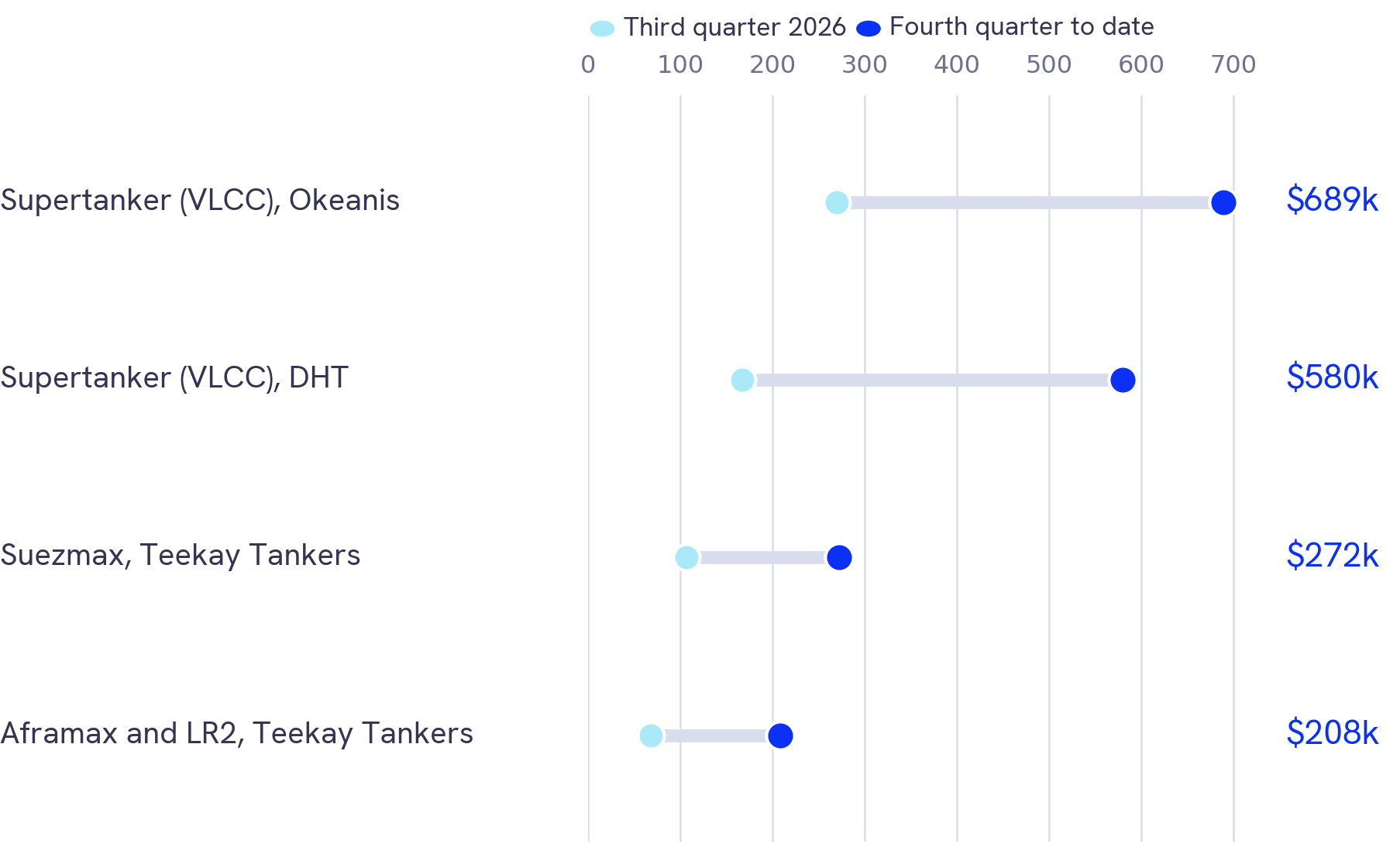
Note: Time-charter-equivalent spot rates as reported by each company. Fourth-quarter figures cover the voyages booked when results were released in November: 48% of spot days for Okeanis, 68% for DHT, and 63% (Suezmax) and 53% (Aframax and LR2) for Teekay Tankers. VLCC: very large crude carrier; LR2: Long Range 2 product tanker.
Source: Okeanis Eco Tankers, DHT Holdings, and Teekay Tankers, third-quarter 2026 results, Forms 6-K filed with the US Securities and Exchange Commission, November 9 and 12, 2026; Reeve Hayward analysis
Oil prices have moved the other way since October. The EIA puts the Brent spot price at an average of $124 a barrel in October, the highest since July 2022, and notes that it fell below $100 on November 4 as more supply reached the market. It expects Brent to average around $100 in November and December and to fall below $90 in the second quarter of 2027.2
Ports and canals: Busier berths, returning carriers
Qatar’s ports have regained momentum. Vessel calls recorded by Mwani Qatar rose from 85 in March to 249 in October, the highest monthly total of 2026, and container volumes reached 59,022 TEU (twenty-foot equivalent units) in October, up from 44,456 in March.8
Further west, the Suez Canal Authority reports that Evergreen’s EVER EON made its first transit on November 8, after a suspension of nearly three years, and that Ocean Network Express returned on November 15, with three more Premier Alliance services scheduled to follow.9 In the strait itself, US Central Command reported in late October that more than 3,000 commercial vessels had transited with its support over six months and that the primary routes were clear of mines.10 A US maritime advisory for the Gulf, the strait, and the Gulf of Oman remains in force until March 8, 2027, and still rates the risk to commercial shipping as high.11
Exhibit 3
Since our November 8 report, volumes and freight rates have risen while oil prices have eased.
Selected indicators for shipping through the Strait of Hormuz, as of November 18, 2026
| Indicator | In our November 8 report | Latest |
|---|---|---|
| Oil through Hormuz | 4.9 million barrels a day, second quarter 2026 | 9.1 million barrels a day, third quarter 2026 (second quarter revised to 5.1) |
| LNG through Hormuz | 0.8 billion cubic feet a day, second quarter 2026 | 1.4 billion cubic feet a day, third quarter 2026 |
| Supertanker spot earnings | Up to about $167,000 a day, third quarter 2026 | Up to $688,800 a day, fourth quarter to date |
| Brent crude oil | Highest monthly average of 2026 in October | Below $100 a barrel on November 4; around $100 expected for November and December |
| Suez Canal | 1,490 transits and $724 million of revenue in October | Evergreen and Ocean Network Express transiting again; three more services scheduled |
Note: Hormuz flows are EIA estimates, revised as new tracking data arrive. Brent prices are EIA spot averages and forecasts.
Source: US Energy Information Administration, November 10 and 16, 2026; DHT Holdings and Okeanis Eco Tankers, Forms 6-K, November 2026; Suez Canal Authority, November 8 and 15, 2026; Reeve Hayward, November 8, 2026
What companies in the Gulf can watch next
The direction is clearer than it was in early November, but the route back to normal trade remains gradual and uneven across cargoes. For importers, exporters, and investors in the region, these points can shape plans for 2027:
- Budget for freight as a range. Tanker rates have more than doubled in a quarter. Contracts, budgets, and project cases that assume a single freight rate for 2027 can be tested against both a high case and a return toward earlier levels.
- Keep both routes open. Ship-to-ship transfers, pipelines, and land routes carried much of the recovery. Suppliers and customers who can use more than one route are better placed if conditions change again.
- Watch the LNG timetable. One IEA planning case has LNG flows recovering from January 2027, another from the end of March. Gas-linked businesses can plan around that date while allowing for it to move.
- Follow a few signposts. The EIA’s next quarterly chokepoint data, the Suez Canal’s return of container services, and the status of the US maritime advisory before March 2027 will show whether the trend holds. Our strategy consulting work helps companies turn these signposts into scenarios for their own plans.
The third-quarter data show oil moving through Hormuz in larger volumes, helped by new routes and transfers, while LNG is still in the early stages of its return. Freight markets are pricing the scarcity of ships, and oil prices are pricing the improving supply. Companies that plan for a gradual and uneven recovery, rather than a single date, are likely to be best placed for 2027.
About this article
This article updates our report of November 8, 2026. It draws on the US Energy Information Administration’s Short-Term Energy Outlook and Global Energy Security Data, the International Energy Agency’s Global Gas Security Review 2026 (CC BY 4.0), company results filed with the US Securities and Exchange Commission, Mwani Qatar’s port statistics, the Suez Canal Authority, US Central Command, and the US Maritime Administration. Flow estimates for 2026 are revised often and may change. It is for information only and is not investment advice.
Sources
- US Energy Information Administration, Short-Term Energy Outlook, “Global Energy Security Data,” Tables 2 and 4, November 16, 2026.
- US Energy Information Administration, Short-Term Energy Outlook, November 2026, “Global oil markets” and “Natural gas,” November 10, 2026.
- International Energy Agency, Global Gas Security Review 2026, including the Gas Market Report Q4-2026, IEA, Paris, 2026, CC BY 4.0.
- QatarEnergy, remarks of the Minister of State for Energy Affairs at the Qatar Economic Forum Special Edition in New York, September 21, 2026.
- DHT Holdings, third-quarter 2026 results, Form 6-K, November 9, 2026.
- Okeanis Eco Tankers, third-quarter 2026 results, Form 6-K, November 12, 2026.
- Teekay Tankers, third-quarter 2026 results, Form 6-K, November 12, 2026.
- Mwani Qatar, “Performance Statistics,” 2026 monthly data to October, accessed November 5, 2026.
- Suez Canal Authority, “The Suez Canal witnesses the first transit of the mega container ship EVER EON,” November 8, 2026, and “ONE returns to the Suez Canal,” November 15, 2026.
- US Central Command, “CENTCOM commander visits Strait of Hormuz during milestone week,” October 25, 2026.
- US Maritime Administration, MSCI Advisory 2026-011, “Persian Gulf, Strait of Hormuz and Gulf of Oman,” in force September 9, 2026, to March 8, 2027.
To discuss what this means for your business, speak with our team. Initial conversations are confidential and without obligation.
Speak with our team


