

Qatar’s new listing rules set clear tests for the main and Venture markets, and Dandy’s book-built IPO shows the process at work. Most of what the rules test can be prepared in advance.
Qatar’s stock market is open to more kinds of company than many owners assume. Within a year, two consumer and services businesses came to the main market by different routes. Mosanada, a facility management company, listed its existing shares directly in December 2025, taking the number of companies listed on the Qatar Stock Exchange (QSE) to 55.1 Dandy, a dairy, beverage, and ice cream maker, then sold 40% of its equity in an initial public offering (IPO), allocating 41.2 million shares for a total offering of QR206.4 million, including fees, at a market value of QR515 million, with trading set for November 2026.2 Both belong to the sector that now has the most companies on the main market and one of the smallest shares of its value: consumer goods and services firms numbered 15 of the 54 main market companies at the end of 2025, up from 13 a year earlier, and held 5.3% of a market capitalization of QR644.1 billion (Exhibit 1).3,4
The point for owners is that a listing in Qatar is not reserved for banks and national champions. Mid-sized companies with a sound record already make up much of the list, and more are preparing: companies submitted eight share listing applications to the QFMA in 2025, and six were still under review at the end of the year.3 The exchange has made expanding and diversifying its listings, and raising free float, one of the four pillars of its 2030 strategy.5 The rules have also been rewritten. In November 2025 the Qatar Financial Markets Authority (QFMA) brought its offering, listing, and mergers and acquisitions rules together in one rulebook,6 and in August 2025 it issued a new Governance Code for listed companies.7 Dandy’s offering was approved under the new rules.8 This article sets out who can list, the requirements for each market, the steps from filing to the first trade, what changes after listing, the advantages, and the readiness work that comes before any of it.
Exhibit 1
Consumer and services companies are now the largest group on the main market, while banks hold half its value.
Share of companies and of market capitalization by sector, Qatar Stock Exchange main market, end-2025, %
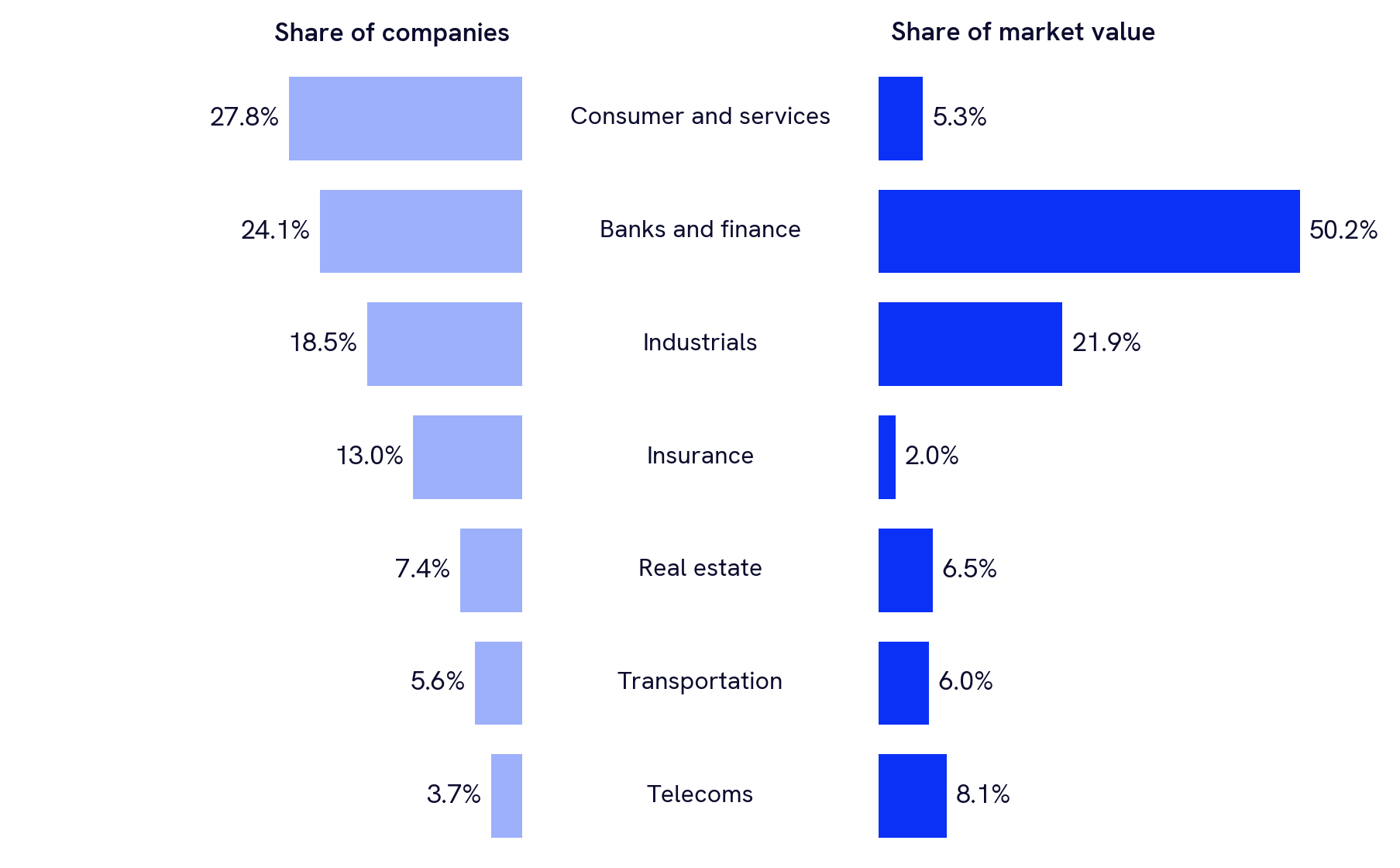
Note: 54 companies and market capitalization of QAR 644.1 billion at the end of 2025, against 52 companies and QAR 620.9 billion a year earlier; consumer goods and services rose from 13 companies to 15. Sector names follow the QFMA’s classification, shortened. Shares may not add to exactly 100% because of rounding.
Source: Qatar Financial Markets Authority, Annual Reports 2025 and 2024; Reeve Hayward analysis
Who can list: Two markets, three routes, and a wide range of issuers
Qatar has two markets for shares. The main equity market is for companies that meet the full listing criteria, and the second equity market, known on the QSE as the Venture Market, is for smaller companies that meet a lighter set.6,4 If a company meets the main market tests, the rules place it on the main market; if it meets only the second market tests, it lists there.6
There are three ways in. The first is an IPO, in which shares are offered to the public and then listed; under the rules, only a listed company or a company making its IPO may offer shares to the public at all.6 The second is a direct listing, in which existing shares are admitted to trading without an offer, on a listing prospectus approved by the QFMA and published at least three working days before trading begins.6 The third is a transfer from the Venture Market to the main market once a company qualifies (Exhibit 2).6
All three routes have been used recently. Damaan Islamic Insurance Company, known as Beema, made the QSE’s first direct listing in January 2023, on the main market.9 MEEZA’s IPO in June 2023 was the first in Qatar priced through book building, with institutional and retail investors together taking 50% of the company.10 In 2024 Al Faleh Educational Holding moved from the Venture Market to the main market, and Qatar Electronic Systems Company (Techno-Q) listed directly on the Venture Market with shares worth QR245.05 million.4 Al Mahhar Holding made the same move up in February 2025, and Mosanada, with capital of QR70 million, listed directly on the main market that December.3 Dandy’s IPO followed in 2026.2
Exhibit 2
Recent listings have used all three routes into Qatar’s market.
Routes to listing and recent examples, Qatar Stock Exchange, 2023–26
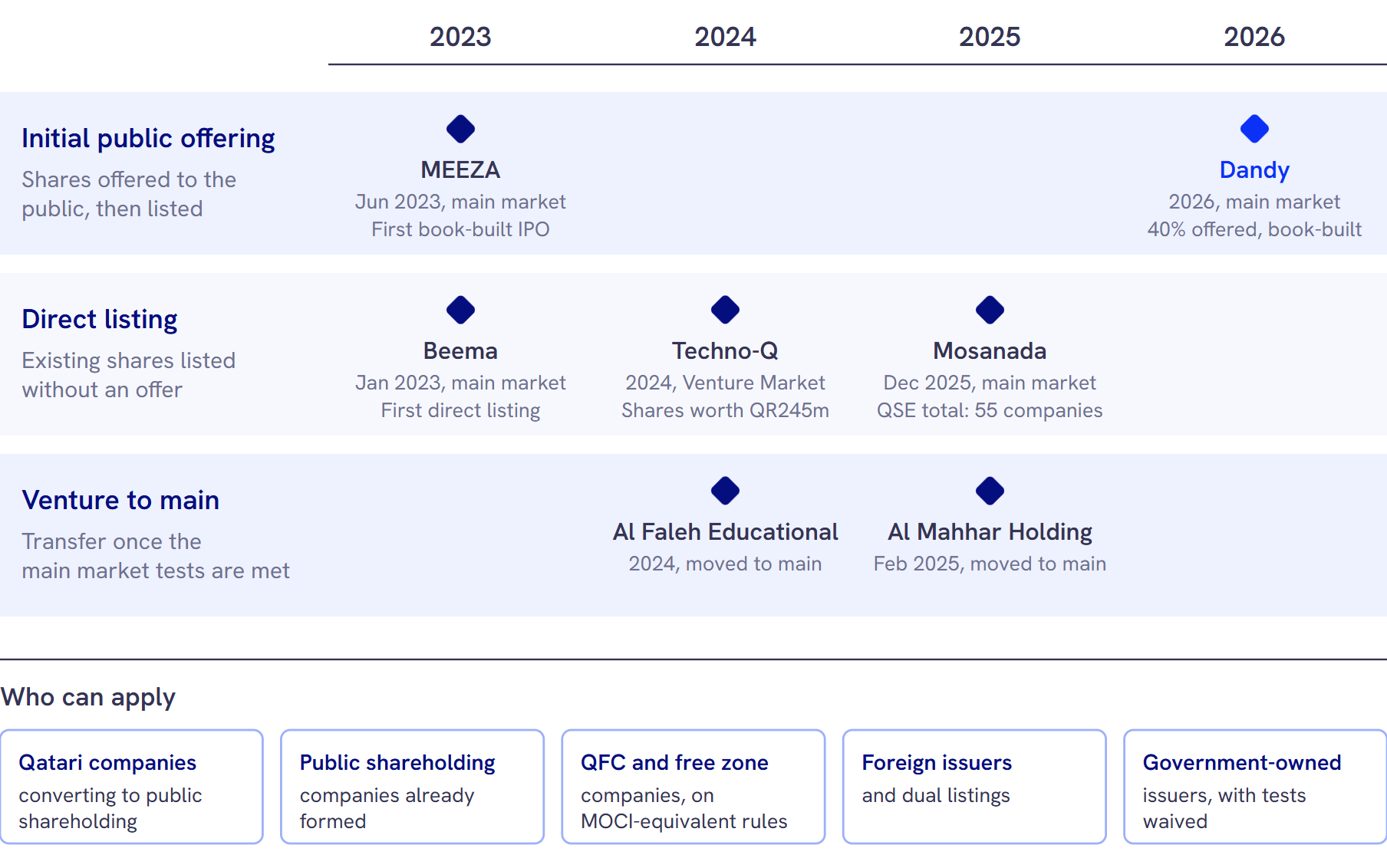
Note: The second equity market under the QFMA rules is the QSE’s Venture Market. For government-owned issuers, the operating history, profitability, and shareholder-number tests do not apply. QFC and free zone companies must align their board, articles, and general assembly rules with those of public shareholding companies registered with the Ministry of Commerce and Industry.
Source: Qatar Financial Markets Authority, Offering and Listing, and Mergers and Acquisitions Rules 2025; QFMA, Annual Reports 2025 and 2024; The Peninsula, January 17 and June 26, 2023, December 16, 2025, and November 1, 2026; Qatar Tribune, June 15, 2026; Reeve Hayward analysis
The rules also reach beyond traditional Qatari joint stock companies. A private Qatari company can convert into a public shareholding company as part of its offering or listing; in that case its application must report how any objections from shareholders or partners under the Commercial Companies Law were handled.6 Companies registered in the Qatar Financial Centre (QFC) or the Qatar Free Zones may list, provided their board, articles of association, and general assembly rules match those of a public shareholding company registered with the Ministry of Commerce and Industry and the Governance Code.6 Foreign issuers may list, and Qatari issuers may dual list abroad with permission.6 Where the issuer is, or is owned by, a government entity, the track record, profitability, and shareholder-number tests do not apply.6 The same rulebook also covers bonds, sukuk, and fund units, each with its own market.6 In late 2025 Ahli Bank and Qatar International Islamic Bank listed the QSE’s first corporate bond and first sukuk, QR500 million each, both by direct listing.3,5
The requirements: One set of tests for each market
The two markets differ by an order of magnitude. A company seeking the main market needs subscribed and paid-up capital of at least QR40 million; the Venture Market needs QR2 million, one-twentieth as much. The main market asks for at least two financial years of operation in the company’s main activity, two years of audited financial statements, and average operating profits over those two years of at least 5% of capital. The Venture Market asks for one year and sets no profit test (Exhibit 3).6
Three further tests decide whether the shares will be widely held. Shareholders’ equity must be at least 100% of paid-up capital for the main market and at least 50% for the Venture Market, on the latest audited statements. Between 20% and 60% of the capital must end up with the public on the main market, and between 10% and 60% on the Venture Market. And an IPO must leave at least 200 public shareholders on the main market and 20 on the Venture Market; a direct listing on the main market needs at least 100 public shareholders holding at least 25% of the capital.6 The definition of “public” matters here: shares held by founders, board members and their immediate families, companies in the same group, anyone entitled to appoint a director, and major shareholders do not count.6
Exhibit 3
The Venture Market asks for a fraction of the main market’s thresholds and sets no profit test.
Eligibility tests for listing shares, main market and Venture Market, Qatar, as set by the QFMA in 2025
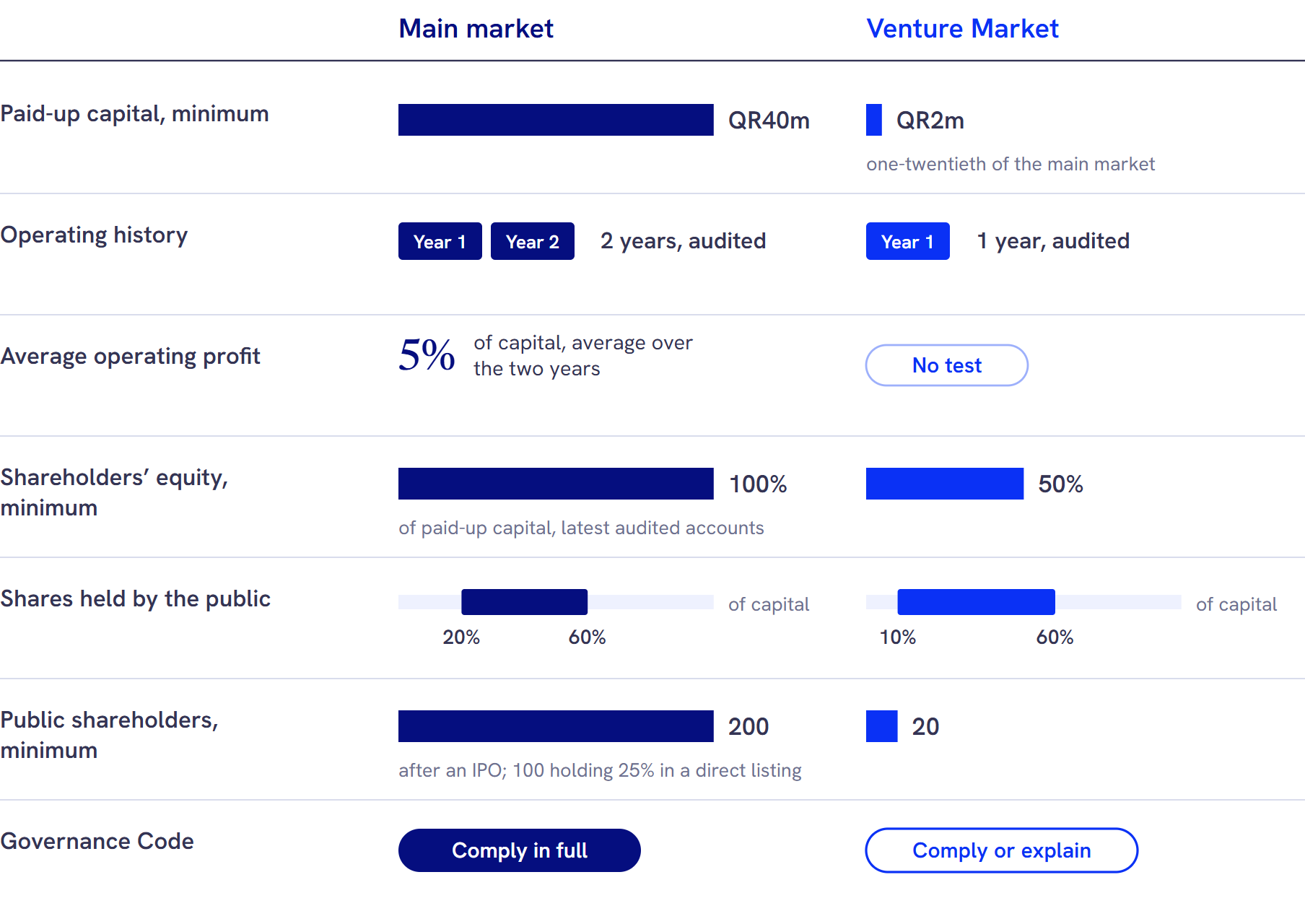
Note: Shares held by founders, board members and their immediate families, group companies, anyone entitled to appoint a director, and major shareholders do not count as held by the public. The operating history may be met through subsidiaries or businesses acquired, merged, or demerged. Bars within each row are drawn to scale.
Source: Qatar Financial Markets Authority, Offering and Listing, and Mergers and Acquisitions Rules 2025, rules 3.2.4, 3.2.5, and 8.2.2; QFMA, Governance Code for Listed Companies, 2025
The shares themselves must also be ready. Each must carry a nominal value of QR1, unless the issuer is foreign, with equal rights for every shareholder, fully paid capital, and no conditions or restrictions on transfer, and the shares must be eligible for electronic settlement at the central depository.6 For many family-owned companies, these conditions mean changes to the articles of association and the share register well before the application. The track record can be met through subsidiaries or businesses acquired or merged into the issuer, which helps groups that have reorganized.6 The tests may become simpler still: the QFMA has compared Qatar’s IPO and direct listing requirements with those elsewhere in the GCC and is preparing projects to update and simplify the rules,3 so owners should plan against the text in force when they apply.
The process: Seven steps, with a clock on most of them
An IPO in Qatar runs through seven steps (Exhibit 4). The first two happen at the company’s own pace. The company prepares its accounts, governance, and structure, and then appoints the advisers the rules require. Chief among them is an offering and listing advisor licensed by the QFMA, which prepares and submits the application, coordinates the other advisers, checks the prospectus, and acts as the company’s point of contact with the regulator and the exchange.6 By the end of 2025 the QFMA had licensed four listing advisors for the main market and five for the Venture Market.3 The price is set by a firm underwriting commitment, by book building, or by a report from a financial evaluator registered with the QFMA, with or without an underwriter.6
From filing onward, the rules set the pace. The QFMA must decide on an application within 30 working days and notify the company within five more, although it can extend the period if it asks for more information. If the price is set by book building, at least 30% of the shares offered go to institutional investors, who are invited at least five working days in advance and bid during a period of no more than ten working days. The public subscription then runs for two to four weeks through banks regulated by Qatar Central Bank or entities the QFMA authorizes, and the shares must be allocated within five working days of its close, on a list audited by the external auditor. Once trading starts, an approved price stability mechanism can buy back up to 15% of the shares offered during the first 30 working days.6
Exhibit 4
Once a company files, the rules put a clock on almost every remaining step of an IPO.
Steps in an initial public offering of shares in Qatar, with the time limits set by the QFMA rules
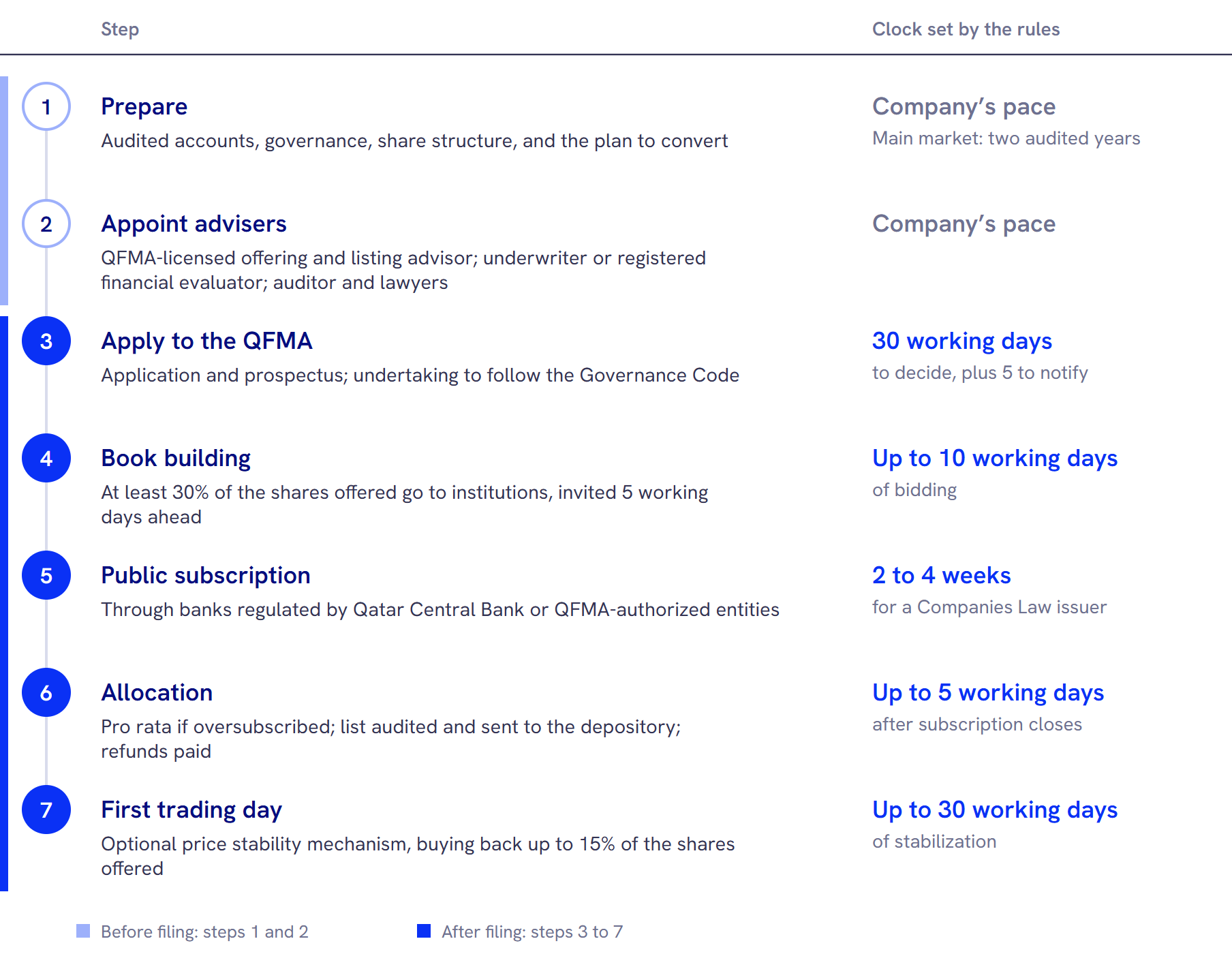
Note: Book building is one of four pricing methods; the others are a firm underwriting commitment, an underwriter informed by a financial evaluator’s report, and a financial evaluator’s report alone. The QFMA may extend its 30 working days if it asks for more information. Issuers not subject to the Companies Law have a subscription period of one to two weeks.
Source: Qatar Financial Markets Authority, Offering and Listing, and Mergers and Acquisitions Rules 2025, rules 2.2.3, 2.2.19–2.2.22, 3.2.7–3.2.8, 3.4.1–3.4.5, and 8.2.8; Reeve Hayward analysis
Dandy’s IPO: The new rules at work
Dandy’s offering shows how the steps fit together. In June 2026 the company announced the QFMA’s approval to offer 40% of its capital, with the price to be set by book building within a range of QR5 to QR5.20 a share. The offer was split in two: 12.36 million shares, 30% of the offering, for institutional investors through book building, and 28.84 million shares, 70%, for Qatari individuals and companies incorporated in Qatar.8 In August the book closed oversubscribed, with 19 institutional investors taking part, and the price was set at QR5.11 At the start of November the lead receiving bank confirmed the allocation of all 41.2 million shares at QR5.01, including offering and listing fees, for a total of QR206.4 million, with trading set for November.2 On the planned split, the existing owners keep 60% of the company, institutions hold 12%, and the public 28% (Exhibit 5).
As reported, about four and a half months passed between the approval announced in mid-June and the final allocation at the start of November. The institutional tranche was set at the rule’s minimum of 30%, and the subscription was handled by eight receiving banks.8,2 The structure follows MEEZA’s offering three years earlier, where qualified investors took 18.7% of the company and retail investors 31.3%.10 Both offerings were priced through book building, which Qatar first used for MEEZA in 2023.
Exhibit 5
Dandy sold 40% of the company in two tranches, at a price set by 19 institutional investors.
Dandy initial public offering, ownership after the offering and milestones, 2026, % of 103 million shares and QAR
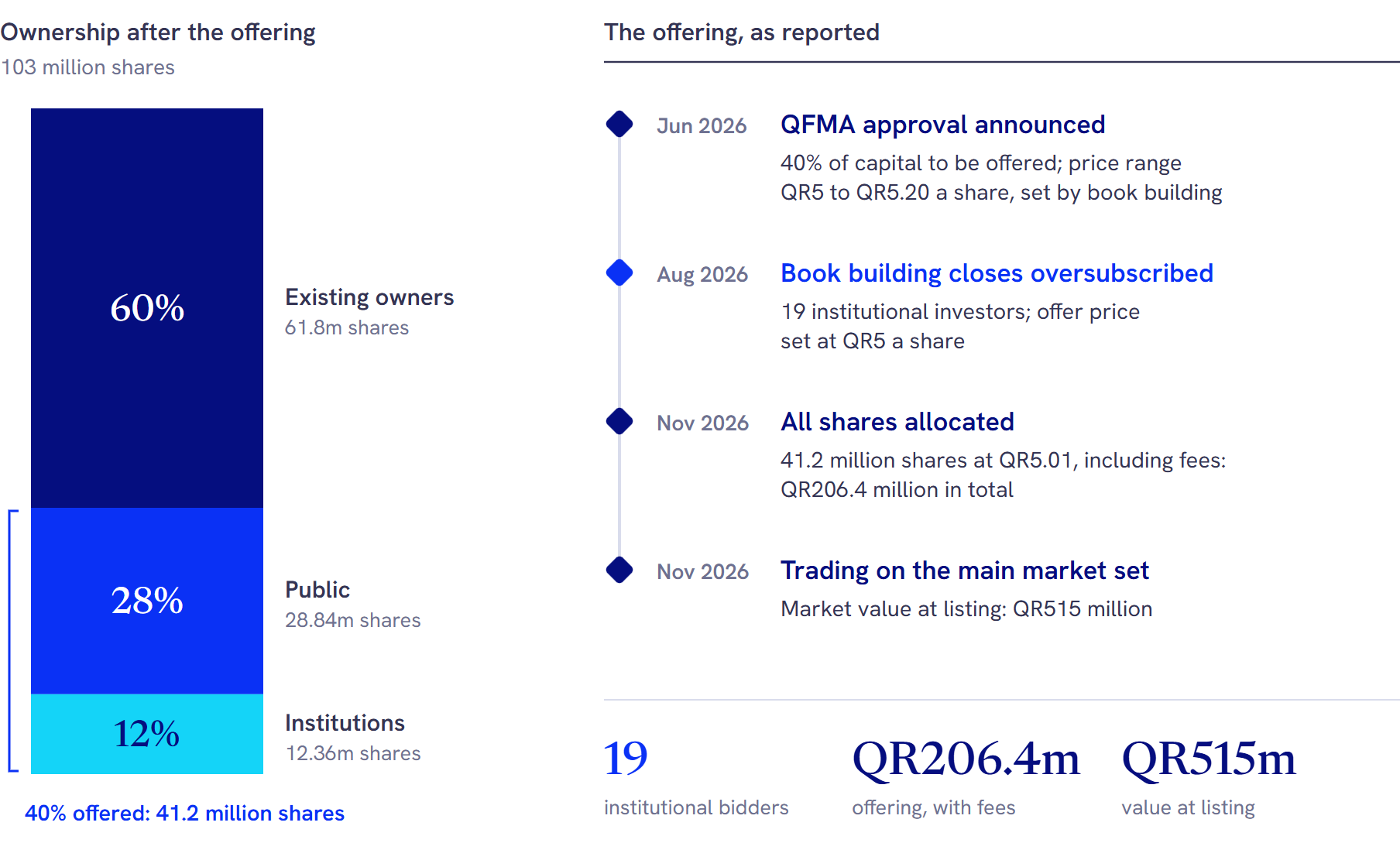
Note: Ownership uses the split announced in June 2026 (30% of the offer to institutions, 70% to Qatari individuals and Qatar-incorporated companies). Total shares are 41.2 million divided by 40%; QR5.01 is the offer price of QR5 plus offering and listing fees.
Source: Qatar Tribune, June 15 and August 4, 2026; The Peninsula, November 1, 2026; Reeve Hayward analysis
After the bell: Lock-ups and continuing obligations
Listing changes what owners can do with their shares. For a year from the first trading day, founders and the major shareholders at listing may not sell any of the shares they held when trading began. In the second year they may sell, but not if the sale would take their combined holding below 40% of the company’s capital. Transfers between founders, to heirs, and court-ordered transfers are not treated as sales. A company that converts by a direct listing on the Venture Market has a lighter regime: owners may sell up to 30% of their original holding in the first year, subject to the same 40% floor (Exhibit 6).6
The company, too, must keep meeting four tests for as long as it is listed. On the main market it needs at least 200 shareholders, paid-up capital of at least QR40 million, at least 10% of its capital available to trade, and shareholders’ equity of at least 75% of paid-up capital, unless it is under a restructuring plan. On the Venture Market the thresholds are 20 shareholders, QR2 million, 5%, and 50%. Every listed company must follow the Governance Code and publish an annual corporate governance report, and a Venture Market company must keep its listing advisor for at least six months after its first trading day.6
Exhibit 6
After listing, founders are locked in for a year, and the company must keep passing four tests.
Lock-up and continuing listing requirements, main market and Venture Market, Qatar
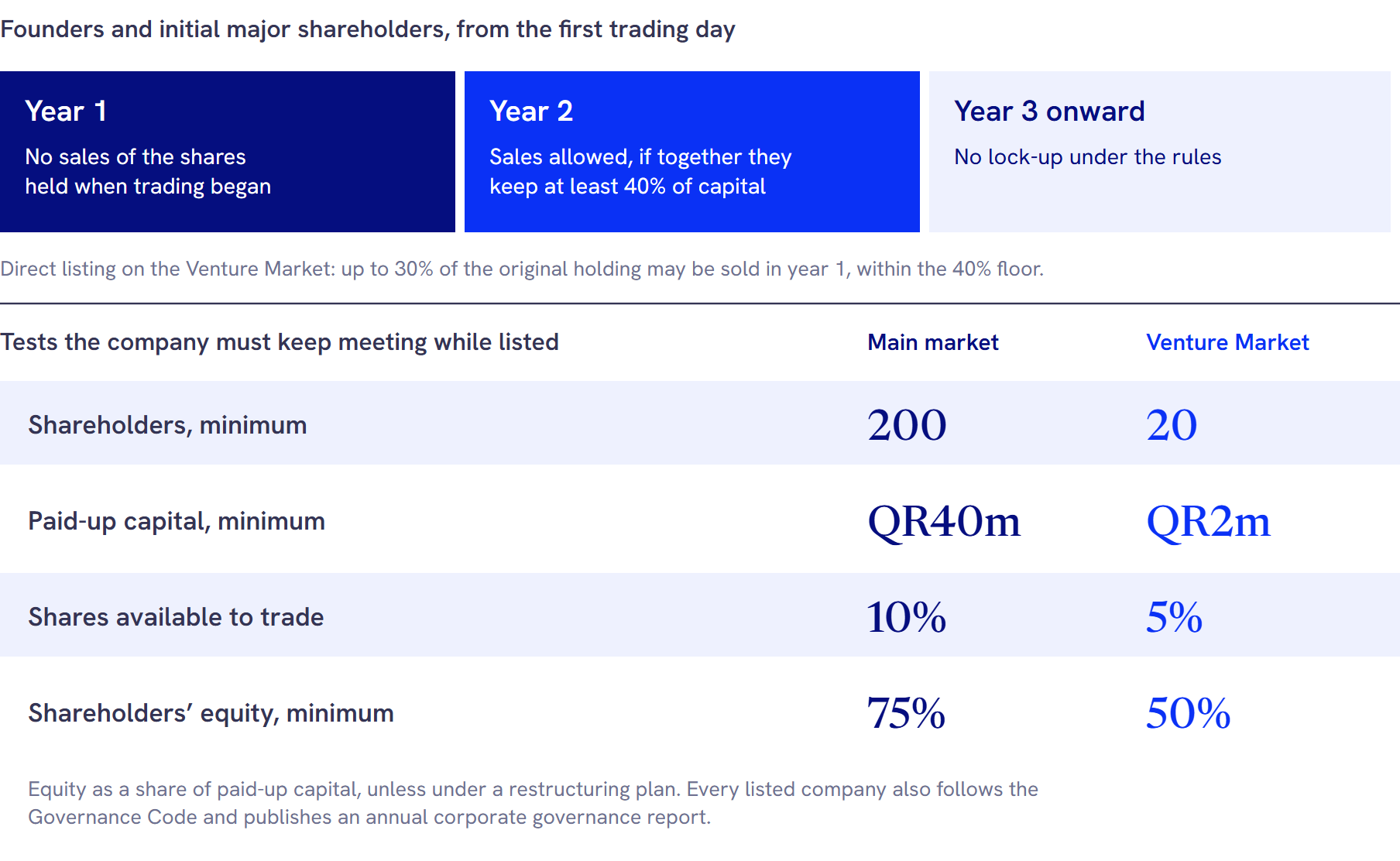
Note: Transfers between founders, to heirs, and by court order are not treated as sales. The equity test does not apply to a company under a restructuring plan. A main market company listed directly has two years to reach 200 shareholders.
Source: Qatar Financial Markets Authority, Offering and Listing, and Mergers and Acquisitions Rules 2025, rules 8.3.1, 8.3.2, and 8.4.1
Why list: Six advantages for a growing company
The obligations are real, and so are the rewards. Companies that have listed or announced plans to list, and the regulator itself, describe much the same benefits: access to capital, a wider investor base, and the discipline of public reporting. Six stand out.
1. Capital at listing, and the right to raise more later
An IPO raises money from a wide base of investors in one transaction, and listing keeps that door open. Because only listed companies may offer shares to the public,6 a listed company can return to its shareholders for growth capital. In September 2026 Baladna completed a one-for-four rights issue of 535,996,240 new shares at QR1.01, raising its paid-up capital by 25%, to about QR2.68 billion, to fund its expansion plans.12 At the subscription price, that is about QR541 million of new equity.
2. A wider and more international shareholder base
A listing opens a company to investors it could not reach privately. The main market had 111,272 active investor accounts at the end of 2025, and in that year 1,537 new accounts were opened by non-Qatari investors, more than three and a half times the 425 opened by Qatari investors.3 Foreign investors accounted for 42.4% of main market trading in 2025,5 and they were net buyers of QR2.06 billion of shares over the year.3 When the QFMA approved Techno-Q’s Venture Market listing, it noted that the listing would let the company benefit from public funding and expand its investor base.4
3. A market value and a way for owners to realize part of it
A listed share has a price every trading day, which gives owners a mark for their stake and a route to sell part of it over time, within the lock-up. Shares worth QR105.3 billion changed hands on the main market in 2025.3 An IPO can also reset the ownership mix in one step: after MEEZA’s offering, its founders held the remaining 50% of the company.10 Large holders can sell down later in an orderly way: in November 2025 a stake of about 5% of Ooredoo held by the Abu Dhabi Investment Authority, 160.5 million shares at QR12.5, was sold for about QR2 billion in Qatar’s first marketed secondary offering. It was oversubscribed by local and international investors and lifted the share of Ooredoo’s capital available for trading to 27%.3 For family-owned businesses, a listed share can also be easier to divide among the next generation than a stake in a private company.
4. Shares that can pay for acquisitions and reward staff
The rulebook provides for offers of securities to pay for an acquisition or a merger, and for employee share schemes in listed companies.6 Listed shares give a growing company a currency for deals and a way to tie senior staff to its long-term value.
5. Governance and transparency that lenders and partners recognize
Listing brings a board with independent members, standing committees, audited reporting, and regular disclosure. The QFMA has said that Techno-Q’s listing would enhance its transparency and financial disclosure in line with the listing requirements.4 When Gulf International Services announced plans to list Amwaj Catering Services, in which it holds 30%, it said a listing would enhance transparency and governance and improve access to capital markets.13
6. A path that can start small
The Venture Market lets a company list with QR2 million of capital, one year of history, and 20 public shareholders, and move up when it qualifies.6 Al Faleh Educational Holding made that move in 2024, and Al Mahhar Holding in 2025.4,3 For a company not yet at the main market’s scale, the Venture Market offers a way to start building a public record early.
QR2.06bn
Net purchases of main market shares by foreign investors in 2025
42.4%
Share of main market trading by foreign investors in 2025
1,537
New main market accounts opened by non-Qatari investors in 2025, against 425 by Qatari investors
Getting ready: What to prepare before the advisers arrive
Most of what the rules test can be prepared before a company files, and much of it before it appoints its offering and listing advisor. The tests look back: two audited years for the main market mean that a company planning to list needs its accounts in order at least two financial years ahead. The forecasts used to market an IPO must be prepared on the same accounting basis and policies as the financial statements, be comparable with past results, and carry the external auditor’s certification of that basis.6 The governance tests apply from the first day of listing.
Governance is often the longest piece of work for a family-owned company. The 2025 Governance Code requires a board of seven to 11 members, at least three of them independent, with a chairman who holds no executive post. It requires three committees: audit; risk management and compliance; and nomination, remuneration, and incentives. The audit committee must be chaired by an independent member, and most of its members must be independent. Main market companies must comply with the Code in full, while Venture Market companies follow it on a “comply or explain” basis (Exhibit 7).7 Finding and appointing independent directors, setting up committees that work, and writing the policies behind them take time.
Exhibit 7
A listed company needs a board of seven to 11, at least three of them independent, and three committees.
Board and committee requirements under the Governance Code for Listed Companies, Qatar, 2025
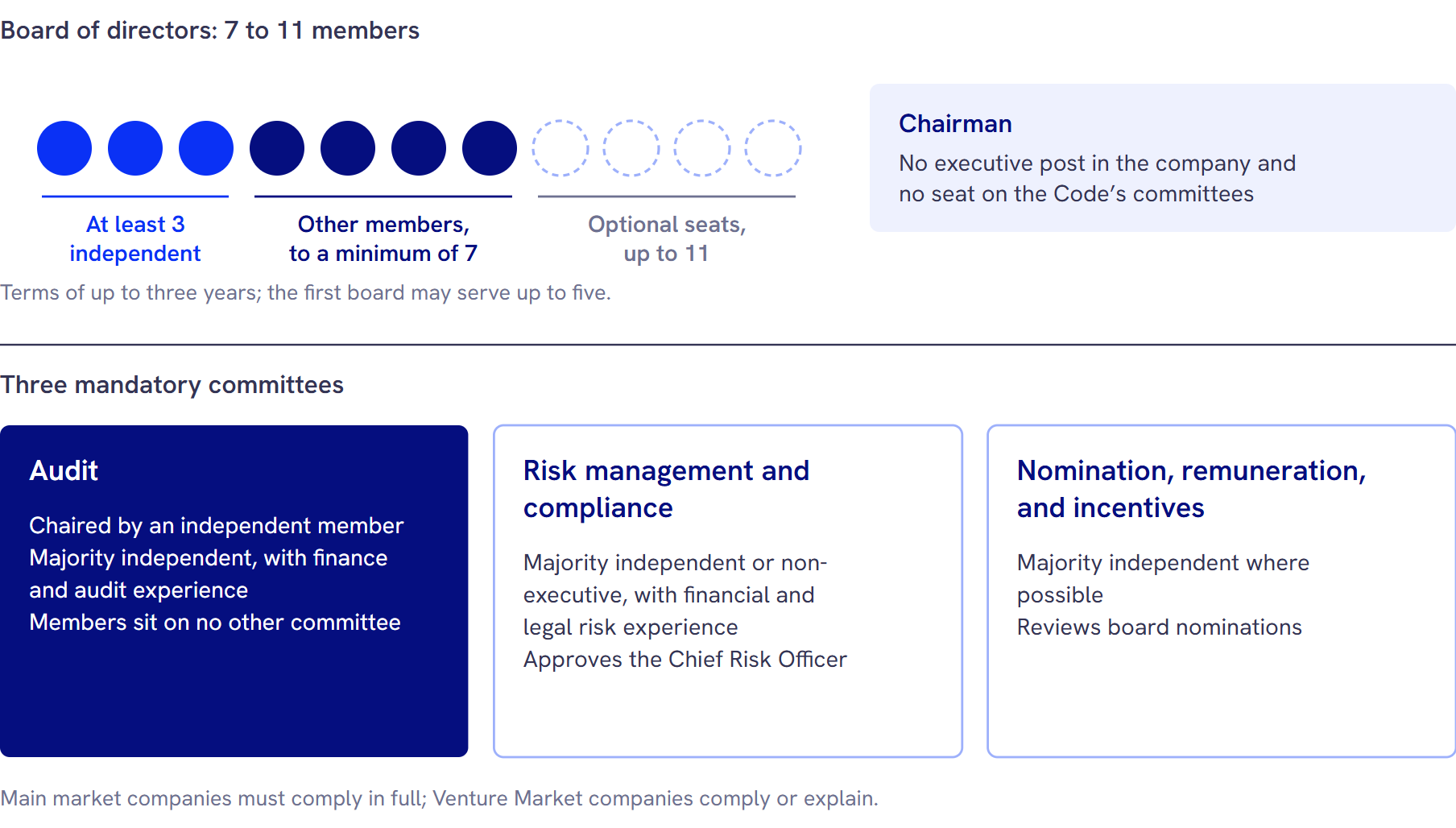
Note: Main market companies must comply with the Code; Venture Market companies follow it on a comply-or-explain basis. Companies had one year from the Code’s publication in the Official Gazette on August 17, 2025, to comply.
Source: Qatar Financial Markets Authority, Governance Code for Listed Companies, Board Decision No. 5 of 2025
An IPO readiness exercise brings this work together and tests the company against the rules before the market does. It sets the company’s position against each listing test, closes the gaps, and leaves the licensed advisers, the auditors, and the financial evaluator with a company that is ready to be examined. In our IPO readiness exercise, we work through five areas, matched to what the rules test (Exhibit 8): the financial history, the forecasts and the model, governance, the share structure, and the equity story.
Exhibit 8
Most of what the listing rules test can be prepared before a company files.
IPO readiness by area, what the QFMA rules test and what a readiness exercise prepares
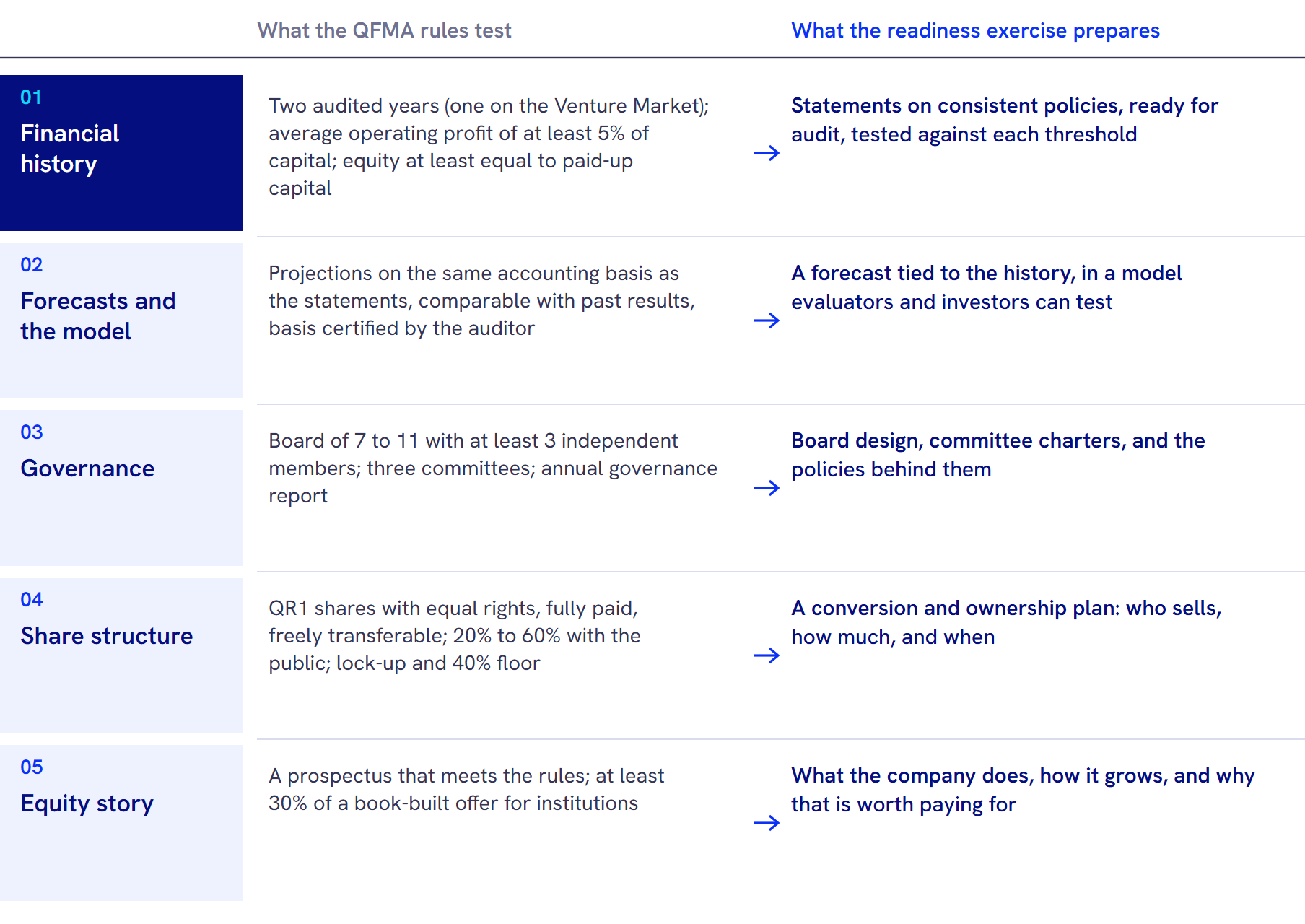
Note: Our framework. The left column summarizes the QFMA rules and Governance Code; the right column describes Reeve Hayward’s readiness work, which precedes the appointment of the QFMA-licensed offering and listing advisor.
Source: Qatar Financial Markets Authority, Offering and Listing, and Mergers and Acquisitions Rules 2025; QFMA, Governance Code for Listed Companies, 2025; Reeve Hayward analysis
What this means for owners
- Choose the market before the timetable. The main market’s QR40 million capital, two-year record, and 5% profit test are the first filter.6 A company that meets only the Venture Market tests can list there and move up later, as Al Faleh and Al Mahhar did.4,3
- Start the clock with the accounts. Two years of audited statements on consistent policies, with equity at or above paid-up capital, are the foundation of the application and of any forecast in the prospectus.6
- Build the board before the prospectus. Seven to 11 directors, three of them independent, and three working committees take longer to put in place than most other items on the list.7
- Plan the founders’ position early. The public must end up with 20% to 60% of a main market company, founders are locked in for a year, and their combined holding cannot fall below 40% in the second year.6 These limits shape how much can be sold and when.
- Prepare for institutions as well as the public. With at least 30% of a book-built offering reserved for institutions, and 19 of them bidding for Dandy’s shares,6,11 the equity story and the model need to stand up to professional investors.
- Treat listing as a permanent standard. Shareholder numbers, free float, equity, and governance are tested for as long as the shares are listed.6
Most of what the rules test can be prepared before a company files.
Qatar’s listing rules are now in one place, its governance standards have been renewed, and recent listings show that mid-sized companies can use each route: an IPO priced by institutions, a direct listing of existing shares, or a start on the Venture Market. The tests are clear and published. The companies that list smoothly are likely to be those that have met them before they file, with clean accounts, a working board, a forecast that matches the books, and a story that investors can test.
About this article
This article draws on the Qatar Financial Markets Authority’s Offering and Listing, and Mergers and Acquisitions Rules 2025, its Governance Code for Listed Companies of 2025, and its Annual Reports for 2025 and 2024; on the Qatar Stock Exchange’s Annual Report 2025; and on reports of recent listings by The Peninsula and Qatar Tribune. The rules are summarized in our own words; the rulebook and the Code are the authoritative texts, and the Arabic versions prevail. Sector shares, Dandy’s ownership after the offering, the value of Baladna’s rights issue, and the ratios between thresholds are our calculations. Exhibits 2, 4, 7, and 8 combine the QFMA’s rules with our own summary and framework. It is for information only and is not investment advice.
Sources
- The Peninsula, “Mosanada shares listed on Qatar Stock Exchange,” December 16, 2025.
- The Peninsula, “QNB Group confirms final allocation of shares ahead of Dandy IPO,” November 1, 2026.
- Qatar Financial Markets Authority, Annual Report 2025, June 2026.
- Qatar Financial Markets Authority, Annual Report 2024, May 2025.
- Qatar Stock Exchange, Annual Report 2025, 2026.
- Qatar Financial Markets Authority, Offering and Listing, and Mergers and Acquisitions Rules 2025, Board Decision No. 8 of 2025, issued November 30, 2025.
- Qatar Financial Markets Authority, Governance Code for Listed Companies, Board Decision No. 5 of 2025, issued August 4, 2025.
- Qatar Tribune, “Dandy set for QSE debut through 40% share offering,” June 15, 2026.
- The Peninsula, “‘Beema’ marks first direct listing in QSE,” January 17, 2023.
- The Peninsula, “MEEZA and QInvest announce successful completion of IPO with oversubscribed order book,” June 26, 2023.
- Qatar Tribune, “Dandy moves closer to QSE listing, sets IPO price at QR5,” August 4, 2026.
- The Peninsula, “Baladna successfully completes capital increase, lists new shares on QSE,” September 9, 2026.
- Qatar Tribune, “GIS announces plan to list Amwaj on Qatar Stock Exchange,” July 8, 2025.
To discuss what this means for your business, speak with our team. Initial conversations are confidential and without obligation.
Speak with our team


