

Investors at Web Summit Qatar more than doubled in two years, and QIA’s Fund of Funds has reached $3 billion. Companies that prepare for the investor’s five checks win the second meeting.
Investors are coming to Qatar in greater numbers, and faster than the companies they come to meet. Web Summit Qatar drew 401 investors to its first edition in 2024 and 931 to its third in February 2026, an increase of 132%, against 57% for startups and 96% for attendees (Exhibit 1).1,2,3 The capital behind them is growing too. The Qatar Investment Authority’s (QIA) Fund of Funds program, whose first $1 billion has drawn 12 venture capital firms to Doha, is being expanded by a further $2 billion,4 and venture investment in Qatar reached a record QAR 214 million in 2025, up 81%, according to Qatar Development Bank’s (QDB) annual venture capital report.5
Yet more capital has not made investors less selective. QDB’s Startup Qatar Investment Program drew more than 5,000 applications from over 65 countries and invested in more than 35 companies.6 For a company in Qatar, the question is no longer whether investors are in Doha. It is whether the company is ready when one of them asks for the numbers. This article looks at where the new capital is coming from, what the national targets for 2030 imply, how investors review a company, and five things to prepare before the first meeting.
Exhibit 1
Investors at Web Summit Qatar more than doubled in two years, outpacing startups and attendees.
Attendees, startups, and investors at Web Summit Qatar, 2024–26, number
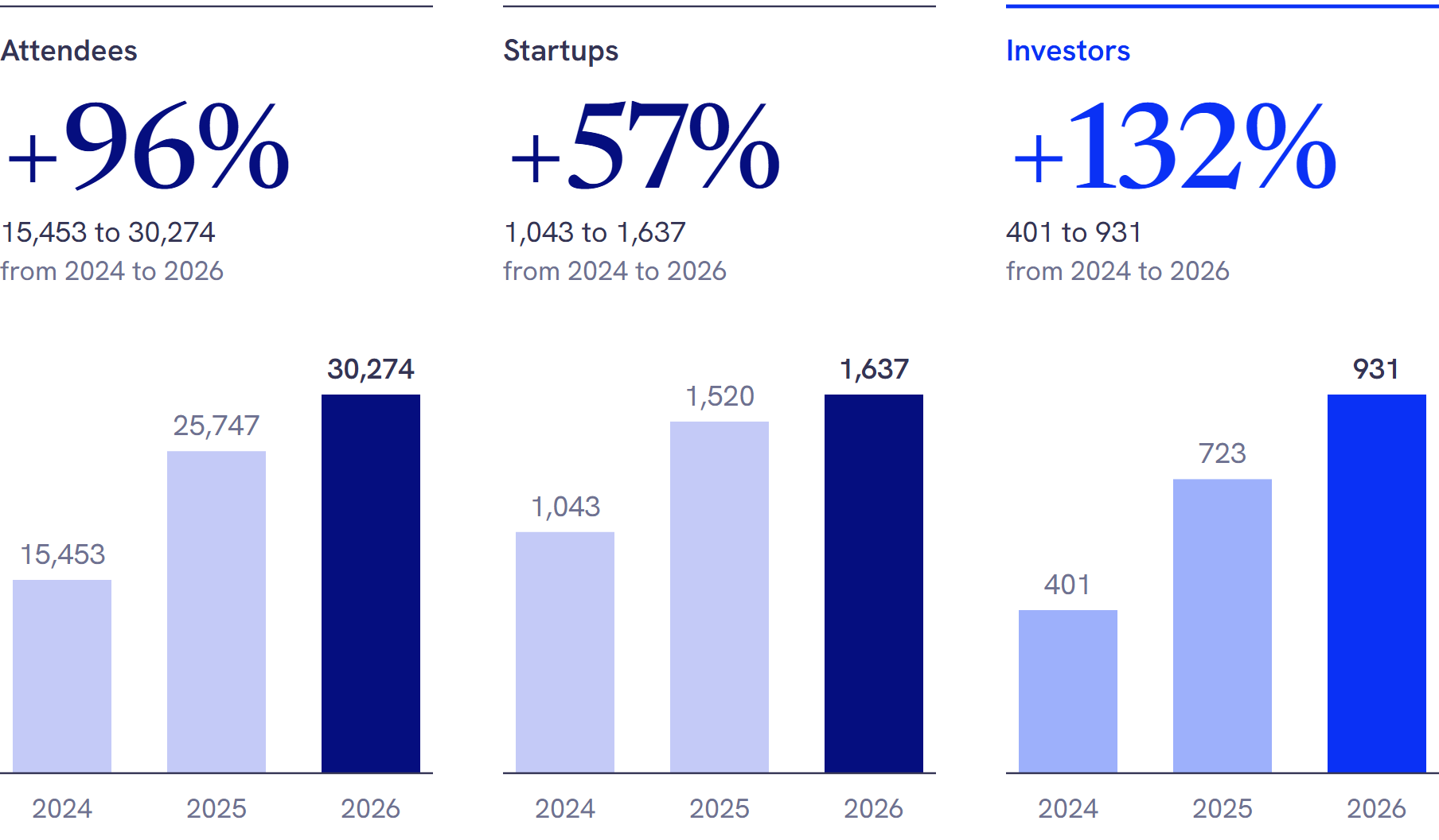
Note: 2024 and 2025 are final counts published after each edition; 2026 counts were published on the opening day of the event. Each panel has its own scale. Growth is from 2024 to 2026.
Source: Qatar Tribune, February 29, 2024, and February 2, 2026; The Peninsula, August 15, 2025; Reeve Hayward analysis
Where the capital is coming from: Four channels that widened in two years
Equity for companies in Qatar now reaches them through four channels that have each grown since 2024: sovereign money that backs venture funds, development capital that invests directly, private and international funds, and a wave of companies arriving from abroad. Each changes who a founder or owner is likely to meet, and what that investor will expect.
Sovereign capital that backs funds rather than companies
QIA’s Fund of Funds program does not invest in companies itself. It commits capital to venture capital funds, and it was launched with $1 billion; and by February 2025 nearly $500 million had been invested across six venture capital firms.7 A year later, at Web Summit Qatar 2026, the Prime Minister announced that the initial commitment had drawn 12 major venture capital firms to Doha and that the program would grow by a further $2 billion (Exhibit 2).4 By November 2026 it was described as a $3 billion program, and Invest Qatar had launched a venture capital funding module on its Invest Qatar Gateway, developed with QIA, to connect startups with participating funds, many of them backed by the program.8
The effect is to put more investment committees within reach of Qatari companies. A fund with a team in Doha has a reason to look at local deals, and a company can meet its partners without travelling abroad. It also means more competition among companies for each fund’s attention, since every one of those funds sees deals from across the region.
Exhibit 2
QIA’s Fund of Funds has tripled in size, and the venture firms it backs have doubled.
QIA Fund of Funds program, size and venture capital firms backed, 2025–26, $ billion and number of firms
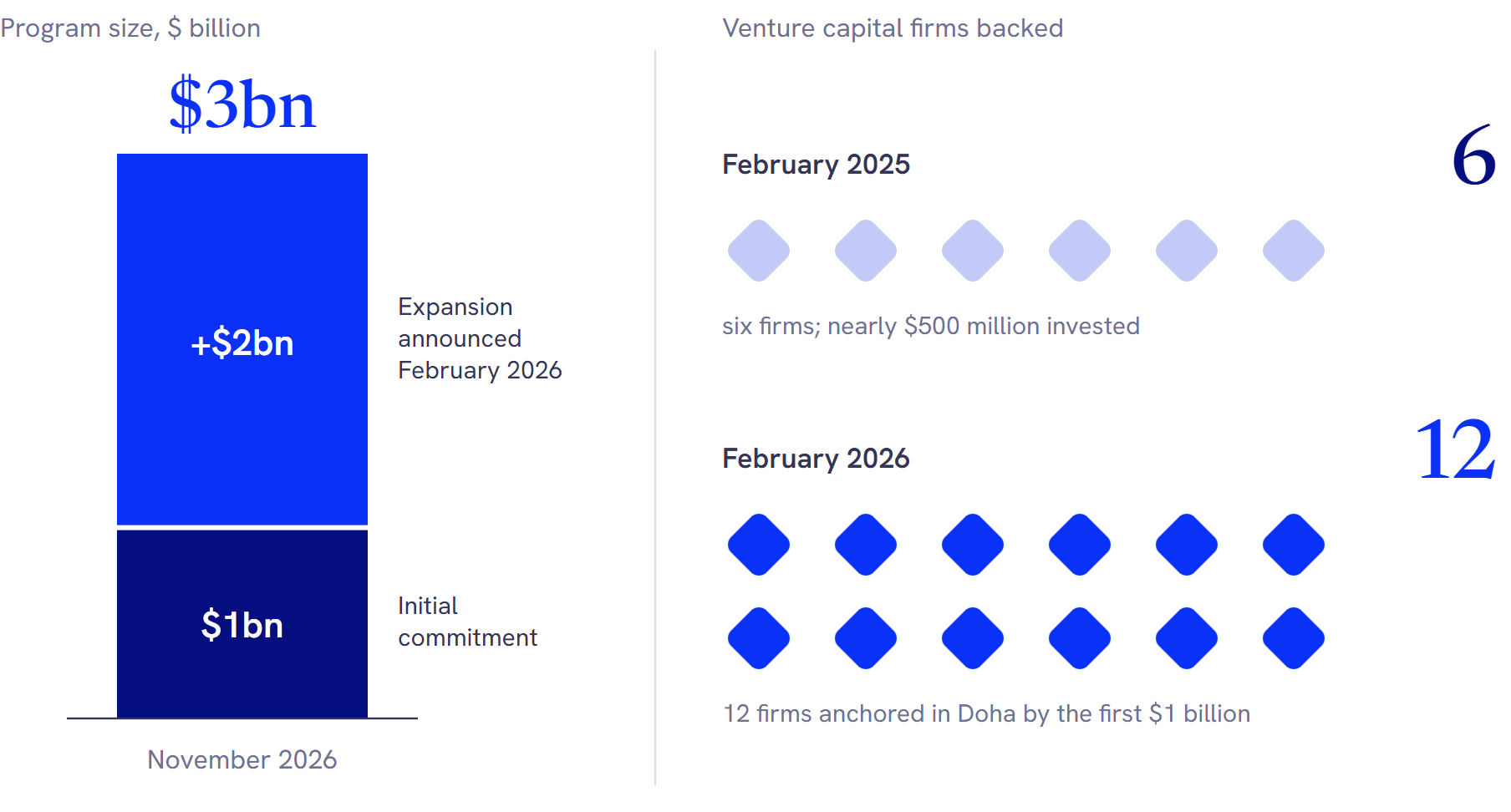
Note: The six firms and nearly $500 million invested are as of February 2025. The 12 firms anchored in Doha by the initial $1 billion and the $2 billion expansion were announced at Web Summit Qatar in February 2026. The $3 billion total is as described in November 2026.
Source: The Peninsula, April 11, 2025, February 2, 2026, and November 13, 2026
Development capital that invests directly
QDB invests directly through the Startup Qatar Investment Program. At its launch in February 2024, the program offered up to QAR 1.8 million for startups setting up in Qatar and up to QAR 18 million for established global startups expanding there.9 In 2025 QDB raised the limits to QAR 4 million for companies at the start stage and QAR 20 million at the expansion stage, and by the end of the year the program had invested more than QAR 138 million in more than 35 local and international companies (Exhibit 3).6 By August 2026 it had invested in more than 40 startups from 15 countries, against a target portfolio of QAR 1 billion by 2030.10 QDB’s investment arm took part in 11 of the 33 venture deals recorded in Qatar in 2025, more than any other investor,5 and its direct and indirect investment commitments grew 16% in 2025 to more than QAR 350 million.6
The program is growing quickly. At Web Summit Qatar 2026 the Prime Minister announced an eightfold increase in QDB’s startup program for 2026, after a year in which, he said, startup registrations doubled and applications exceeded 6,000.4 The ratio in Exhibit 3 is the point for founders: even a development investor with a national mandate backs a small share of the companies that apply.
Exhibit 3
QDB’s startup program backs a small share of applicants, while its maximum tickets have grown.
Startup Qatar Investment Program, applications, investments, and maximum tickets, 2024–25, number and QAR million
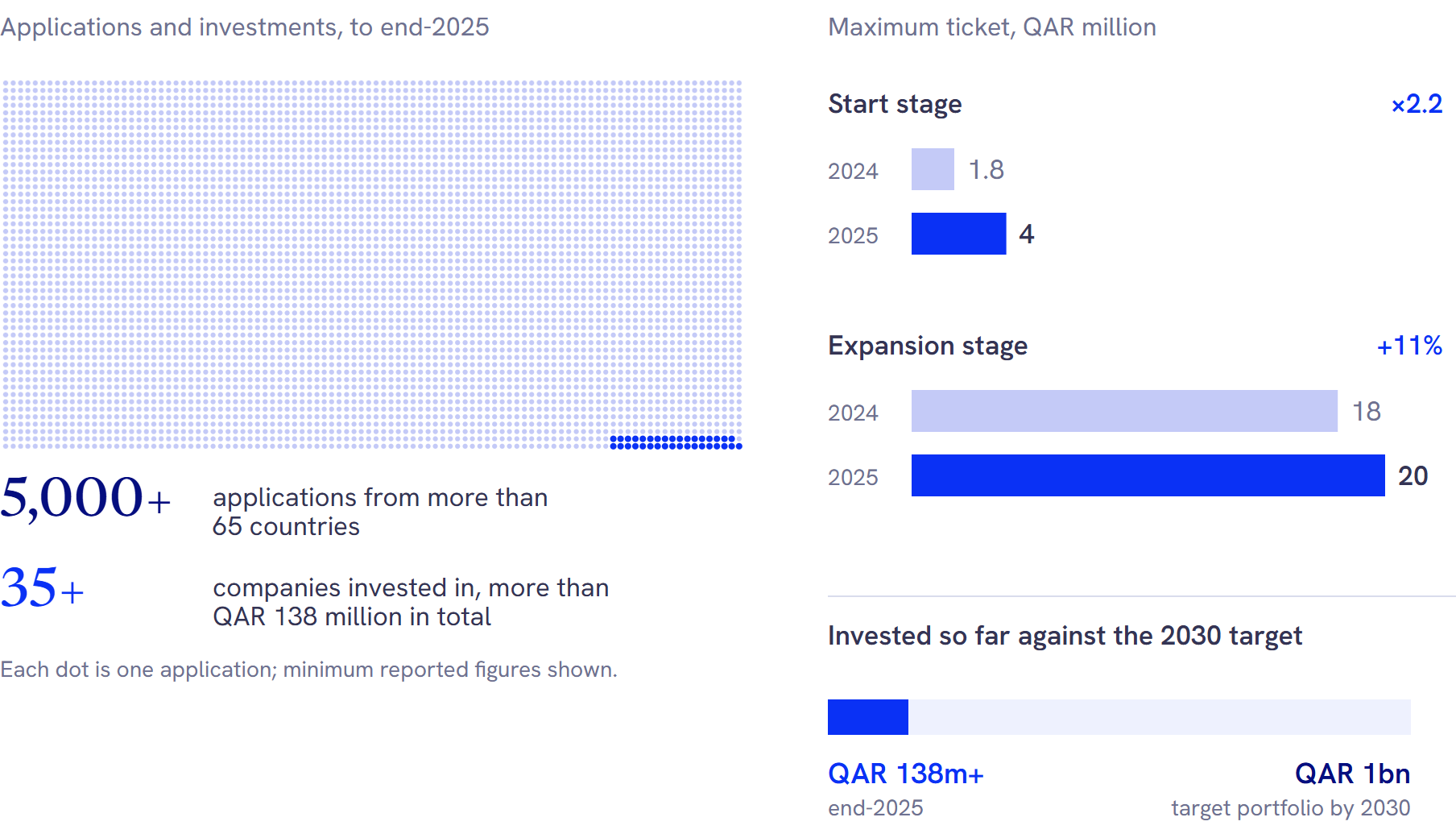
Note: 2024 tickets are the launch terms: up to QAR 1.8 million for startups setting up in Qatar and QAR 18 million for established global startups expanding there. 2025 tickets are the raised limits for the start and expansion stages. Applications and investments are cumulative to the end of 2025 and are shown at their minimum reported values; by August 2026 the program had invested in more than 40 startups from 15 countries.
Source: Qatar Tribune, February 23, 2024, January 5, 2026, and August 6, 2026; Reeve Hayward analysis
Private and international funds, concentrated in early rounds
Private money now leads the market. Private and international investors supplied 86% of the value of venture deals in Qatar in 2025, and Qatar ranked fourth in the Middle East and North Africa (MENA) by both deal count and value, with 5% of the region’s deals.5 The market is still young: pre-seed and seed rounds made up 93% of the 33 deals, early-stage deals accounted for 61% of funding, and fintech was the most active sector, with 33% of deals.5 Transport and logistics raised the most money, QAR 80 million, from a small number of large transactions.5
For a company beyond its first rounds, that profile matters. A growth round of several million dollars is a larger decision than most local deals, and it is likely to involve a regional or international fund, possibly one backed by the Fund of Funds, with its own committee and its own diligence list.
Companies arriving from abroad
The fourth channel brings both competition and partners. The Ministry of Commerce and Industry (MOCI) reported 12,449 non-Qatari companies established in Qatar in 2025, seven times the number in 2024.11 The pace has continued: 5,272 were established in the second quarter of 2026, 81% more than the 2,911 of a year earlier (Exhibit 4).12,13 About 28,000 commercial registrations were issued in 2025, up 57% on 2024,14 and 6,328 new registrations in the first quarter of 2026 were 18.5% more than a year earlier.15 The ministry has cut the time needed to establish a company to two days.16
For a Qatari company, the new arrivals are potential customers, partners, and acquirers. They are also rivals for the same funds, which is one more reason to arrive at a meeting prepared.
Exhibit 4
Non-Qatari companies set up in Qatar in the second quarter of 2026 were 81% more than a year earlier.
Non-Qatari companies established in Qatar, by quarter, 2025–26, number
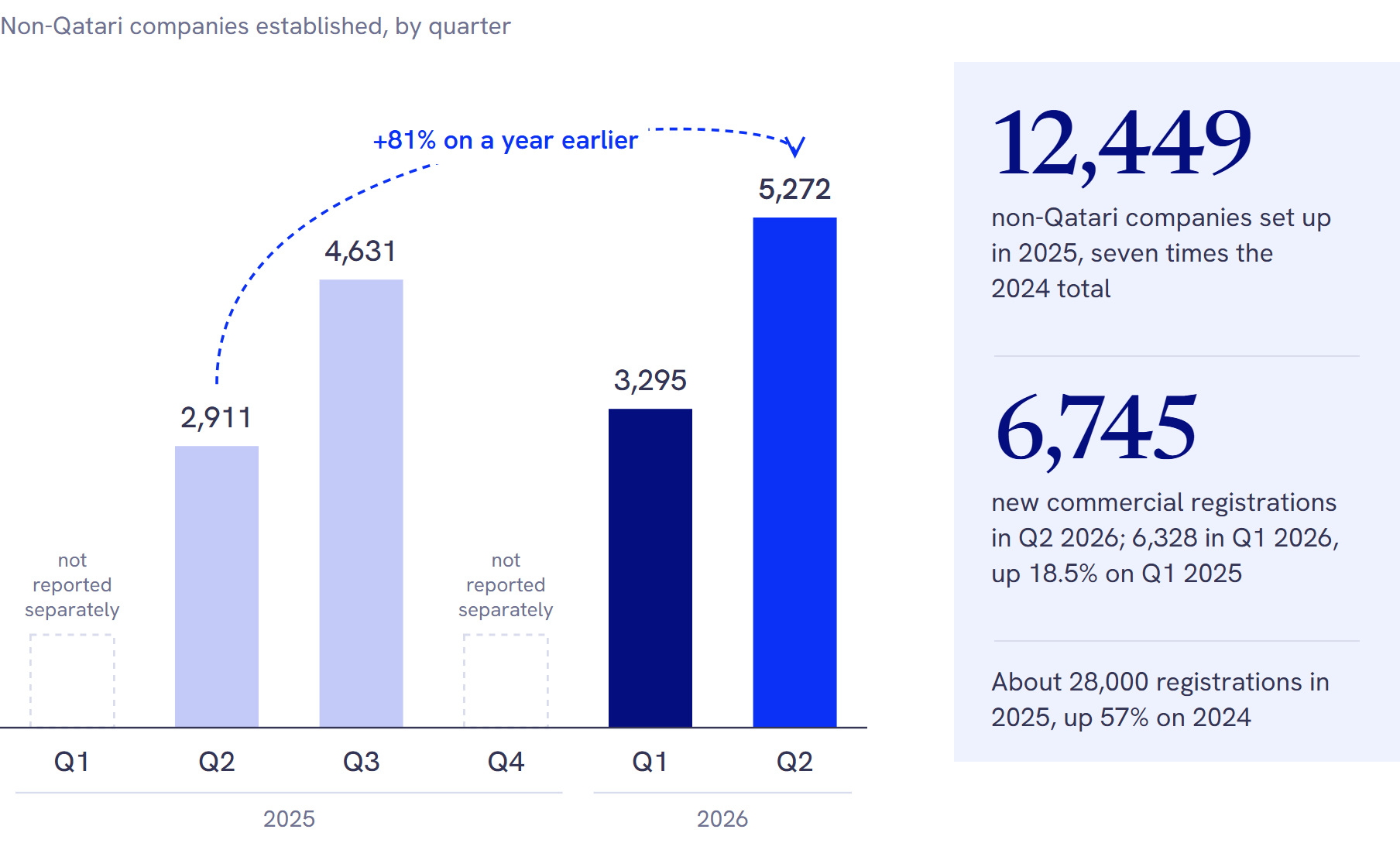
Note: The Ministry of Commerce and Industry did not report the first and fourth quarters of 2025 separately; together they account for 4,907 of the 12,449 companies established in 2025. “Seven times” restates the ministry’s 600% growth on 2024.
Source: Ministry of Commerce and Industry, as reported by The Peninsula, July 21 and October 29, 2025, and February 18, May 24, and September 1, 2026; Reeve Hayward analysis
×2.3
Growth in investors at Web Summit Qatar from 2024 to 2026, from 401 to 931
$3bn
Size of QIA’s Fund of Funds program after the $2 billion expansion announced in February 2026
12,449
Non-Qatari companies established in Qatar in 2025
What the 2030 targets imply: Room for many more deals
The national targets point in one direction. The Third National Development Strategy (NDS3) for 2024 to 2030 sets three targets for startup finance by 2030: startup funding equal to 0.1% of gross domestic product (GDP), 70 investment deals in startups, and 70% of venture funding from the private sector. It also commits to a new national fund of funds to bring investors into risk capital.17
Translated into riyals, the first target is substantial. Qatar’s GDP at current prices was QAR 785.3 billion in 2025, on the National Planning Council’s quarterly estimates,18 so 0.1% would be about QAR 785 million a year. The QAR 214 million invested in 2025 was a record and about a quarter of that level, and the 33 deals were a little under half of the 70 targeted.5 On the closest published measure, the 86% of 2025 value that came from private and international investors is already above the private-sector target.5 The distance to the first two targets is the opening for companies: with public programs expanding and private funds arriving, the market has room for more than three times today’s annual investment.
QAR 785m
A year: the NDS3 target of startup funding equal to 0.1% of GDP, at 2025 GDP
70
Investment deals in startups targeted for 2030
70%
Share of venture funding from the private sector targeted for 2030
How investors decide: Five stages, one sequence
Investors differ in style, but their review follows a familiar path. Guidance from the US Small Business Administration (SBA) sets out the sequence. A company looks for individual “angel” investors or venture capital firms with a good reputation and experience of startup companies. The investor reviews the business plan against its own criteria, because most funds concentrate on one industry, region, or stage of development. It then examines the management team, the market, the products and services, the corporate governance documents, and the financial statements. If it wants to invest, the two sides agree a term sheet setting out the terms, and further rounds follow as the company meets its milestones, with the price adjusted as the plan is delivered (Exhibit 5).19
Venture capital is different from a loan in three ways the SBA highlights: it takes equity rather than debt, it accepts higher risk in exchange for the chance of higher returns, and it holds for longer than traditional financing. Almost all venture capitalists will want at least a seat on the board, so owners should expect to give up some control as well as some ownership.19 In our experience, for a family-owned or founder-led company in the Gulf, that last point often needs more preparation than the numbers.
Exhibit 5
An investor’s review runs through five stages, and each calls for material a company can prepare in advance.
Stages of an equity investment review, what the investor checks and what to have ready
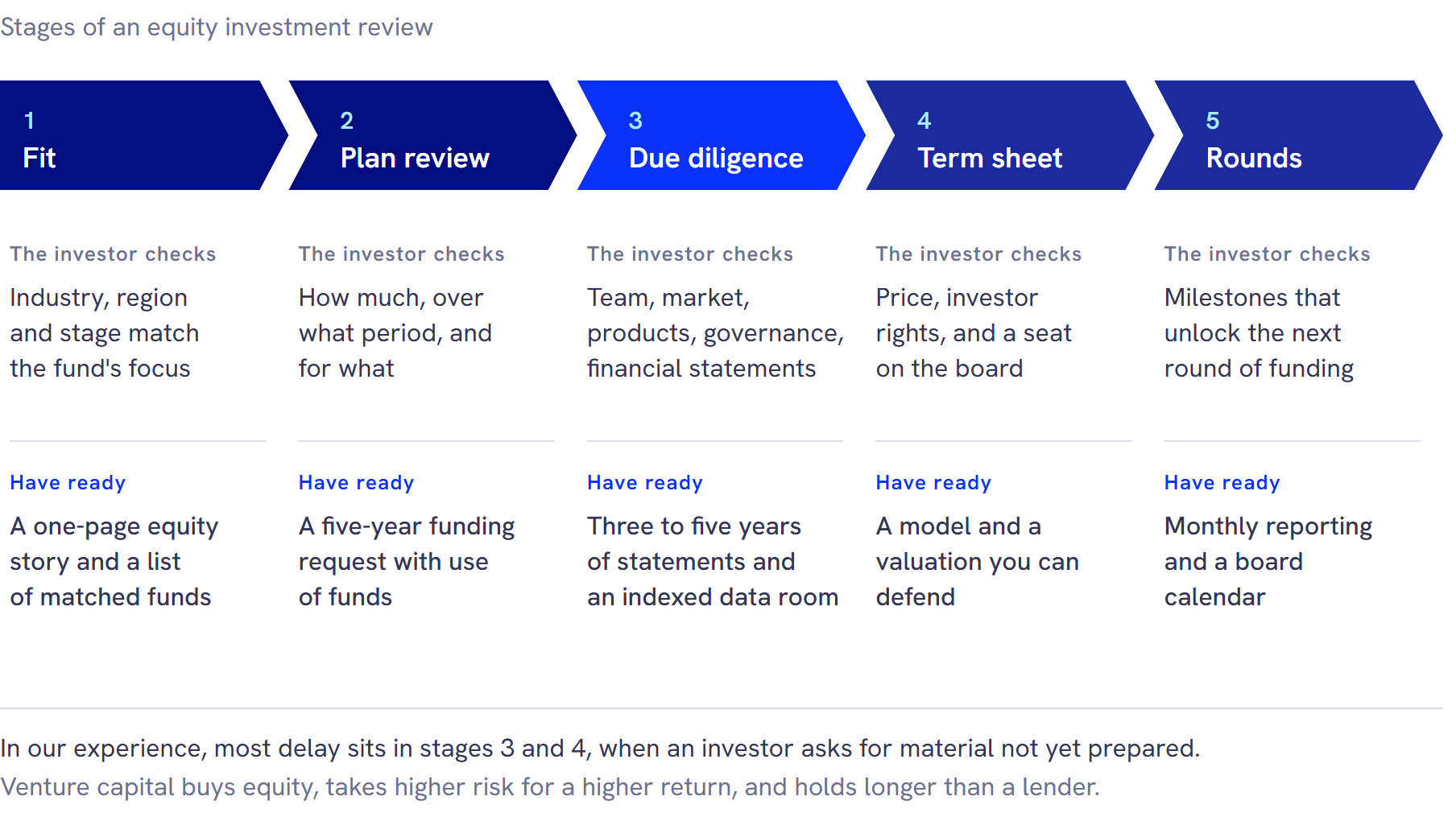
Note: Stages and the investor’s checks follow the SBA’s description of the venture capital process; “Have ready” and the line on delays are our summary and experience.
Source: US Small Business Administration, “Plan your business”; Reeve Hayward analysis
The numbers an investor will ask for
The financial record an investor expects is specific. The SBA’s guidance on a funding request asks a company to state how much it needs over the next five years and what it will use the money for, whether it wants debt or equity, and on what terms. An established business should include income statements, balance sheets, and cash flow statements for the last three to five years. The projections should cover the next five years, with forecast income statements, balance sheets, cash flow statements, and capital expenditure budgets, and should be quarterly or even monthly for the first year. Above all, the projections should match the funding request (Exhibit 6).19
Two things follow. A company that keeps monthly management accounts can produce the first projected year from its own records, which makes the forecast easier to defend. And a model that links the use of funds to the cash flow forecast lets an investor change one assumption and see its effect on cash.
Exhibit 6
Investors expect up to five years of history and five years of projections, with the first year in monthly detail.
Financial statements an investor typically asks for, by year before and after the funding request
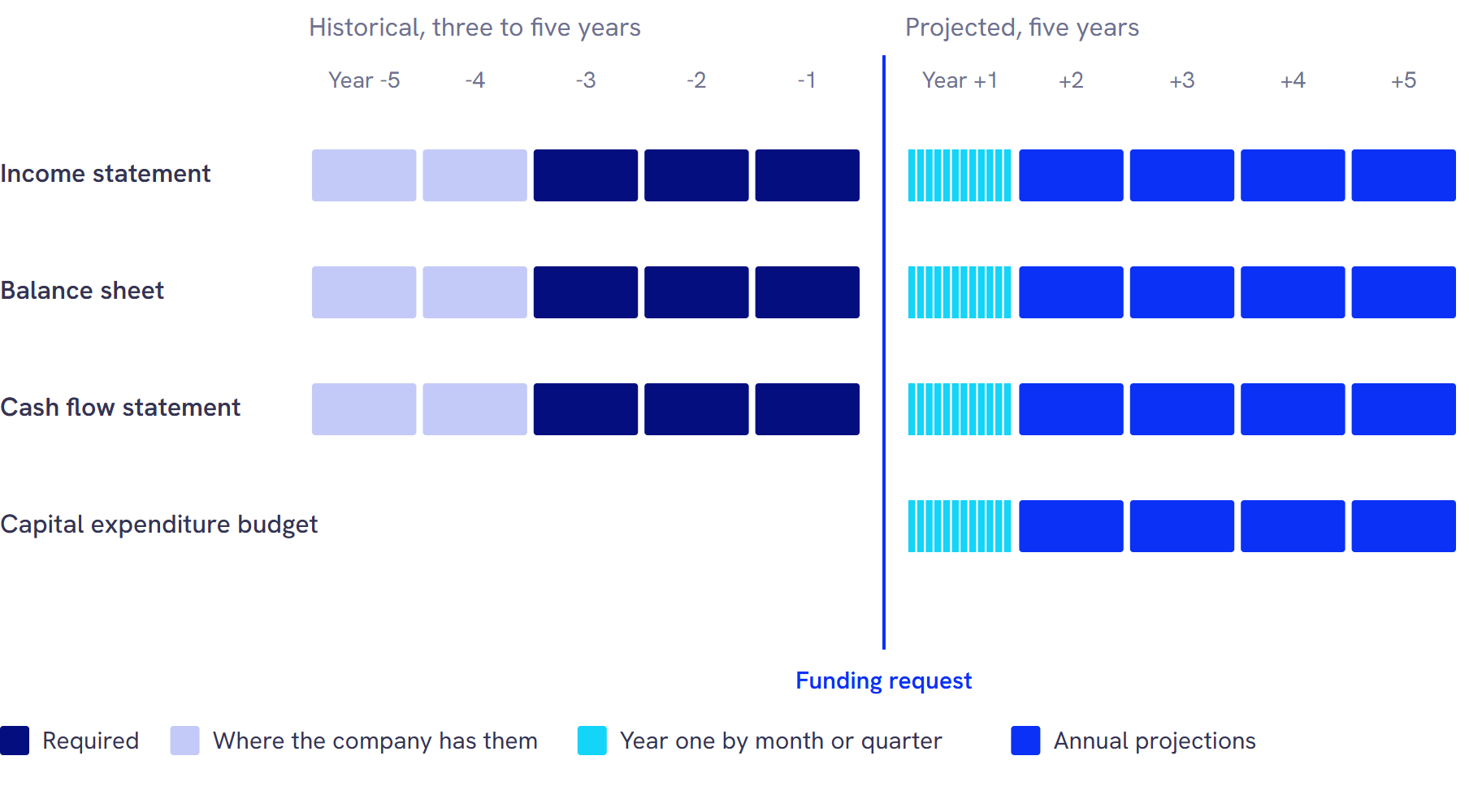
Note: The SBA asks established businesses for the last three to five years of statements and for five-year projections, quarterly or monthly for the first year. Our drawing shows three years as required and the fourth and fifth where available.
Source: US Small Business Administration, “Plan your business”; Reeve Hayward analysis
Five things to prepare before the first meeting
In our experience with Qatari companies, most time is lost at the due diligence and term sheet stages, when an investor asks for material that has not yet been prepared. The gap is rarely the idea. It is the evidence behind it. We have identified five areas where preparation shortens the path from first meeting to term sheet, and in each one readiness moves through the same three levels (Exhibit 7).
Exhibit 7
A company is ready for a term sheet when all five areas reach the right-hand column.
Investor readiness by area, three levels
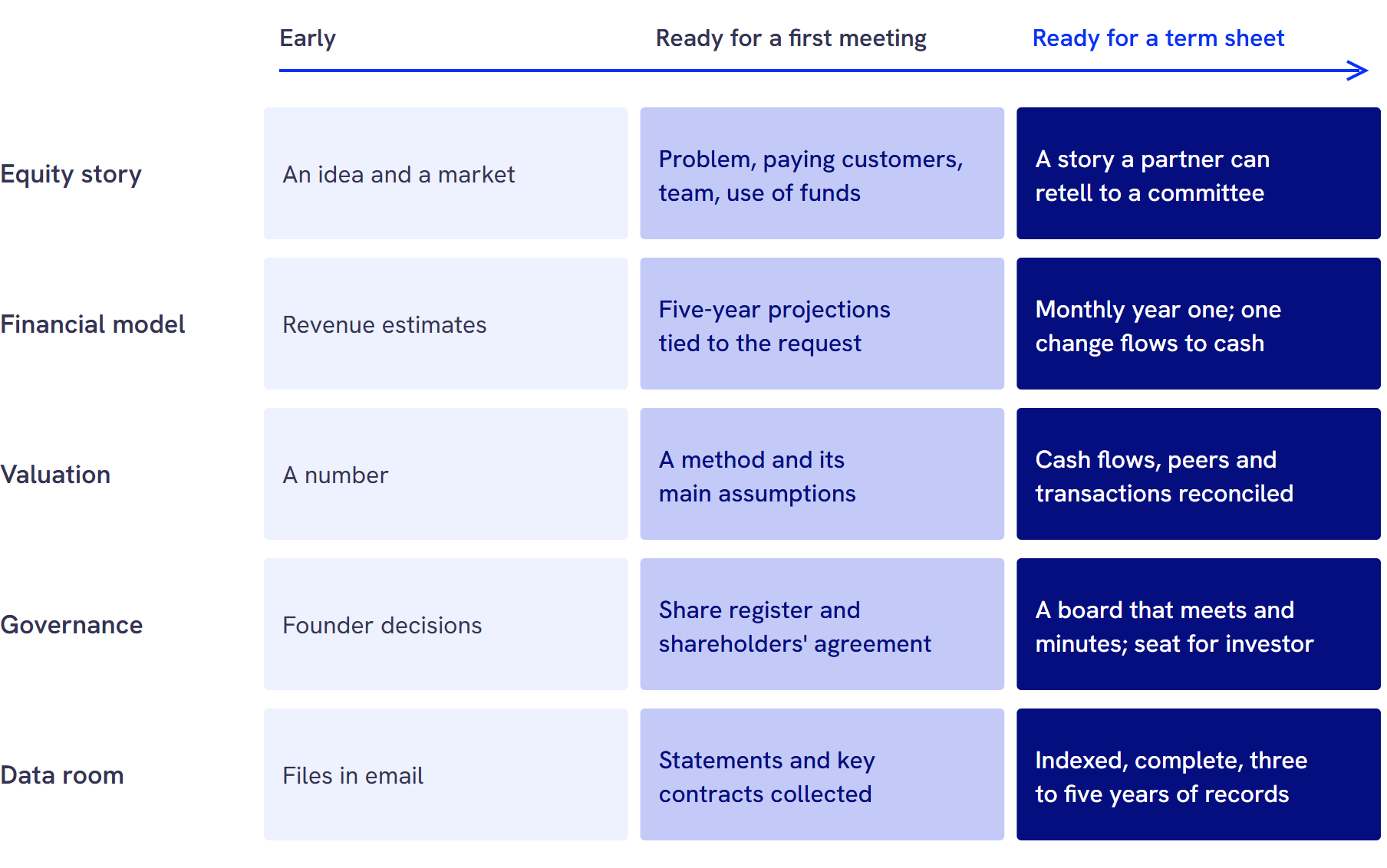
Note: Our framework, built on the review stages in Exhibit 5.
Source: Reeve Hayward analysis; US Small Business Administration
1. Write an equity story an investor can repeat
An investment committee hears about a company second-hand, from the partner who met the founders. The story has to survive that retelling: the problem, the customers who pay to solve it, why this team, and what the money will achieve and by when. Because funds focus by industry, region, and stage,19 the story should also say plainly where the company sits on each, so that the fund can see the fit before the first meeting ends.
2. Build a model that matches the funding request
The model is the funding request in numbers. It should carry five years of projected statements and capital expenditure, monthly or quarterly detail for the first year, and a use of funds that ties to the cash flow forecast.19 A model built this way answers the questions a committee asks before it asks them. A model that cannot show where the cash goes invites harder questions on price.
3. Arrive with a valuation you can defend
The price is negotiated, but the method should not be. A company that can show how its figure was reached—cash flows, comparable companies, and recent transactions—keeps the discussion on assumptions rather than on a number. Our capital and debt advisory work starts here: the model, the valuation, and the investor materials that support them.
4. Put governance in order before it is asked for
Corporate governance documents are on every due diligence list.19 For a family-owned or founder-led company in the Gulf, that usually means a clean share register, a shareholders’ agreement, clear signing authority, and a board that meets and minutes its decisions. Because almost all venture investors expect a board seat,19 it helps to decide in advance how the board will work with an outside member, what information it will receive, and how often.
5. Open the data room before the term sheet
Due diligence moves at the speed of the slowest document. Three to five years of financial statements,19 key contracts, licenses, and employment records, filed and indexed, let an investor test the case quickly. They also signal how the company will report after the money arrives, when later rounds depend on milestones being met.19
What this means for companies in Qatar
- Match the investor to the stage. With 93% of Qatar’s 2025 deals at pre-seed and seed,5 a company raising a larger growth round should look at both local and international funds, including those backed by the Fund of Funds, and should check each fund’s focus before it asks for a meeting.
- Use the public programs to prepare. Road to Web Summit Qatar 2027, launched by Invest Qatar in November 2026, is a two-day bootcamp for 10 to 15 startups from Qatar’s national innovation programs, covering pitch development, go-to-market strategy, media readiness, and investor meeting planning.8 The funding module on the Invest Qatar Gateway connects startups with participating funds.8
- Plan the raise around the calendar. Web Summit Qatar brought 931 investors to Doha in February 2026.3 A company that has its model, valuation, and data room ready before the next edition can turn meetings there into diligence rather than introductions.
- Prepare for a board as well as the money. Once a venture fund invests, it becomes actively involved in the company.19 Agreeing the reporting pack and the board calendar early makes the first months after closing smoother.
- Prepare once, raise many times. A model, a valuation, and a data room built for the first round can be updated for each later round rather than rebuilt.
The gap is rarely the idea. It is the evidence behind it.
In two years, Qatar has gained a deeper pool of investors: more of them at its largest technology event, a sovereign program that has drawn venture funds to Doha, a development bank writing larger tickets, and record venture investment in 2025. The 2030 targets point to more than three times today’s annual investment. The companies that raise first are likely to be those that have done the investor’s homework for them: a clear story, a working model, a defensible price, sound governance, and a data room ready to open.
About this article
This article draws on attendance figures for Web Summit Qatar, program figures for QIA and QDB, and company formation figures from the Ministry of Commerce and Industry, as reported by Qatar Tribune and The Peninsula; the 2030 targets in the National Planning Council’s Third National Development Strategy; the Council’s quarterly GDP estimates on the Qatar Open Data Portal, published under a CC BY 4.0 licence; and the US Small Business Administration’s published guidance on the venture capital process. The 2025 venture figures come from QDB’s annual venture capital report as reported by Qatar Tribune and are quoted as single figures. Growth rates, the riyal value of the GDP target, and the comparisons with the 2030 targets are our calculations. Exhibits 5 to 7 combine the SBA’s description of the process with our own summary and framework. It is for information only and is not investment advice.
Sources
- Qatar Tribune, “Web Summit’s debut in MENA ends on high note,” February 29, 2024.
- The Peninsula, “Organisers outline plans for expanded Web Summit Qatar 2026 with 30,000 attendees,” August 15, 2025.
- Qatar Tribune, “Global capital gathers in Doha as Web Summit Qatar hits record scale,” February 2, 2026.
- The Peninsula, “PM unveils $2bn boost for tech startups at Web Summit 2026,” February 2, 2026.
- Qatar Tribune, “Qatar VC investments surge 81% to record QR214 mn in 2025: QDB,” February 2, 2026.
- Qatar Tribune, “QDB records exceptional year in empowering private sector,” January 5, 2026.
- The Peninsula, “Strategic transactions drive economic diversification and growth in Qatar,” April 11, 2025.
- The Peninsula, “Startup Qatar unveils new programme to strengthen startup readiness,” November 13, 2026.
- Qatar Tribune, “QDB launches new investment programme to fund tech startups,” February 23, 2024.
- Qatar Tribune, “QDB invests in AI unicorn Multiverse Computing,” August 6, 2026.
- The Peninsula, “Over 12,400 non-Qatari companies registered in 2025, up 600%,” February 18, 2026.
- The Peninsula, “Over 2,900 non-Qatari companies established in Q2 2025: MoCI,” July 21, 2025.
- The Peninsula, “Qatar registers strong performance across digital transformation, consumer protection,” September 1, 2026.
- The Peninsula, “Meeting reviews MoCI’s key achievements, qualitative initiatives in fourth quarter of 2025,” February 18, 2026.
- The Peninsula, “Qatar attracts over 3,290 non-Qatari companies in Q1,” May 24, 2026.
- The Peninsula, “Commercial registrations increase by 81.5% in Q3,” October 29, 2025.
- National Planning Council, Third National Development Strategy 2024–2030, accessed November 21, 2026.
- National Planning Council, “Estimates of Quarterly Gross Domestic Product by Economic Activities at Current Prices,” Qatar Open Data Portal (data.gov.qa), CC BY 4.0, accessed November 21, 2026.
- US Small Business Administration, “Plan your business,” including “Fund your business,” public domain, accessed November 19, 2026.
To discuss what this means for your business, speak with our team. Initial conversations are confidential and without obligation.
Speak with our team


