

Saudi Arabia, the UAE and Qatar are all spending on semiconductors, and one flagship fab plan has already been shelved. The better odds lie in design, packaging and integration.
The Gulf will not build a leading-edge chip fab this decade, and the more useful question is where it can build anything else. In April 2026, Alat, the Public Investment Fund company set up with $100 billion to make Saudi Arabia an electronics manufacturing base, dropped its plans to invest in semiconductor production after its attempts to invest in chipmakers and secure chip plants failed against competition from other countries.1 Yet the design, packaging, and integration ends of the industry remain open, and that is where most of the revenue sits. Among the 318 listed semiconductor and equipment companies that McKinsey tracks, fabless design companies earned 34% of 2024 revenue, foundries 12%, and packaging and test companies 5% (Exhibit 1).2 On a value-added basis, the Semiconductor Industry Association (SIA) and Boston Consulting Group (BCG) put design at 56% of the industry total in 2022, wafer fabrication at 19%, and assembly, test, and packaging at 6%.3
The three Gulf states are pursuing that opening in different ways. Saudi Arabia’s National Semiconductor Hub is recruiting fabless design companies. The United Arab Emirates has won a dedicated US export-control status and is setting up a chiplet design and assembly facility. Qatar has brought the Belgian research center imec to Doha and placed Qatar Investment Authority (QIA) capital in chip and equipment companies abroad. This article looks at why the fab is the hardest step, what each state is doing, how US export rules set the terms, and where the realistic openings are.
Exhibit 1
Fabless chip designers earned a third of the industry’s revenue in 2024; packaging and test companies a twentieth.
Revenue of 318 listed semiconductor and capital equipment companies by value-chain segment, FY2024, % of $1,000 billion
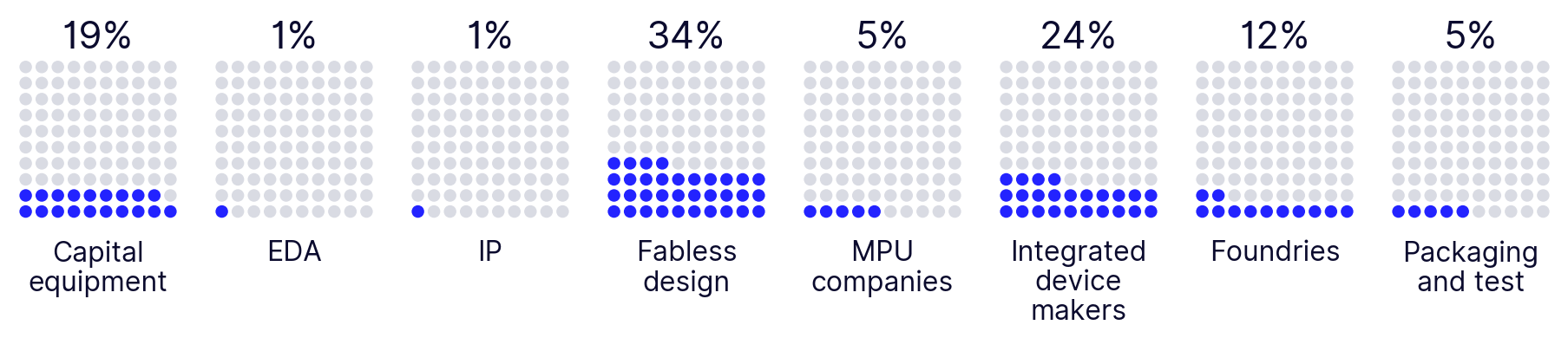
Note: Listed companies only; Apple, Samsung Electronics, Nikon, Toshiba, Fujitsu, Sony, and Fuji are excluded. Integrated device makers design and manufacture their own chips, mostly memory and analog. EDA is design software; IP is licensed design blocks. Shares are rounded and sum to 101.
Source: McKinsey & Company, “Perspectives on value creation in semiconductors,” second quarter 2025, based on company reports and Capital IQ; Reeve Hayward analysis
Why the fab is the hardest step
A fab is the most capital-intensive point in the chain. In 2021 SIA and BCG put the cost of a state-of-the-art fab of standard capacity at roughly $5 billion for advanced analog chips to $20 billion for advanced logic and memory, and estimated that wafer fabrication absorbed about 65% of the industry’s capital expenditure while producing about a fifth of its value added.4 Their 2024 update projects about $2.3 trillion of private investment in wafer fabrication between 2024 and 2032, against $720 billion in the ten years before the US CHIPS Act.3 Real projects run higher. TSMC budgeted about $40 billion for its first two Arizona fabs in December 2022, and in March 2025 raised its planned US investment to $165 billion for three more fabs, two advanced packaging plants, and a research center.5, 6
Capital is only the entry ticket. By installed capacity in 2024, China held 27% of wafer fabrication, Taiwan 18%, and South Korea 16%, and companies headquartered in Taiwan and South Korea lead fabrication at advanced nodes below 10 nanometers.3, 7 A new entrant also competes with incentive programs in the United States, Europe, Japan, and India for the same equipment, engineers, and anchor customers. That is the competition Alat ran into, and its retreat is a useful precedent: capital alone, even $100 billion of it, does not secure a fab.1
The prize, meanwhile, has grown. World Semiconductor Trade Statistics (WSTS) raised its forecast in June 2026 and now expects the global market to grow 90% to $1.51 trillion in 2026, led by a memory segment forecast to rise about 250% to more than $800 billion on demand for AI infrastructure, with a further 27% of growth to about $1.9 trillion in 2027.8 The question for the Gulf is how to take part without owning a fab.
$1.51 trillion
Global semiconductor market forecast for 2026, up 90% on 2025 (WSTS, June 2026)
$5–20 billion
Capital cost of one state-of-the-art fab of standard capacity (SIA and BCG, 2021 estimate)
35,000
Nvidia GB300-class chips each that G42 and HUMAIN were approved to buy in November 2025
What each Gulf state is actually doing
Three distinct strategies stand out (Exhibit 2).
Saudi Arabia is betting on design. The National Semiconductor Hub, launched in June 2024 under the Research, Development and Innovation Authority, set out to establish at least 50 chip design companies in the kingdom by 2030, train 5,000 design engineers, and back the effort with a deep-tech venture fund of more than SAR 1 billion, about $266 million.9 Its first cohort drew 64 applications, all from US companies, and accepted 16 against an original aim of five, with about $2 million per company in operating capital through to tape-out.10 Japan’s EdgeCortix was among the companies selected to open in Riyadh in early 2025,11 and in July 2025 King Abdulaziz City for Science and Technology reported 25 chips designed and produced for training and research with students from four Saudi universities.12 The hub was unaffected by Alat’s retreat, because it never depended on a fab.
The UAE is betting on access and assembly. Mubadala has owned GlobalFoundries since 2009 and still holds about 73% after selling shares in May 2026.13 At home, Tawazun Council signed an agreement with Lockheed Martin in May 2026 to set up a chiplet design and microelectronics assembly facility in Abu Dhabi, with EDGE Group and Khalifa University as implementation partners; it starts with design, assembly, and applied research, and no completion date or investment value has been published.14 Mastiska, founded in 2024 with its model team in Abu Dhabi, closed a $10 million seed round in November 2025, backed mainly by GCC sovereign funds, to develop inference accelerators as a fabless company.15
Qatar is betting on research and on stakes in the global chain. imec, the Belgian nanoelectronics research center, agreed in November 2025 to open a regional research hub at Qatar Science and Technology Park, supported by Invest Qatar and the Qatar Research, Development and Innovation Council, with about 100 staff targeted by 2030 and a focus on chip design, silicon photonics, 3D integration, and AI-assisted design of custom chips.16 QIA took a strategic stake in the US inference-chip company Positron in its $230 million Series B, announced at Web Summit Qatar in February 2026 at a valuation above $1 billion,17 joined the $380 million round that valued the Dutch chip-metrology company Nearfield Instruments at $1.6 billion in June 2026,18 and had earlier anchored Ardian’s semiconductor fund and taken a minority stake in Japan’s Kokusai Electric.19 None of these produces a Qatari chip. Together they place Qatari capital at the design, equipment, and research points of the chain, where value added is highest.
Exhibit 2
The Gulf’s live semiconductor programs sit in design, assembly, research, and equity stakes; the one fab program has been shelved.
| Country | Program | Point in the chain | Position at October 2026 |
|---|---|---|---|
| Saudi Arabia | National Semiconductor Hub (RDIA) | Fabless design | 50 design companies and 5,000 engineers targeted by 2030; first cohort of 16 from 64 applicants. |
| Saudi Arabia | KACST Saudi Semiconductors Program | Design and research | 25 training and research chips produced with four universities, July 2025. |
| Saudi Arabia | Alat semiconductor unit (PIF) | Fabrication | Chip production plans dropped, April 2026; resources moved to data centers. |
| UAE | Tawazun, EDGE, Khalifa University, and Lockheed Martin | Chiplet design and assembly | Agreement signed May 2026 for an Abu Dhabi facility; no completion date published. |
| UAE | Mubadala stake in GlobalFoundries | Fabrication, abroad | About 73% owned after a share sale in May 2026. |
| UAE | Mastiska | Fabless design | $10 million seed round, November 2025, mainly from GCC sovereign funds. |
| Qatar | imec regional hub, QSTP | Research and design | Agreed November 2025; about 100 staff targeted by 2030. |
| Qatar | QIA stakes | Design and equipment, abroad | Positron ($230 million round, 2026), Nearfield Instruments ($380 million round, 2026), Ardian Semiconductor, Kokusai Electric. |
Note: Programs with a public commitment or transaction since 2024. Talks with foundries that have not produced an agreement are excluded. QIA’s investment sizes are not disclosed; the figures are the size of each round.
Source: Semafor, April 2026; Arab News, June 2024; EE Times, February 2025; Asharq Al-Awsat, July 2025; AGBI, May 2026; Zawya, May 2026; Wamda, November 2025; Qatar News Agency, November 2025 and June 2026; Positron AI, February 2026; Ardian, May 2024; Reeve Hayward analysis
Export controls set the terms
For AI chips, the binding constraint is the US export license rather than Gulf capital. On November 19, 2025, the US Department of Commerce authorized exports of advanced chips to G42 in the UAE and HUMAIN in Saudi Arabia, each approved to buy the equivalent of up to 35,000 Nvidia GB300 chips, conditioned on security and reporting requirements that the Bureau of Industry and Security (BIS) monitors.20 HUMAIN announced the same day that it had agreed to purchase 600,000 Nvidia chips,21 is targeting 200 megawatts of Qualcomm AI200 and AI250 systems from 2026,22 and hosts Groq’s Dammam data center, which Saudi Arabia committed $1.5 billion to expand in February 2025.23
In July 2026 the two countries’ positions diverged. BIS moved the UAE from Country Groups D:3 and D:4 to Country Group A:5 and created a list of approved entities, including UAE government agencies and two UAE AI companies, that can receive advanced computing items without a license; the two companies’ approval expires 270 days after the rule took effect on July 10, 2026, unless BIS extends it.24 Saudi Arabia has no equivalent rule, and HUMAIN continues to buy under case-by-case authorizations.20, 24
Capital alone, even $100 billion of it, does not secure a fab.
Two implications follow. A Gulf chip company designing for the region’s AI build-out has a customer base that is large and, in Saudi Arabia, still short of licensed supply. And any design that depends on leading-edge foundry capacity and the most advanced memory runs through the same licensing process as the GPUs it would replace, so a design built on older nodes and standard memory has a shorter path to a product.
Where the odds are better
Reading the value chain against the Gulf’s constraints points to four openings. Fabless design for AI inference takes the largest share of industry revenue with little physical capital, and the region’s data centers are a captive customer.2 Assembly, packaging, and test is a small share of value but capital- and labor-intensive, and in 2024 China and Taiwan held 28 and 20% of its installed capacity, so buyers value a second location.7 System integration, from racks to cooling, is built near the customer, and HUMAIN’s approved purchases set the demand. Research and equity stakes in the global chain, the Qatari route, capture value from equipment and design without a fab.
The same discipline applies as in any capital project, and it is the work we do in strategy consulting in Qatar: start from the customer, size the ask against the value chain, and treat licensing as a design input.
- Start from a customer, not a cleanroom. The programs that have moved all have a buyer in view: HUMAIN for inference hardware, EDGE for chiplets in guidance systems, Jump Trading as a customer before it co-led Positron’s round. A design plan without a named first customer is a research project.
- Size the ask against the chain. A fabless design company in the hub model needs about $2 million to reach tape-out, on the hub’s own figures;10 a fab needs $5 billion to $20 billion and still has to find customers.4 Capital intensity, not ambition, should decide the entry point.
- Treat export licensing as a design input. Decide early whether the product needs leading-edge foundry capacity and high-bandwidth memory, which route through US licensing, or can be built on older nodes and standard memory. The answer changes the supply chain, the timetable, and the list of buyers.
- Attach to a program rather than compete with it. The hub in Riyadh, the Abu Dhabi chiplet facility, and imec in Doha offer grants, training, or shared tools. For a mid-sized Gulf company, supplying one of them with test services, packaging materials, cooling, or systems assembly is a nearer opportunity than designing a chip.
- Test the plan the way a lender would. Run the case with the first customer delayed, the license refused, and the foundry slot missed. If the project only works when all three go right, it is not yet a project.
Alat’s retreat settled the fab question for now. What remains is a set of smaller, better-matched bets: design teams in Riyadh with a captive AI customer, a chiplet assembly line in Abu Dhabi tied to a defense buyer, and Qatari capital placed in research and equipment where the chain pays most. The Gulf is unlikely to make the world’s chips this decade, but it can own a growing share of how they are designed, packaged, and put to work, and the companies that attach to those programs early will benefit.
About this article
This article draws on public sources checked on October 8, 2026: McKinsey’s second-quarter 2025 review of listed semiconductor companies, with 2024 revenue; SIA and BCG supply-chain studies of 2021 and 2024 and SIA’s 2025 industry report; WSTS forecasts of June 2026; and company, government, and press announcements from June 2024 to July 2026. Program targets are as stated by their sponsors. It is for information only and is not investment advice.
Sources
- Matthew Martin, “Saudi’s Alat removes head, drops chip ambitions,” Semafor, April 8, 2026.
- McKinsey & Company, “Perspectives on value creation in semiconductors,” second quarter 2025 (data as of July 30, 2025; FY2024 revenue of 318 listed companies).
- Semiconductor Industry Association and Boston Consulting Group, “Emerging Resilience in the Semiconductor Supply Chain,” May 2024, Exhibit 2 (value added by activity and region, 2022).
- Semiconductor Industry Association and Boston Consulting Group, “Strengthening the Global Semiconductor Supply Chain in an Uncertain Era,” April 2021, page 18.
- TSMC, “TSMC Announces Updates for TSMC Arizona,” press release, December 6, 2022.
- TSMC, “TSMC Intends to Expand Its Investment in the United States to US$165 Billion,” press release, March 4, 2025.
- Semiconductor Industry Association, “2025 State of the U.S. Semiconductor Industry,” July 2025, page 20 (value added by activity and region, 2024).
- World Semiconductor Trade Statistics, “Global Semiconductor Market Surges Beyond USD 1.5 Trillion in 2026,” Spring 2026 forecast, June 2, 2026.
- Arab News, “Saudi Arabia launches ‘National Semiconductor Hub’ to drive industry localization,” June 5, 2024.
- Nitin Dahad, “Saudi Arabia Chip Hub Aims for First Tapeout in July,” EE Times, February 13, 2025.
- EdgeCortix, “EdgeCortix Selected by Saudi Arabia’s Ministry of Investment to Expand into Riyadh,” press release, February 6, 2025.
- Asharq Al-Awsat, “KACST Manufactures 25 Advanced Electronic Chips by Saudi Talents,” July 25, 2025.
- AGBI, “Mubadala raises $2bn from GlobalFoundries share sale,” May 2026; AGBI, “UAE seeks chip sovereignty with design-only approach,” December 2025.
- Tawazun Council, “Tawazun and Lockheed Martin sign strategic agreement to establish UAE’s chiplet design and assembly facility,” press release via Zawya, May 2026.
- Wamda, “Mastiska closes $10 million seed to advance sovereign silicon for AI compute,” November 27, 2025.
- Qatar News Agency, “Global Semiconductor Leader IMEC to Launch Regional R&D Hub in Qatar by 2026,” November 25, 2025.
- Positron AI, “Positron AI Raises $230 Million Series B at Over $1 Billion Valuation,” press release, February 2026.
- Qatar News Agency via Qatar Tribune, “QIA joins $380 mn Nearfield round,” June 23, 2026.
- Ardian, “QIA announces intent to anchor an investment commitment to Ardian Semiconductor,” press release, May 13, 2024.
- US Department of Commerce, “Statement on UAE and Saudi Chip Exports,” November 19, 2025.
- The National, “US approves export of Nvidia AI chips to UAE and Saudi Arabia,” November 20, 2025.
- Qualcomm, “HUMAIN and Qualcomm to Deploy AI Infrastructure in Saudi Arabia for Global Inferencing,” press release, October 2025.
- Groq, “Saudi Arabia Announces $1.5 Billion Expansion to Fuel AI-powered Economy with Groq,” press release, February 10, 2025; Reuters, February 10, 2025.
- Morgan Lewis, “BIS Upgrades UAE Export Control Status, with AI Chip Access Limited to Approved Entities,” July 21, 2026, on the BIS final rule effective July 10, 2026.
To discuss what this means for your business, speak with our team. Initial conversations are confidential and without obligation.
Speak with our team


