

The Gulf’s largest sovereign funds hold about $80 billion of private credit, much of it with global managers. As regional funds form, here is what that could mean for mid-sized Gulf companies.
Gulf capital has become one of private credit’s largest backers. The region’s biggest sovereign wealth funds more than quadrupled their private credit holdings between 2021 and 2025, to about $80 billion, according to Global SWF data reported by Semafor.1 On November 2, Apollo launched a €10 billion European lending platform, backed by its own funds and by investors including the Abu Dhabi Investment Council (Exhibit 1).2 In September, Qatar Investment Authority (QIA) agreed a $5 billion program with J.P. Morgan Asset Management to fund mid-sized companies in the United States.3
At home, the market is younger and growing. PwC forecasts that private credit in the GCC and Egypt will grow by 15% to 30% a year over the next five to six years, to between $11 billion and $20 billion.4 This article looks at why private credit grew, how Gulf capital entered it, what is changing in the region, and when it suits a mid-sized Gulf company.
Exhibit 1
Gulf sovereign investors have gone from backing global credit managers to running and anchoring lenders of their own.
Timeline of private credit milestones for Gulf sovereign investors, 2009–26, nonexhaustive
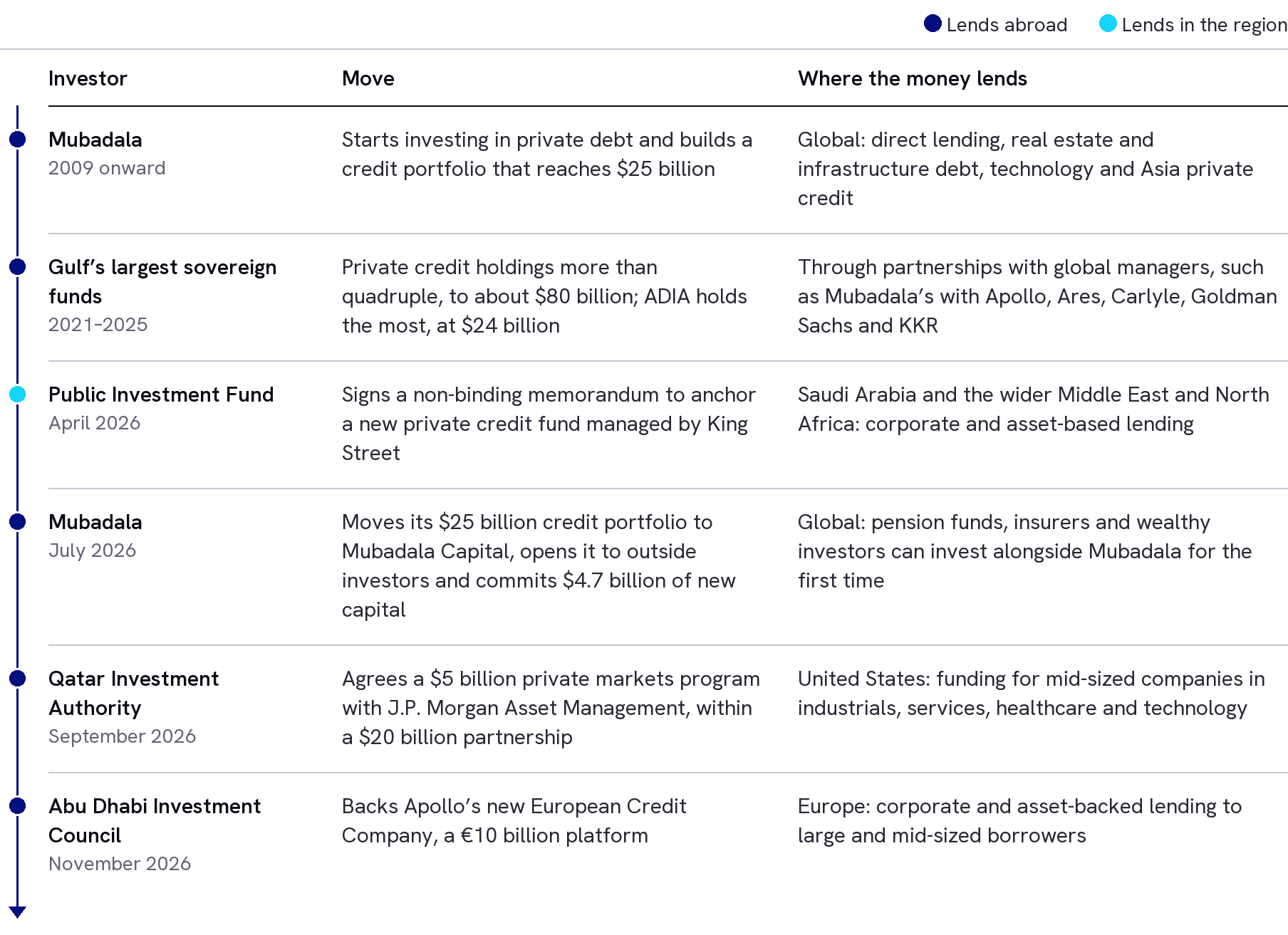
Note: The PIF memorandum is non-binding. The reports do not give the amount committed by the Abu Dhabi Investment Council. Holdings for 2021–25 are Global SWF figures for the largest Gulf sovereign wealth funds, as reported by Semafor.
Source: Semafor, April 9 and September 22, 2026; Alternative Credit Investor, April 7, July 6, and November 2, 2026; Reeve Hayward analysis
Why private credit grew: Banks stepped back and funds stepped in
Private credit is lending by funds rather than banks, negotiated directly between lender and borrower. The Bank for International Settlements (BIS) puts the loans outstanding worldwide at more than $1.2 trillion, up from about $100 billion in 2010.5 More than 87% of that lending is in the United States, where it passed $1 trillion in 2024; Europe outside the United Kingdom accounts for about 6%, and the United Kingdom for 3% to 4%.5
The BIS finds that private credit has grown most in countries with lower interest rates, stricter banking regulation, and less efficient banking systems.5 Borrowers value loan terms shaped to their needs, covenants written for their business, and faster decisions than a bank can usually offer. Smaller companies with high debt and few tangible assets to pledge are the most likely to use it.5
A Federal Reserve study describes the typical borrower as a mid-sized company with annual revenue between $10 million and $1 billion. The loans are usually senior and secured, almost all carry floating rates, and they are priced above comparable syndicated loans.6 For borrowers, the implication is practical: the money is flexible, and lenders price that flexibility.
$1.2 trillion
Private credit loans outstanding worldwide, more than this amount on the BIS count
$80 billion
Private credit held by the Gulf’s largest sovereign funds in 2025
$11–20 billion
PwC forecast range for GCC and Egypt private credit in five to six years
Gulf capital: From investor to lender
Abu Dhabi leads. The Abu Dhabi Investment Authority (ADIA) holds the largest amount, at $24 billion, and Mubadala has the largest share, with 5% of its portfolio invested through partnerships with Apollo, Ares, Carlyle, Goldman Sachs, and KKR.1 Funds in Kuwait, Qatar, and Saudi Arabia have raised their allocations more gradually; the Public Investment Fund (PIF) held about 1% of its portfolio in private credit.1
The funds are also changing how they hold the asset. Mubadala has invested in private debt since 2009. In July it moved its $25 billion credit portfolio to Mubadala Capital, opening it to pension funds, insurers, and wealthy investors for the first time, and committed $4.7 billion to the growth of the business.7 In effect, the sovereign fund’s credit book now sits inside an asset manager that can take in other investors’ money.
QIA’s program with J.P. Morgan Asset Management is part of a $20 billion partnership and will fund mid-sized US companies in industrials, services, healthcare, and technology.3 At home, QIA has created Doha Investment, a wholly owned platform that manages its domestic portfolio of more than 40 companies and is mandated to support national champions, with investors expecting it to bring more international capital and private-sector participation into the economy.8
At home: A young market with room to grow
Funds aimed at the region are starting to form. In April, PIF signed a non-binding memorandum to anchor a new King Street fund that would lend to companies and finance assets in Saudi Arabia and the wider Middle East and North Africa.9 King Street’s founder said the regional market will need to grow by at least 15% to 30% a year over the next five years to finance the region’s development, the same range as the PwC forecast.9
Banks remain the region’s main lenders, and that is unlikely to change soon. Private credit is likely to grow alongside them, in the deals banks are less suited to: larger growth loans, acquisition finance, and terms built around a single company’s cash flow.
When private credit suits a mid-sized company
For a company choosing how to fund its next stage, private credit sits between a bank loan and new equity (Exhibit 2). The BIS describes the companies that turn to it as those that want flexible terms and quick execution and are often underserved by banks, such as firms with growth plans but limited collateral.5
Exhibit 2
Private credit sits between a bank loan and new equity on cost, flexibility and control.
Main features of three ways to fund growth, for a mid-sized company, general terms
| Feature | Bank loan | Private credit | New equity |
|---|---|---|---|
| Who provides it | A bank, lending from its regulated balance sheet | A fund run by an asset manager, lending one to one | Investors who take a share of ownership |
| Typical use | Working capital, asset finance and term loans within the bank’s limits | Growth, acquisitions and refinancing that need tailored terms or speed | Growth that outruns the company’s capacity to borrow |
| Terms | Standard documentation, collateral and covenants | Usually senior and secured, at floating rates, with covenants written for the borrower | No repayments; owners give up part of the value and some control |
| Cost | Set by the bank’s credit policy and pricing | Priced above comparable syndicated loans | A share of future profits and value |
Note: General features; terms vary by lender, market and borrower. The private credit column draws on studies of global markets by the BIS and the Federal Reserve.
Source: Bank for International Settlements, BIS Quarterly Review, March 2025; Federal Reserve Board, FEDS Notes, February 23, 2024; Reeve Hayward analysis
The trade-off is cost against control. A private lender will usually charge more than a bank and ask for security and covenants, but it can lend against a company’s own cash flow and move quickly. Equity carries no repayments but gives away part of the upside. For an owner-managed Gulf company planning an acquisition or a large expansion, the middle option may preserve ownership while funding the plan.
What this means for Gulf companies
- Treat private credit as a complement to the bank. The regional banks remain the main lenders. A company can keep its bank lines for working capital and use private credit for a specific acquisition or project.
- Prepare for a lender that tests cash flow. Private lenders price risk against leverage, covenants and security. Audited accounts, a financial model with a downside case, and a clear account of how the loan will be repaid or refinanced shorten the conversation.
- Compare the full cost. Set the margin, fees, covenants and prepayment terms of a private loan against bank pricing and against the value owners would give up in an equity round.
- Watch the regional funds as they launch. The PIF-anchored fund and Mubadala Capital’s opening to outside investors point to more local lenders over the next few years. Companies weighing these options can first test them against their own plans; a financial model with a downside case is part of our business planning work in Qatar.
The money is flexible, and lenders price that flexibility.
For years, Gulf sovereign funds learned private credit by backing the world’s largest managers. They now run credit businesses of their own and are anchoring funds that lend in the region. The companies best placed to use that capital are likely to be those that can show a lender a clear plan, audited numbers and a credible path to repayment.
About this article
This article draws on reporting by Semafor, Alternative Credit Investor, and The Peninsula of announcements by Gulf sovereign funds and their partners; Global SWF figures as reported by Semafor; a PwC forecast as reported by Alternative Credit Investor; and studies of the global private credit market by the Bank for International Settlements and the Federal Reserve. It is for information only and is not investment advice.
Sources
- Kelsey Warner, “Gulf sovereigns quadruple private credit portfolios,” Semafor, April 9, 2026, citing Global SWF data.
- “Apollo launches €10bn European credit platform,” Alternative Credit Investor, November 2, 2026.
- Matthew Martin, “Qatar Investment Authority deepens US ties with JPMorgan,” Semafor, September 22, 2026.
- “Middle East private credit boosted by ‘entrepreneurial ecosystem’,” Alternative Credit Investor, April 28, 2025, reporting a PwC forecast.
- Fernando Avalos, Sebastian Doerr, and Gabor Pinter, “The global drivers of private credit,” BIS Quarterly Review, Bank for International Settlements, March 2025.
- Fang Cai and Sharjil Haque, “Private Credit: Characteristics and Risks,” FEDS Notes, Board of Governors of the Federal Reserve System, February 23, 2024.
- “Mubadala opens $25bn private credit portfolio to outside investors,” Alternative Credit Investor, July 6, 2026.
- Joel Johnson, “Qatar’s new investment platform targets global capital and private-sector expansion,” The Peninsula, October 5, 2026.
- “Saudi’s PIF anchors King Street credit fund targeting Middle East,” Alternative Credit Investor, April 7, 2026.
To discuss what this means for your business, speak with our team. Initial conversations are confidential and without obligation.
Speak with our team


