

The six Gulf states have signed the agreement for a railway linking them by December 2030. More than half of Qatar's import tonnage comes from its Gulf neighbors, mostly bulk materials suited to rail.
The Gulf railway now has a signed agreement and a target date. On November 8, 2026, in Manama, the transport ministers of the six Gulf Cooperation Council (GCC) states signed the general agreement for a railway linking Qatar, Kuwait, Saudi Arabia, Bahrain, the United Arab Emirates (UAE), and Oman, with full operation targeted for December 2030.1 For Qatar, the freight in question is large. Between January 2025 and February 2026, the five other GCC states supplied 9.4% of Qatar’s imports by value but 54.5% by weight (Exhibit 1).2
Yet the network will arrive in stages. The agreement assigns responsibilities to each state, and the links between neighbors are at different points. This article sets out what was agreed, which freight could move by rail, which links come first, and what companies in Qatar can do in the meantime.
Exhibit 1
Qatar’s five GCC neighbors supply 9% of its imports by value but 55% by weight.
Share of Qatar’s imports by country of origin, January 2025 to February 2026, % of total value and of total weight
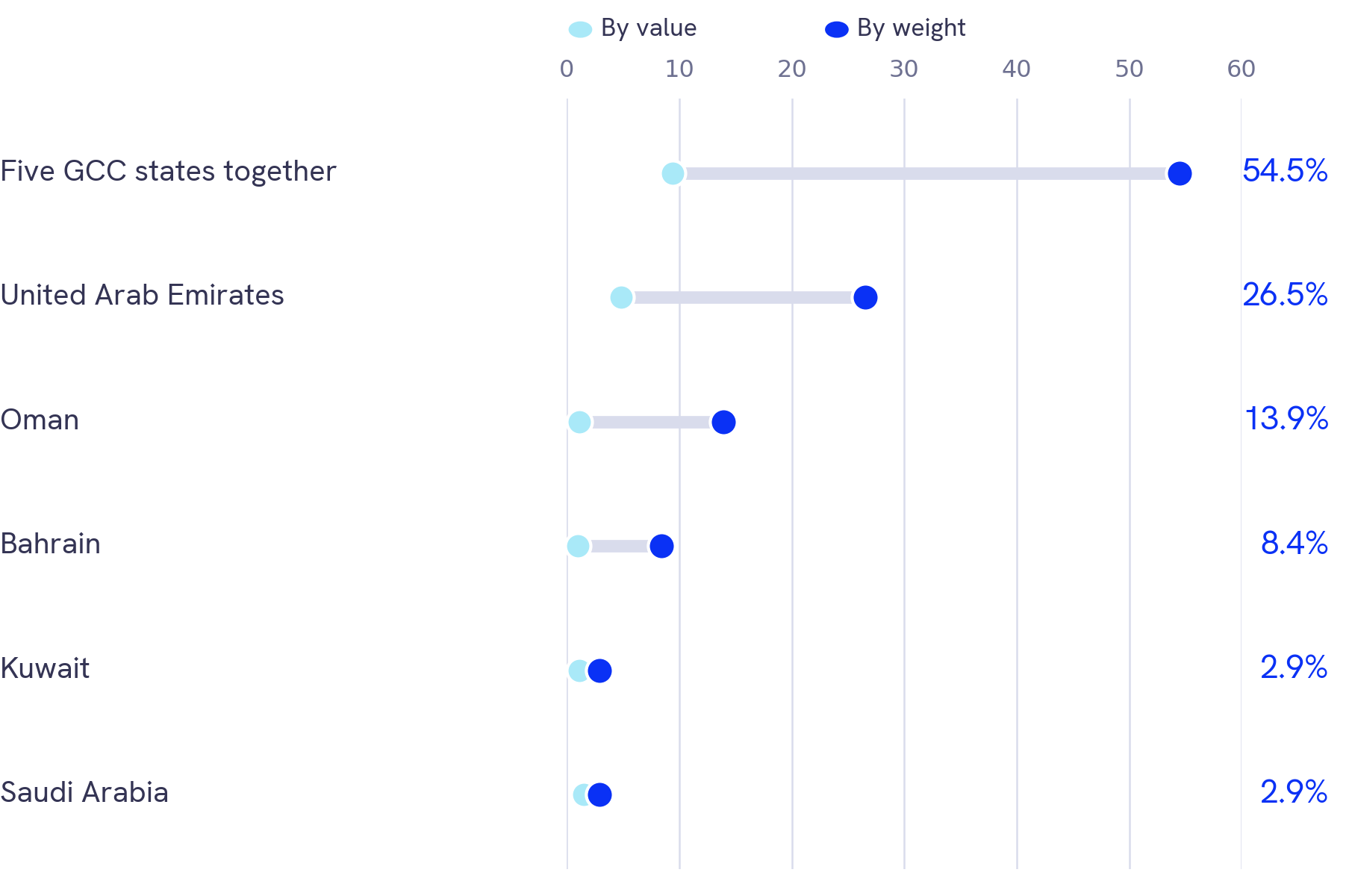
Note: Country of origin is where goods were produced; it does not show the route or mode of entry. Total imports in the period were QAR 163.4 billion and 26.1 million metric tons. By value, the shares are 4.8% for the UAE, 1.5% for Saudi Arabia, 1.1% each for Kuwait and Oman, and 1.0% for Bahrain.
Source: National Planning Council, “Qatar Imports 2025-2026,” Qatar Open Data Portal, CC BY 4.0; Reeve Hayward analysis
What was agreed: One framework for six national networks
The agreement sets a framework for coordination between the member states and the GCC Railways Authority. It defines each country’s responsibilities, includes a timeline for building and operating the line, and standardizes technical and operating criteria, safety requirements, and interoperability between the national networks.3 The GCC’s Supreme Council approved the network in 2009 and decided in December 2021 to set up the Authority to coordinate it.3 Qatar’s Minister of Transport said the agreement would ease the movement of people and goods, improve the efficiency of logistics services, and open wider prospects for trade and tourism among member states.3
Published figures for the network’s length differ with the route counted. Reports at the signing put it at more than 2,100 kilometers.1 In May 2026, the director general of the GCC Railways Authority said the total length exceeds 1,700 kilometers and that the overall completion rate had passed 50%.4 He also set out the case for freight: wider use of rail would reduce reliance on trucks, lower road maintenance costs, and cut emissions from heavy vehicles.4
The timing fits a wider reassessment of trade routes. Three days before the signing, the Organisation for Economic Co-operation and Development (OECD) published a study of the India-Middle East-Europe Corridor, a planned network of sea, rail, and road links. It found that rail is the least developed part of the corridor’s physical infrastructure, pointed to missing cross-border rail links and reliance on a few maritime chokepoints, and called the rail network across the Arabian Peninsula a major priority.5
The freight in question: Heavy, low-value cargo from next door
Trade data published by the National Planning Council show why the line matters to Qatar. In the 14 months to February 2026, Qatar imported 26.1 million metric tons of goods worth QAR 163.4 billion. The five other GCC states supplied 14.2 million tons of that, worth QAR 15.4 billion.2 The UAE alone accounted for 26.5% of the tonnage, Oman for 13.9%, and Bahrain for 8.4%. Goods from GCC states averaged about QAR 1,080 a ton, compared with about QAR 12,470 a ton from the rest of the world, a gap of more than 11 times.
Three product groups explain the weight (Exhibit 2). Stone, aggregates, and cement made up 68.3% of the tonnage from GCC states, ores 15.4%, and mineral fuels and oils 6.7%.2 Aggregates for concrete from the UAE and Oman came to about 9.1 million tons, or 34.9% of everything Qatar imported by weight. Iron ore from Bahrain added about 2.1 million tons.
Exhibit 2
Stone, ores, and fuels make up 90% of the tonnage Qatar imports from GCC states.
Qatar’s imports from the five other GCC states by product group, January 2025 to February 2026, % of weight
Note: Product groups are chapters of the Harmonized System: chapter 25 (salt, sulfur, earths and stone, plastering materials, lime, and cement), chapter 26 (ores, slag, and ash), and chapter 27 (mineral fuels and oils). Total weight from the five states was 14.2 million metric tons. GCC states supplied 86.1% of all Qatar’s chapter 25 imports by weight, 56.0% of chapter 26, and 74.8% of chapter 27.
Source: National Planning Council, “Qatar Imports 2025-2026,” Qatar Open Data Portal, CC BY 4.0; Reeve Hayward analysis
Two points of care apply. The data record where goods were produced, not how they arrived, and bulk materials have long come by sea: in the first half of 2015, Qatar Primary Materials Company unloaded 4.6 million tons of gabbro from 78 barges.6 And the series ends in February 2026, so it shows the pattern of trade the railway was designed around. Rail is unlikely to replace shipping for this cargo. It could give the heaviest part of Qatar’s imports a second route.
54.5%
Share of Qatar’s import tonnage that originated in the five other GCC states, January 2025 to February 2026
9.4%
Share of Qatar’s import value from the same five states over the same period
2030
December 2030 is the target for full operation of the GCC railway
Which links come first: Road today, the first cross-border rail trials in 2027
The land route already carries more than it did. In March 2026, during the disruption to shipping in the region, most shipments to Qatar were moving by land through the border with Saudi Arabia under the international road transport (TIR) system, which links Qatar to about 76 countries and lets goods travel under a single customs seal.7 Qatar runs the system electronically through its Al Nadeeb customs platform.7 The OECD draws the same conclusion for the wider corridor: road remains the most practical inland option until rail links improve, and procedures and delays at borders hold back transport more than the quality of infrastructure does.5
Rail will follow link by link (Exhibit 3). The line between Oman and the UAE is the furthest along: Hafeet Rail reported 40% completion in April 2026,8 and Oman’s transport minister expects trial operations in the fourth quarter of 2027.9 It will connect Sohar Port to the UAE’s national network, the direction from which much of Qatar’s aggregate comes. Qatar’s own announced rail link is the high-speed line to Riyadh, which is for passengers.10 Freight to and from Qatar will depend on the GCC railway’s sections through Saudi Arabia. At the northern end, Kuwait’s 111-kilometer section was at the study and design stage when its tenders were reported in November 2024.11
Exhibit 3
The Oman–UAE line is due for trials in 2027, three years before the target for the full network.
Selected rail links in the GCC, plan and latest reported status, as of November 2026
| Link | What is planned | Latest reported status |
|---|---|---|
| GCC railway, six states | One interoperable network for passengers and freight, with responsibilities defined for each state | General agreement signed November 8, 2026; full operation targeted for December 2030; overall completion above 50% in May 2026 |
| Oman–UAE (Hafeet Rail) | 238 kilometers linking Sohar Port to the UAE’s national network through Al Buraimi and Al Ain; freight and passengers | 40% complete in April 2026; trial operations expected in the fourth quarter of 2027 |
| Qatar–Saudi Arabia high-speed line | 785 kilometers from Doha to Riyadh through Al-Hofuf and Dammam at more than 300 kilometers an hour; passengers only | Announced in December 2025; about six years to complete |
| Kuwait section | 111 kilometers, the northern end of the GCC railway, connecting to Saudi Arabia | Study and design phase tendered, as reported in November 2024 |
Note: The table lists links for which we found reporting that we could cite; it is not a full list of sections. The Qatar–Saudi Arabia line is a separate passenger project and is shown because it is Qatar’s first announced rail link to a neighbor.
Source: The Peninsula, November 8 and May 11, 2026; TradeArabia, April 23 and September 16, 2026; Ministry of Transport, State of Qatar; Times Kuwait, November 7, 2024
Inside Qatar, the routes have been planned for more than a decade (Exhibit 4). Qatar Rail’s long-distance plan sets out five main lines in four phases, and its first phase covers nearly 143 kilometers of track with a station, three freight yards, and an intermodal yard.12 The lines would link Doha with Saudi Arabia for passengers and freight, Doha with Dukhan and Al Shamal, and Mesaieed with Ras Laffan, with a passenger-only line to Bahrain.13 The line to the Saudi border is the one that would join Qatar to the GCC railway.
Exhibit 4
Qatar’s planned long-distance lines meet at Doha, and one runs to the Saudi border.
Qatar Rail’s planned long-distance network, schematic of the five main lines
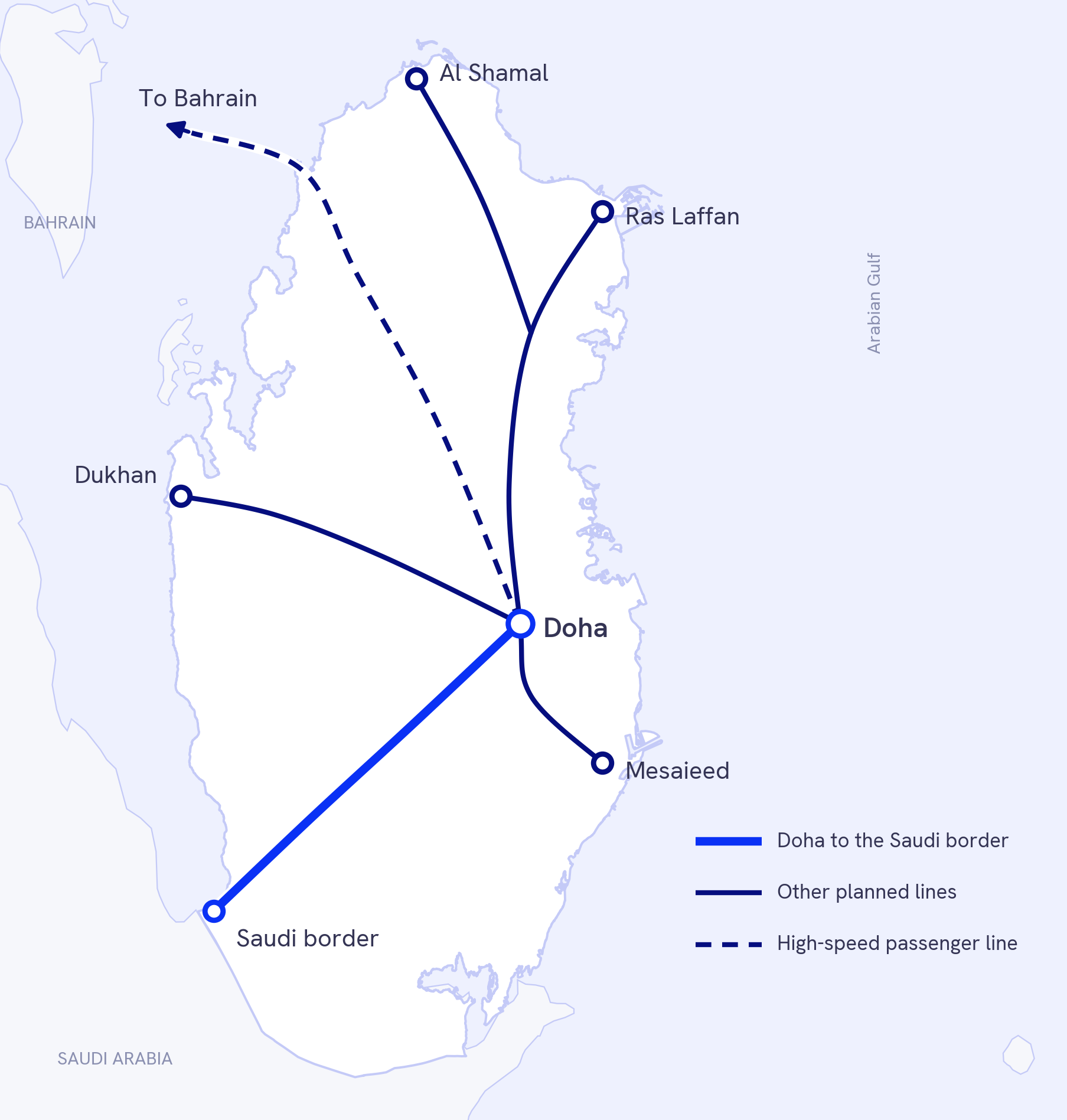
Note: Schematic drawn by Reeve Hayward from the published description of the plan. The lines join the named places by indicative paths; they are not surveyed alignments. Planned, not built. The high-speed passenger line to Riyadh announced in December 2025 is a separate project and is not shown.
Source: Wikipedia, “Qatar Rail,” CC BY-SA 4.0; The Peninsula, March 31, 2015; base map from geoBoundaries, CC BY 4.0, and Natural Earth; Reeve Hayward analysis
What companies in Qatar can do now
None of this calls for waiting until 2030. The choices that decide who benefits from a new route are made years earlier, in site selection, supply contracts, and the assumptions behind an investment case. This is the ground our feasibility studies in Qatar cover.
- Measure freight by weight as well as value. Importers of building materials, ores, and fuels should know their tonnage by origin and what transport adds to the landed cost of each ton. The lower the value of a ton, the more the route matters to the margin.
- Test new sites against two routes. A warehouse, plant, or stockyard chosen today will still be operating when the first cross-border trains run. A feasibility study should model logistics costs with sea delivery and with land delivery, and show how the result changes if a rail terminal opens nearby.
- Write route flexibility into long contracts. Supply agreements that run past 2027 can allow a change of delivery point or mode, and say how any saving or extra cost is shared. That is easier to agree before the option exists than after.
- Use the customs tools already in place. The TIR system and the Al Nadeeb platform are available now. If procedures at borders slow freight more than infrastructure does, as the OECD finds, the companies that master the paperwork gain first.
- Follow the milestones, not only the target date. The trial runs between Sohar and the UAE in late 2027, and design and construction awards for the sections through Saudi Arabia and Qatar, will say more about timing than December 2030 does.
For Qatar, the heaviest half of its imports already comes from the states the line will connect.
The agreement gives the Gulf railway a framework, national responsibilities, and a date. For Qatar, the heaviest half of its imports already comes from the states the line will connect. Companies that know their tonnage, their routes, and their contract terms are likely to be the first to benefit as each link opens.
About this article
This article draws on the National Planning Council’s “Qatar Imports 2025-2026” dataset, published on the Qatar Open Data Portal under a CC BY 4.0 licence, with data from January 2025 to February 2026. Shares by country of origin and by product group are our calculations from that dataset; country of origin records where goods were produced, not the route they took. Facts about the railway are as reported by The Peninsula, TradeArabia, and Times Kuwait, and as published by Qatar’s Ministry of Transport and the OECD. The map of planned lines in Qatar is our schematic, drawn from published descriptions of Qatar Rail’s plan; it does not show surveyed routes. It is for information only and is not investment advice.
Sources
- The Peninsula, “Agreement signed for joint framework of GCC Railway Project,” November 8, 2026.
- National Planning Council, “Qatar Imports 2025-2026,” Qatar Open Data Portal (data.gov.qa), CC BY 4.0, data from January 2025 to February 2026, accessed November 13, 2026.
- The Peninsula, “Qatar signs general agreement to connect GCC countries with railways,” November 8, 2026.
- The Peninsula, “GCC railway linkage project exceeds 50% completion: Official,” May 11, 2026.
- OECD, Measuring Connectivity across the India-Middle East-Europe Corridor, OECD Publishing, Paris, November 5, 2026, CC BY 4.0.
- The Peninsula, “QPMC unloads 4.6m tonnes of Gabbro in first half,” August 18, 2015.
- The Peninsula, “Qatar expands land cargo network linking around 75 countries, streamlines customs procedures,” March 12, 2026.
- TradeArabia, “Hafeet Rail enters fast track; Oman–UAE rail project 40pc completed,” April 23, 2026.
- TradeArabia, “Oman-UAE rail link set for trials in late 2027,” September 16, 2026.
- Ministry of Transport, State of Qatar, “High-Speed Electric Rail Project for Passengers between Qatar and Saudi Arabia Strategic Step to Enhance Cooperation, Developmental Complementarity,” December 2025.
- Times Kuwait, “Kuwait embarks on landmark railway project with Saudi support,” November 7, 2024.
- Wikipedia, “Qatar Rail,” CC BY-SA 4.0, accessed November 14, 2026.
- The Peninsula, “Falling oil prices won’t hit rail projects: Qatar,” March 31, 2015.
To discuss what this means for your business, speak with our team. Initial conversations are confidential and without obligation.
Speak with our team


