

The best error-corrected qubits fail five times in a million cycles, and most roadmaps target fault-tolerant machines for 2029 or 2030. This report sets out the breakthroughs, the money, the sectors affected and encryption deadlines.
Quantum computing has moved from physics to engineering. On 19 October 2026, Quantinuum reported that error-corrected qubits on its Helios computer failed five times in a million cycles, in a result published as a preprint; in February 2023, the best comparable result Google could publish was about three errors in 100 (Exhibit 1).1 Error correction, the technique that every useful quantum computer will need, has now been shown to work as theory predicts on three kinds of hardware: superconducting circuits, on Google’s Willow chip in December 2024 and China’s Zuchongzhi 3.2 a year later; neutral atoms, at Harvard, MIT and QuEra in November 2025; and trapped ions, at Quantinuum in 2026.2 The physicists whose experiments in the 1980s laid the groundwork for superconducting qubits received the 2025 Nobel Prize in Physics.3
Exhibit 1
The best error-corrected qubits now fail five times in a million cycles, against three times in 100 in 2023.
Logical error per cycle of error-correction experiments, by hardware type, 2023–26, and vendors’ targets, log scale
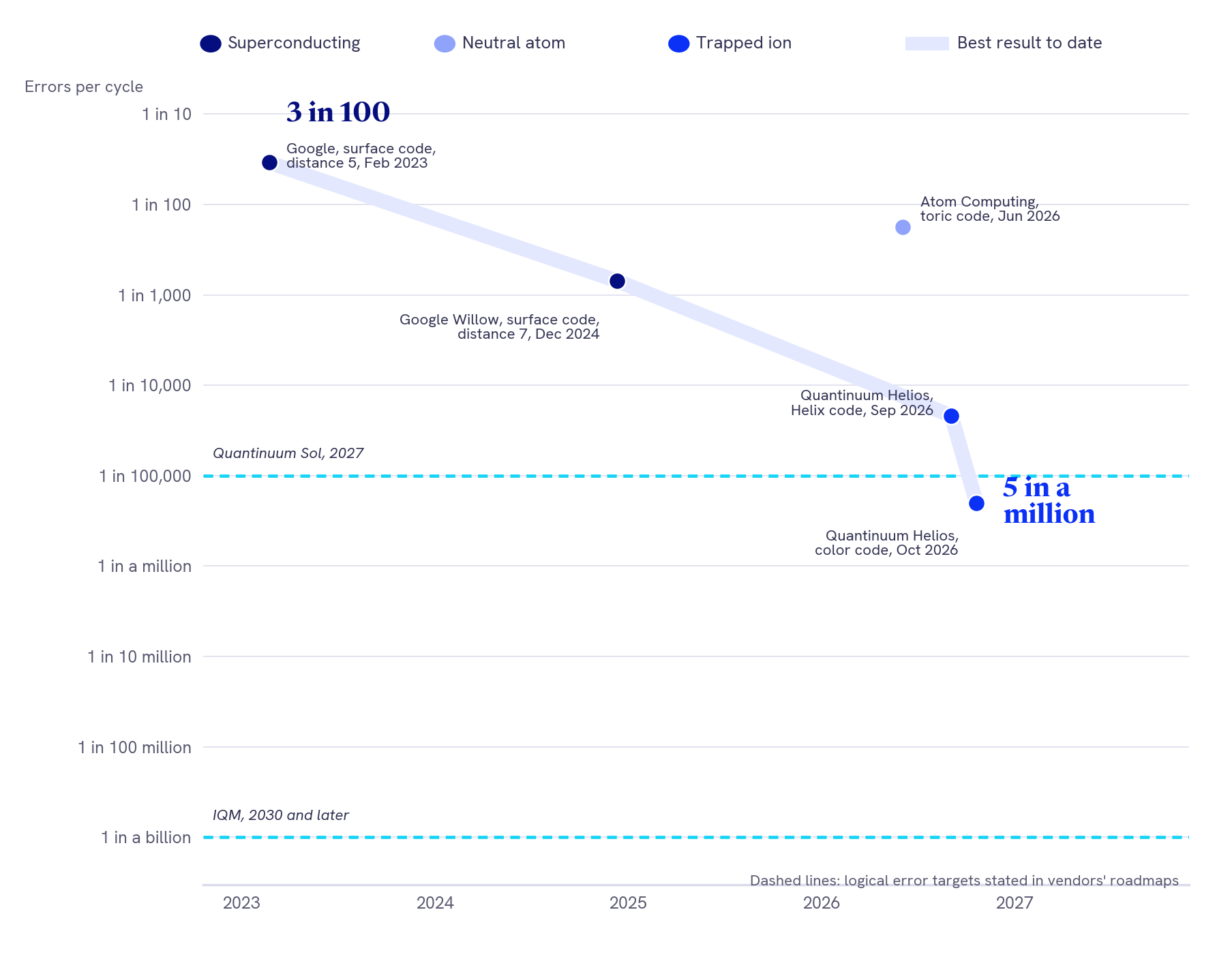
Note: Memory experiments on one logical qubit; codes, cycle times and numbers of rounds differ, so results are indicative across hardware types. Quantinuum’s 2026 results and Atom Computing’s are preprints. Targets: one error in 100,000 cycles for Quantinuum Sol (2027) and one in a billion for IQM (2030 and later).
Source: Google Quantum AI (Nature; arXiv); Atom Computing (arXiv); Quantinuum (arXiv; SEC filings); IQM; Reeve Hayward analysis
Money has followed the science. Quantum companies raised $10.9 billion in 2025, almost four times the $2.75 billion of 2024, and six quantum computing companies listed their shares in the first eight months of 2026, among them Quantinuum, whose $1.68 billion offering in June valued it at about $15.7 billion at the offer price.4 Governments have added programs of their own, from the UK’s £2.5 billion ten-year strategy to US letters of intent worth $2.0 billion.5
Yet the machines that will change how companies work are still to come. Vendors’ roadmaps place their first fault-tolerant computers, able to run long calculations without their errors piling up, in 2029 and 2030, and the US Defense Advanced Research Projects Agency (DARPA) is testing whether any design can deliver more value than it costs by 2033.6 Revenue is still small: the three largest listed quantum companies reported about $186 million between them in 2025.7 The effect most companies will feel first is on security. Estimates of the machine needed to break the RSA-2048 encryption that protects much of today’s internet have fallen from 20 million qubits in 2019 to under 1 million in 2025, and regulators have begun to set dates for moving to new, quantum-safe cryptography.8
This report sets out what has been discovered; the race to fault tolerance; the money behind it; the sectors where value could come first; the cryptography deadlines; the Gulf’s position; and what boards can do now. It describes published research, company filings and official data; it does not forecast share prices, value any company or recommend any security (see sidebar, “About the research”).
What has been discovered: From proof of principle to working error correction
The first claim that a quantum computer had beaten a classical one came in 2019, when Google’s 53-qubit Sycamore chip sampled random circuits in 200 seconds, a task Google put at 10,000 years for a supercomputer; IBM replied that a classical machine could do it in 2.5 days.9 That exchange set the pattern for the next five years: demonstrations on test problems, followed by classical counter-arguments. China’s University of Science and Technology (USTC) reported its own advantage with photons in 2020 and with its 105-qubit Zuchongzhi 3.0 chip in March 2025.10 In October 2025, Google’s Quantum Echoes algorithm ran 13,000 times faster on its Willow chip than the best classical method on Frontier, one of the world’s fastest supercomputers.11 In July 2026, IBM and three partners claimed advantage on problems in materials physics; the papers are preprints, and a public tracker that IBM helped launch lists them as candidates for classical teams to challenge.12
The more important progress has been in error correction (Exhibit 2). Qubits are fragile: heat, stray fields and imperfect control make the best of them err between about once in 1,000 and once in 10,000 operations, while a useful program such as breaking RSA-2048 needs billions of operations.13 The answer is to spread one logical qubit across many physical ones, which check one another; it works only if the hardware is accurate enough that adding qubits removes more errors than it creates. Google crossed that threshold with Willow in December 2024: each step up in the size of its code cut the logical error rate by a factor of 2.14, to 0.143% per cycle.14 Harvard, MIT and QuEra crossed it with neutral atoms in November 2025, and USTC with a factor of 1.4 in December.15 Trapped ions have gone furthest: Quantinuum’s errors fell by a factor of 12 per step in October 2026, reaching five errors in a million cycles, about ten times better than its own record of September.16 Google added another missing piece the same month, producing the special “magic states” that fault-tolerant programs consume with 99.99% fidelity, 40 times fewer errors than before.17
Exhibit 2
Since 2023, quantum computing’s milestones have shifted from beating classical computers on test problems to correcting errors at scale.
Selected milestones in quantum computing, by area, 2019 to November 2026,
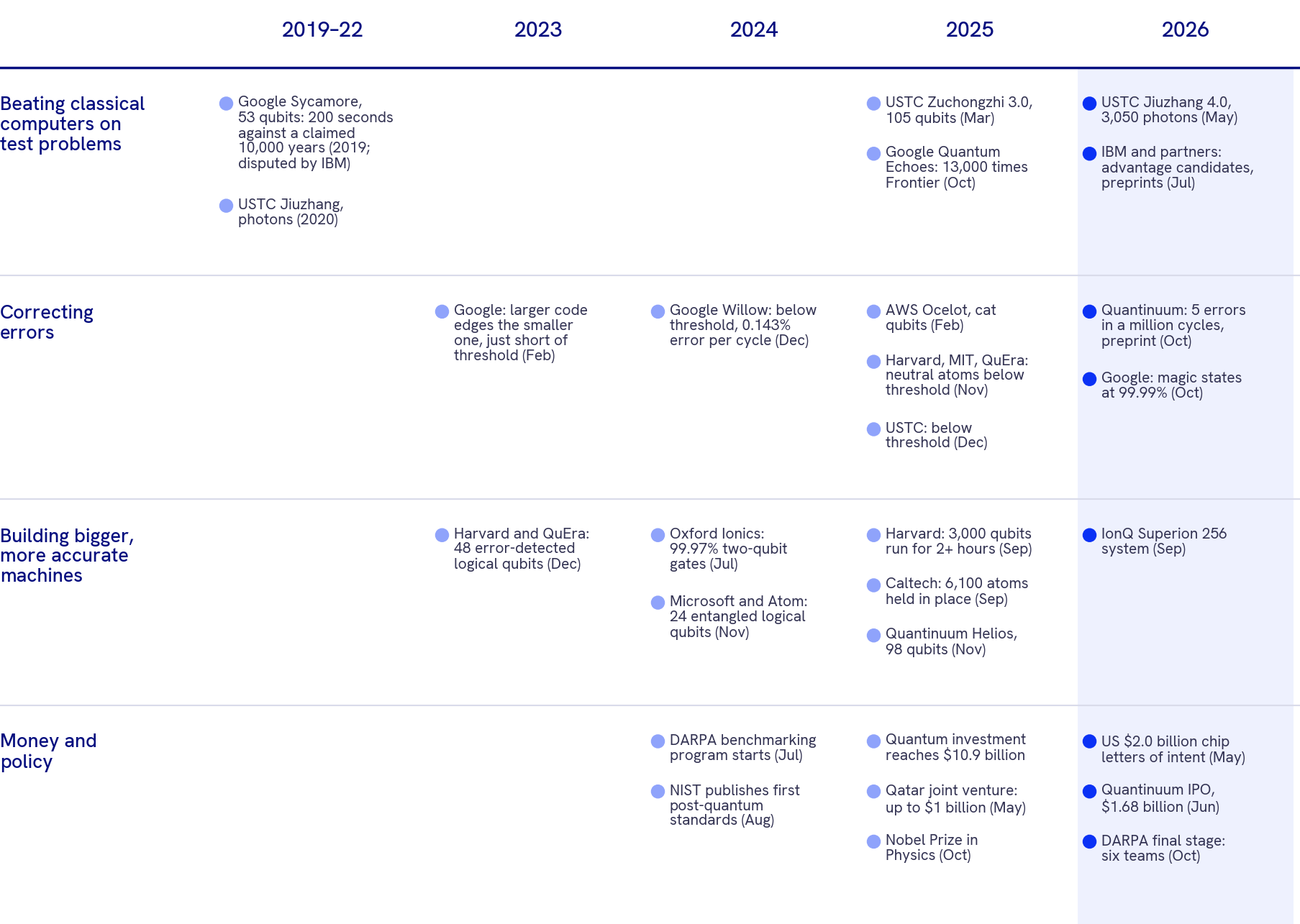
Note: Selection by Reeve Hayward of results in open-access papers, preprints, SEC filings, university and government releases; claims of quantum advantage on test problems remain contested. Logical qubits in 2023 and 2024 were error-detected or early error-corrected and are not comparable with later counts.
Source: arXiv; Nature and PRX Quantum (open access); SEC filings; Harvard; Caltech; USTC; NSFC; NIST; DARPA; MIT Quantum Index Report; Reeve Hayward analysis
The machines have also grown and become more accurate. Harvard ran an array of more than 3,000 atomic qubits continuously for over two hours in September 2025, and Caltech held more than 6,100 atoms in place the same month, though without the gates that link them.18 Quantinuum’s Helios, launched in November 2025, has 98 qubits whose two-qubit operations succeed 99.921% of the time across every pair, and IonQ reported 99.99% on a laboratory prototype a month earlier.19 Not every claim is settled: Microsoft says its Majorana chips, announced in February 2025 and June 2026, use a new kind of topological qubit, while several physicists argue that the published data do not yet show one; DARPA has nonetheless placed Microsoft in the final stage of its evaluation.20
The race to fault tolerance: Most roadmaps point to 2029 and 2030
Five hardware approaches are in the race, and each trades speed against accuracy and scale. Superconducting circuits, used by Google, IBM and USTC, are fast but must be cooled close to absolute zero; trapped ions, used by Quantinuum and IonQ, are the most accurate but slower; neutral atoms, used by QuEra, Pasqal, Atom Computing and Infleqtion, scale to thousands of qubits; photonic machines, pursued by PsiQuantum and Xanadu, compute with light and can be made in chip factories; and Microsoft’s topological approach aims for qubits that are stable by design.
Their roadmaps converge on the end of the decade (Exhibit 3). IBM plans Starling, its first fault-tolerant system, for 2029, and thousands of logical qubits beyond 2033.21 Quantinuum plans Sol, with close to 100 logical qubits, for the second half of 2027 and Apollo, a fully fault-tolerant machine with hundreds, for 2029.22 Pasqal plans more than 200 logical qubits in 2029, Infleqtion 1,000 by 2030 and IonQ 800 logical qubits in 2027 and 80,000 in 2030.23 PsiQuantum is building a utility-scale machine near Brisbane with about A$940 million from the Australian and Queensland governments.24 The counts are each company’s own and are defined differently, so they show direction rather than a league table.
Exhibit 3
Most hardware makers target their first fault-tolerant machines for 2029 or 2030, ahead of DARPA’s 2033 test.
Target year stated by each company for a fault-tolerant or error-corrected machine, and the number of logical qubits it states, by hardware type, as of November 8, 2026
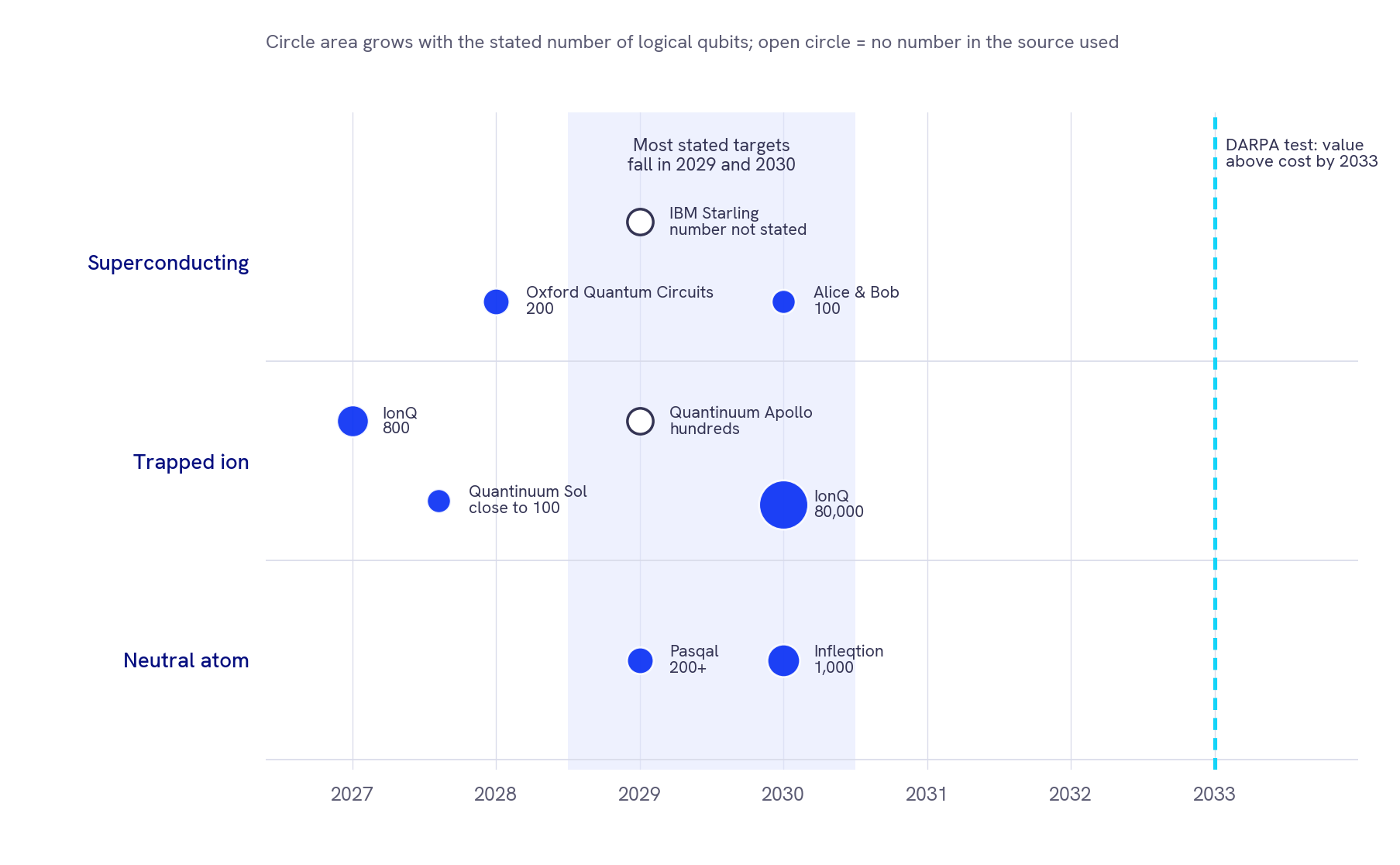
Note: Company statements, not independent forecasts; logical qubits are defined differently by each company and are not like-for-like. IBM’s Starling is shown without a number because the source used gives none.
Source: SEC filings of Quantinuum, IonQ, Infleqtion, Bleichroeder Acquisition Corp. II (Pasqal) and SeeQC (IBM roadmap); Wikipedia (Alice & Bob; Oxford Quantum Circuits); DARPA; Reeve Hayward analysis
DARPA’s Quantum Benchmarking Initiative is the closest thing to an independent referee. It asks whether a design could reach “utility scale,” where the value of its results exceeds its cost, by 2033, and it has evaluated more than 20 companies since 2024. On 7 October 2026, Atom Computing, Diraq, IBM and IonQ joined Microsoft and PsiQuantum in its final stage, where each can receive up to $300 million.25 China is pursuing the same goals: USTC’s Jiuzhang 4.0, a photonic machine with 3,050 photons, was announced in May 2026.26
The money: A record year for investment and a wave of listings
Investors committed more to quantum companies in 2025 than in the previous three years combined. MIT’s Quantum Index Report counts $10.9 billion of funding in 2025, against $2.75 billion in 2024; financing after a company’s listing made up about 52% of the 2025 total, and companies based in the United States raised about 61%.27 Venture funding alone also set a record: Crunchbase counts $4.1 billion for quantum start-ups in 2025.28
The public markets opened in 2026 (Exhibit 4). Infleqtion, Horizon Quantum, Xanadu, IQM and Pasqal listed through mergers with listed acquisition companies, and Quantinuum through a conventional initial public offering on Nasdaq in June that raised $1.68 billion.29 Listed companies have since raised more: IonQ sold $2.0 billion of shares in October 2026.30 Private rounds have grown too; Oratomic, a neutral-atom start-up, raised $775 million within seven months of 2026.31
Exhibit 4
Six quantum computing companies listed their shares in 2026, led by Quantinuum’s $1.68 billion offering.
Quantum computing companies that listed in 2026, by date of first trade, as reported in filings
| Company | Route and exchange | First trade | Money raised |
|---|---|---|---|
| Infleqtion | SPAC, New York Stock Exchange | February 17 | More than $550 million |
| Horizon Quantum | SPAC, Nasdaq | March 20 | About $120 million |
| Xanadu | SPAC, Nasdaq and Toronto | March 27 | About $302 million |
| Quantinuum | Initial public offering, Nasdaq | June 4 | $1.68 billion; valued at about $15.7 billion |
| IQM | SPAC, Nasdaq and Nasdaq Helsinki | July 2 | €198.7 million net |
| Pasqal | SPAC, Nasdaq | August 28 | About $360 million |
Note: SPAC is a special purpose acquisition company, a listed company formed to merge with a private one. Proceeds are gross unless stated and include private placements arranged with the listing. IQM’s proceeds are net. Quantinuum’s value is its shares outstanding after the offering at the offer price.
Source: SEC EDGAR filings of the companies and their merger partners; Reeve Hayward analysis
Revenues are growing from a small base. IonQ’s revenue rose from $43.1 million in 2024 to $130.0 million in 2025, and it now expects $505 million to $515 million in 2026, including a chip foundry it bought in July; Quantinuum’s rose from $23.0 million to $30.9 million, and D-Wave’s from $8.8 million to $24.6 million.32
Governments remain the other large funder (Exhibit 5). Their programs differ in length and in what they cover, so they are best read side by side rather than added up. The largest recent commitments include the UK’s £2.5 billion strategy for 2024 to 2034 and a further £670 million for quantum computing; $2.0 billion of US Commerce Department letters of intent with nine companies, under which the government takes minority stakes; Japan’s ¥471.1 billion over fiscal years 2021 to 2025; and an extra €1 billion from France for 2026 to 2030.33 Qatar will invest up to $1 billion in quantum technology through a joint venture between Quantinuum and Al Rabban Capital, announced in May 2025; we return to it below.34
Exhibit 5
Governments have committed billions to quantum technology through programs that run into the 2030s.
Selected public quantum programs, by country, amount as announced and period, local currency
| Country | Program | Amount | Period |
|---|---|---|---|
| UK | National Quantum Strategy; quantum computing package | £2.5 billion; £670 million | 2024–34; announced 2025 |
| US | Commerce letters of intent with nine companies; Energy Department research centers | $2.013 billion; $625 million | 2026; up to five years |
| EU | Quantum Technologies Flagship | €1 billion | From 2018, ten years |
| France | National quantum strategy, new tranche | €1 billion | 2026–30 |
| Germany | Federal action plan and science organizations | About €3 billion | 2023–26 |
| Spain | Quantum Technologies Strategy | €808 million | 2025–30 |
| Japan | Quantum budgets | ¥471.1 billion | Fiscal 2021–25 |
| South Korea | Quantum budget | ₩198 billion | 2025 |
| India | National Quantum Mission | INR 6,003.65 crore | 2023–24 to 2030–31 |
| Australia | Commonwealth and Queensland, PsiQuantum | About A$940 million | From 2024 |
| Netherlands | Quantum Delta NL | €614.9 million | From 2021 |
| Qatar | Joint venture of Quantinuum and Al Rabban Capital | Up to $1 billion | From 2025 |
Note: Programs differ in scope (research, industry support, equity stakes) and period, so amounts are not additive and are shown in the currency announced. Qatar’s figure is investment through a joint venture, not a government budget. Spain: “Origen de los datos: sitio web de lamoncloa.gob.es. Ministerio de la Presidencia,” April 24, 2025.
Source: GOV.UK; NIST; US Department of Energy; European Commission; info.gouv.fr; German Bundestag, Drucksache 20/6610; lamoncloa.gob.es; Cabinet Office of Japan; korea.kr; Press Information Bureau, India; Prime Minister of Australia; Nationaal Groeifonds; The White House; Reeve Hayward analysis
Where value could come first: Chemistry, materials and finance
Chemistry and materials come first because the hardware obeys the same physics as the molecules it simulates: designing catalysts, batteries, fertilizers and drugs depends on how electrons behave, which classical computers can only approximate. The hardest problems remain out of reach for now: a 2025 study by Google researchers estimated that simulating FeMoco, the core of the enzyme that fixes nitrogen and a target for cleaner fertilizer production, would need 3.2 million to 4.5 million physical qubits.35 Optimization and machine learning, the uses most often promised for logistics and finance, depend on algorithms that have yet to beat classical methods at scale; finance is first in line, however, for the cost of quantum-safe security.
Published results so far are real but narrow (Exhibit 6). JPMorgan, with Quantinuum and US national laboratories, produced random numbers whose randomness was certified by supercomputers, in a peer-reviewed paper; IonQ, AstraZeneca, Amazon Web Services and NVIDIA ran one step of a drug-making reaction 20 times faster than before; and Ford Otosan cut the time to schedule 1,000 vehicles on a production line from 30 minutes to under 5 with a D-Wave application now in use.36 Insilico Medicine and the University of Toronto, which used a hybrid model to design cancer drug candidates, were careful to say that they saw no sign of quantum advantage.37
Exhibit 6
Published results from companies using quantum computers are real but narrow, and most are not yet peer reviewed.
Selected results reported by companies using quantum computers, by sector, 2025–26,
| Sector | Who | Result | Status |
|---|---|---|---|
| Banking | JPMorganChase, Quantinuum, US laboratories | 71,313 bits of randomness certified by supercomputers | Peer reviewed, Mar 2025 |
| Pharmaceuticals | IonQ, AstraZeneca, AWS, NVIDIA | Step of a drug-making reaction simulated 20 times faster than before | Company filing, Aug 2025 |
| Pharmaceuticals | Insilico Medicine, University of Toronto | 2 of 15 designed molecules active against a cancer target; no quantum advantage claimed | Peer reviewed, Jan 2025 |
| Manufacturing | Ford Otosan, D-Wave | Scheduling 1,000 vehicles cut from 30 minutes to under 5, in production | Company filing, Mar 2025 |
| Materials | Qedma, IBM | Magnetization dynamics on up to 74 qubits in a regime the classical methods tested could not reliably simulate; checked on Quantinuum hardware | Preprint, Jul 2026 |
| Energy | E.ON, Qoro, UK National Quantum Computing Centre | Energy-trading schedule for a 1,354-node grid with about one-third of the hardware time | Preprint, Oct 2026 |
Note: Results as stated by the companies or authors; comparisons are with the classical methods each chose. Preprints have not been peer reviewed.
Source: Nature (CC BY); SEC filings of IonQ and D-Wave; University of Toronto; arXiv; PostQuantum; Reeve Hayward analysis
The Gulf’s energy companies are among the early users. Aramco and Pasqal have named port logistics, carbon dioxide storage, well placement and rig scheduling among the problems for the 200-qubit machine now running in Dhahran.38
The cryptography clock: The first deadline is already running
For most companies, the first cost of quantum computing will be a security project, and it is due before the machines arrive. The public-key cryptography that protects online banking, payments and company networks, chiefly RSA and elliptic-curve methods, could be broken by a large fault-tolerant quantum computer. Data encrypted today can be stored and read later; NIST, the US standards body, warns that adversaries “collect encrypted data now with the goal of decrypting it once quantum technology matures.”39 The estimated size of the machine needed has been falling faster than the hardware has been growing (Exhibit 7). Gidney’s 2025 estimate cut the 2019 figure of 20 million noisy qubits to fewer than 900,000 running for under a week, and a 2026 design by Iceberg Quantum puts it at about 100,000 qubits, under assumptions that are yet to be demonstrated at scale.40 No machine of that size exists yet. In the latest survey for evolutionQ’s Quantum Threat Timeline Report, 26 experts put the likelihood of a code-breaking quantum computer at 28% to 49% within ten years and 51% to 70% within 15 years.41
Exhibit 7
The estimated size of a code-breaking quantum computer has fallen from a billion qubits to about 100,000, and migration deadlines start in 2026.
Estimated physical qubits needed to break RSA-2048 encryption, by year of estimate, and selected deadlines for moving to post-quantum cryptography, 2026–35, log scale; deadlines by year
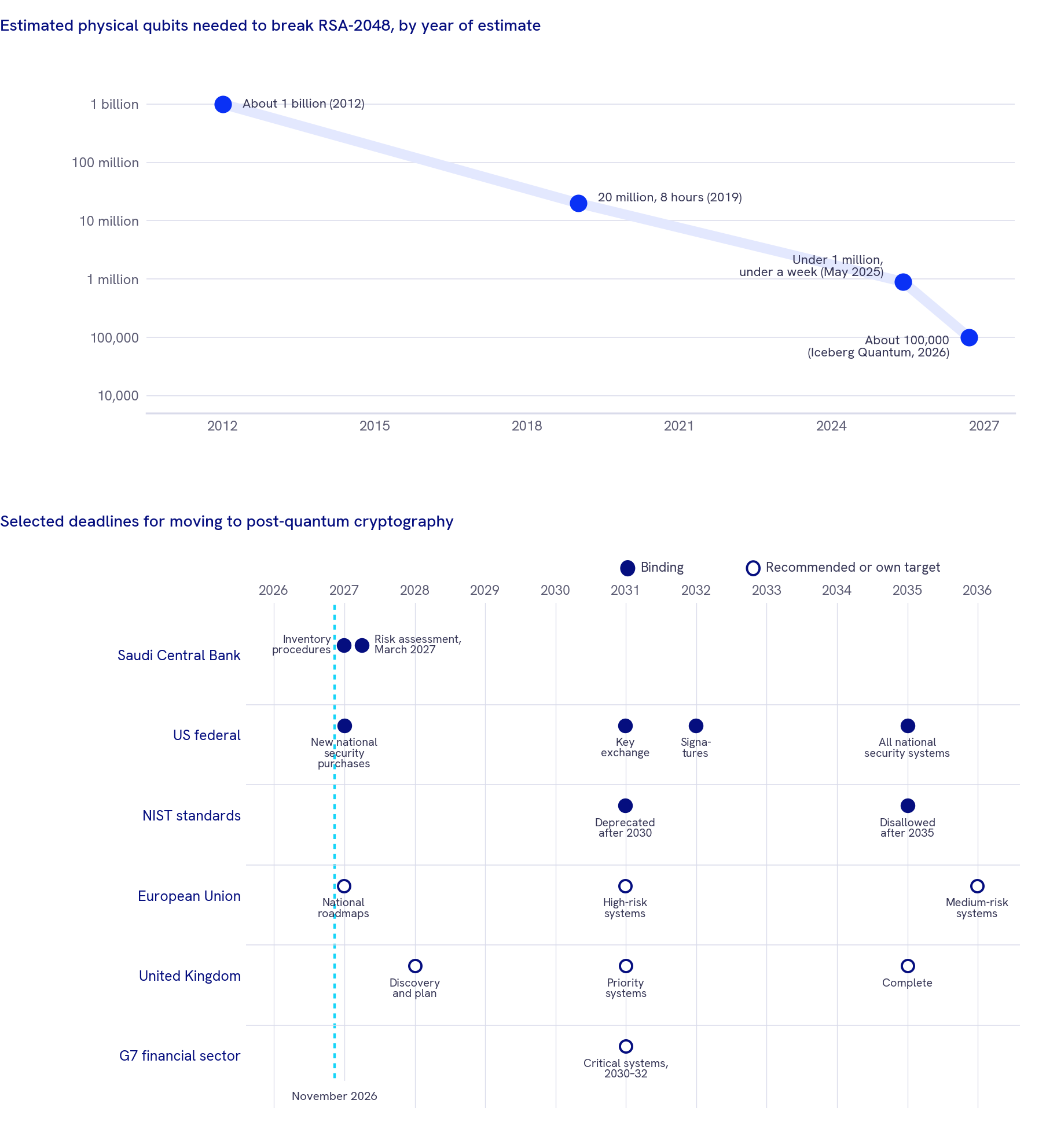
Note: Estimates assume error rates and qubit designs that differ by study. Deadlines are binding for the bodies they apply to (US federal systems, Saudi financial institutions) or recommended (EU, UK, G7). NIST’s dates apply to US federal standards and are widely used as a reference.
Source: arXiv (Gidney and Ekerå; Gidney); Iceberg Quantum; NIST; The White House and OMB; NSA; EU NIS Cooperation Group; UK NCSC; G7 Cyber Expert Group; PostQuantum; Reeve Hayward analysis
The deadlines are now dated. NIST published the first three post-quantum standards in August 2024 and will deprecate today’s public-key methods after 2030 and disallow them after 2035; a US executive order of June 2026 requires the most sensitive federal systems to use post-quantum key exchange by the end of 2030 and signatures by the end of 2031.42 The European Union asks member states to set national roadmaps by the end of 2026 and to move high-risk systems by 2030; the UK’s National Cyber Security Centre sets milestones in 2028, 2031 and 2035; and the G7’s cyber experts expect critical financial systems to move by 2030 to 2032.43 In the Gulf, the Saudi Central Bank has given financial institutions until 31 December 2026 to put procedures for an inventory of their cryptography in place and until 31 March 2027 to complete a quantum risk assessment.44
Preparation is under way in the region. A September 2026 study of organizations in key GCC markets by QuantumGate and the UAE Cyber Security Council found that 64% have a budgeted post-quantum initiative.45
The Gulf: Partnerships, machines and secure networks
The Gulf states have taken complementary routes into quantum technology (Exhibit 8). Qatar’s has been built on partnerships, people and secure networks. In May 2025, Quantinuum and Al Rabban Capital formed a joint venture through which Qatar will invest up to $1 billion in quantum technology; Quantinuum now leases an office in Doha and lists Qatar among its key strategic partnerships.46 Hamad Bin Khalifa University’s Qatar Center for Quantum Computing (QC2), founded with a $10 million grant in 2022, opened Qatar’s first quantum laboratory in May 2025, and its researchers use Quantinuum’s machines through the cloud; in October 2026 the university agreed with Quantum Computing Inc. to install one of its Dirac-3 systems in Qatar.47 In May 2026, Ooredoo, the university and the Ministry of Defense set up Qatar’s first quantum-safe communications link in Ooredoo’s live network, and in October the National Cyber Security Agency set out its plans for the post-quantum era.48 Qatar’s first global quantum computing hackathon, run by the Ministry of Communications and Information Technology in November 2025, drew 474 applications from 64 countries.49
Exhibit 8
Qatar, Saudi Arabia and the UAE are building quantum capability by complementary routes, with most milestones since 2025.
Selected quantum technology milestones, by country, 2021 to 2027,
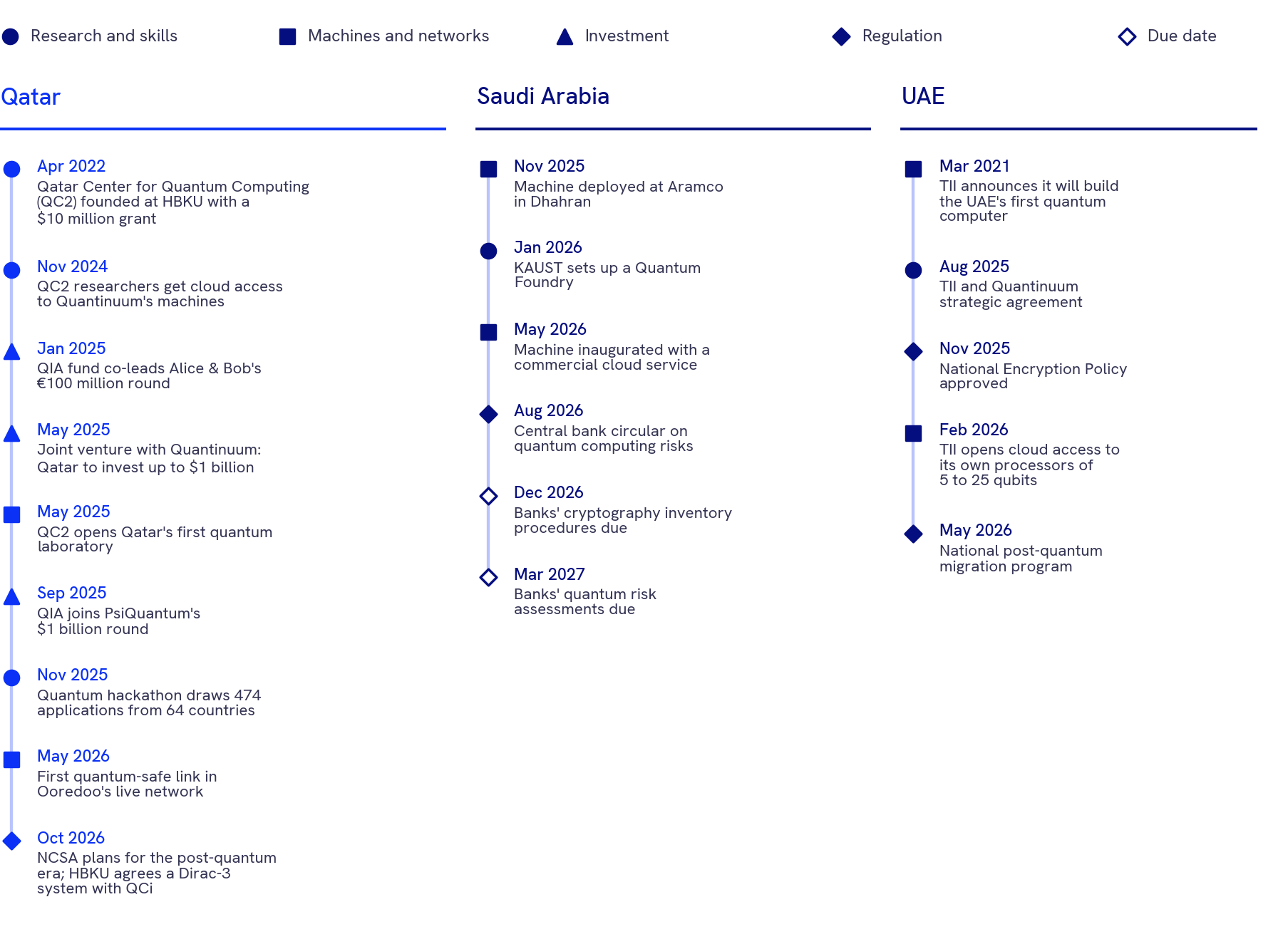
Note: Selection by Reeve Hayward; dates are announcements. The Saudi Central Bank deadlines apply to banks, finance companies and payment firms that it regulates.
Source: HBKU; The White House; Quantinuum (SEC filings); CCI France Qatar; Quantum Policy Forum; The Peninsula; SEC EDGAR (Aramco and Pasqal); PostQuantum; TII; QuantumGate; Reeve Hayward analysis
Qatar’s capital is also invested in the industry abroad. A fund that the Qatar Investment Authority (QIA) runs with France’s Bpifrance co-led a €100 million round for Alice & Bob in January 2025; QIA joined PsiQuantum’s $1 billion round in September 2025 and anchored a London fund for quantum start-ups in November 2025.50
Saudi Arabia hosts the region’s first installed machine: a 200-qubit neutral-atom computer that Pasqal deployed at Aramco in Dhahran in November 2025 and that was inaugurated in May 2026 with a commercial quantum-computing-as-a-service platform. KAUST set up a quantum foundry in January 2026, and the Saudi Central Bank’s circular makes Saudi Arabia the only GCC state so far with dated post-quantum duties.51 The UAE is building its own hardware: the Technology Innovation Institute has offered cloud access to superconducting processors of 5 to 25 qubits made partly in house since February 2026, and a national encryption policy approved in November 2025 requires government entities to plan their move to post-quantum cryptography.52
What boards can do now
The timeline sets the agenda. Fault-tolerant machines are three to five years away on their makers’ own plans, the security deadlines start now, and the companies that gain first will be those that know which of their problems quantum computers can solve and have people who can work with them. Five steps follow:
- Start the cryptography inventory. Know where the business relies on RSA and elliptic-curve encryption, which data must stay secret for ten years or more, and which suppliers hold the keys; the Saudi Central Bank’s first deadline falls on 31 December 2026, and other regulators are likely to set their own.
- Ask suppliers for their post-quantum plans. Banks, telecom operators, cloud providers and software vendors will move first; contracts and renewals are the place to ask for dates.
- Find the problems that matter. Simulation of molecules and materials, scheduling and security are where published results already exist; a short list of a company’s own hard problems, sized by value, is the basis for any pilot.
- Build skills through partners. Cloud access to machines from Quantinuum, IBM, IonQ and others lets teams learn without buying hardware, and Qatar’s university, joint venture and hackathon programs are ways to train people locally.
- Watch the evidence, not the share prices. Peer review of the 2026 records, DARPA’s 2033 test and the delivery of the 2027 to 2029 machines will show whether the roadmaps hold.
The indicators we will follow, in order of the next data point:
- The EU Quantum Act. The European Commission plans to propose it in the fourth quarter of 2026, and the US National Quantum Initiative reauthorization has passed committees in both houses of Congress.53
- The Saudi Central Bank’s deadlines of 31 December 2026 and 31 March 2027, and Qatar’s post-quantum guidance. The first dated duties in the Gulf will show how fast regional institutions move.
- Quantinuum’s Sol in the second half of 2027. The first machine on the roadmaps with about 100 logical qubits will test the claims of the past year.
- Peer review of the 2026 records. Quantinuum’s error-correction results and the 2026 advantage claims are still preprints.
Quantum computing has passed the point where the question was whether it could work; error correction now does what theory said it would, on more than one kind of hardware, and the industry has the money to build the machines its roadmaps describe. What remains uncertain is the timing and the size of the gains, and the useful machines are still years away. The cost of quantum-safe security is more certain, and closer.
The cost of quantum-safe security is more certain, and closer.
For companies in Qatar and the Gulf, that points to a practical sequence: secure the data first, then find the problems worth solving, and build the skills to solve them through the partnerships the region already has. The same questions of timing, priority and capability belong in strategy consulting in Qatar: a technology plan that waits for the machines will start late on the part that cannot wait.
About this report
This report draws only on sources whose terms allow our use, re-checked on November 10, 2026: open-access papers and preprints under open licences on arXiv and in Nature and PRX Quantum; companies' filings with the US Securities and Exchange Commission; government and standards bodies, including NIST, DARPA, the European Union, the UK National Cyber Security Centre and governments' own announcements; universities and research foundations, including Hamad Bin Khalifa University, Harvard, Caltech and USTC; MIT's Quantum Index Report 2026, Crunchbase and PostQuantum under their stated terms. Facts whose sources did not allow our use were replaced from a primary source or left out. Several results cited are preprints that have not been peer reviewed, company roadmaps are statements of intent, and logical qubits are counted differently by each company. Statements about what could happen are analytical judgments, not forecasts. The report does not value any company or recommend any security. It is for information only and is not investment advice.
The Research team at Reeve Hayward prepared this report in Doha. To discuss the findings, contact the team at info@reevehayward.com or +974 5577 4811.
Sources
- Quantinuum Inc., Form 8-K, Exhibit 99.1, November 5, 2026 (SEC EDGAR); “Quantum error correction well below the color code threshold,” arXiv 2610.24077, October 16, 2026 (preprint, CC BY); Google Quantum AI, “Suppressing quantum errors by scaling a surface code logical qubit,” Nature, February 22, 2023 (CC BY).
- Google Quantum AI, “Quantum error correction below the surface code threshold,” arXiv 2408.13687 (CC BY); National Natural Science Foundation of China, January 5, 2026; Harvard Gazette, “A potential quantum leap,” November 12, 2025.
- J. Q. You, arXiv 2510.19846, October 2025 (CC BY).
- MIT Quantum Index Report 2026, “Funding,” qir.mit.edu (CC BY-ND 4.0); Quantinuum Inc., prospectus (Form 424B4), June 5, 2026, SEC EDGAR; Reeve Hayward analysis.
- UK Government, “National Quantum Strategy,” GOV.UK (Open Government Licence); US Department of Commerce and NIST, May 21, 2026.
- DARPA, “Quantum Benchmarking Initiative,” program page, read November 8, 2026.
- IonQ, Form 8-K, February 25, 2026; Quantinuum Inc., prospectus, June 5, 2026; D-Wave Quantum, Form 8-K, February 26, 2026 (SEC EDGAR); Reeve Hayward analysis.
- C. Gidney and M. Ekerå, “How to factor 2048 bit RSA integers in 8 hours using 20 million noisy qubits,” arXiv 1905.09749, May 2019 (CC BY); C. Gidney, “How to factor 2048 bit RSA integers with less than a million noisy qubits,” arXiv 2505.15917, May 21, 2025 (CC BY).
- H.-S. Zhong et al., “Quantum computational advantage using photons,” arXiv 2012.01625, December 2020 (CC BY); Wikipedia, “Quantum supremacy” (CC BY-SA).
- Zhong et al., arXiv 2012.01625; National Natural Science Foundation of China, March 6, 2025.
- Google Quantum AI, arXiv 2506.10191 (CC BY).
- PostQuantum, “IBM’s three quantum advantage claims, fact-checked,” August 1, 2026 (CC BY 4.0).
- Quantinuum Inc., prospectus, June 5, 2026; IonQ, Form 8-K, Exhibit 99.1, November 5, 2025 (SEC EDGAR); Gidney, arXiv 2505.15917 (CC BY).
- Google Quantum AI, arXiv 2408.13687 (CC BY).
- Harvard Gazette, November 12, 2025; National Natural Science Foundation of China, January 5, 2026.
- Quantinuum, arXiv 2610.24077, October 16, 2026, and arXiv 2609.03194, September 2, 2026 (preprints, CC BY); Quantinuum Inc., Form 8-K, November 5, 2026.
- Google Quantum AI, arXiv 2512.13908 (CC BY).
- Harvard Gazette, “Clearing significant hurdle to quantum computing,” September 25, 2025; Caltech, “Caltech team sets record with 6,100-qubit array,” September 24, 2025.
- Quantinuum Inc., prospectus, June 5, 2026; arXiv 2511.05465 (CC BY); IonQ, Form 8-K, Exhibit 99.1, November 5, 2025.
- PostQuantum, analysis of Majorana 2, June 3, 2026 (CC BY 4.0); DARPA, October 7, 2026.
- SeeQC, Form S-1/A, November 6, 2026, describing IBM’s roadmap (SEC EDGAR).
- Quantinuum Inc., Form 8-K, November 5, 2026, and prospectus, June 5, 2026.
- Bleichroeder Acquisition Corp. II, Form 8-K, Exhibit 99.1, May 26, 2026; Infleqtion, Form 8-K, September 24, 2026; IonQ, Form 8-K, Exhibit 99.1, August 6, 2025 (SEC EDGAR).
- Prime Minister of Australia, “Delivering a Future Made in Australia with 400 new technology jobs in Brisbane,” April 30, 2024 (CC BY 4.0).
- DARPA, “Four more teams enter Quantum Benchmarking Initiative’s final stage,” October 7, 2026; DARPA, program page.
- USTC News Center, May 2026.
- MIT Quantum Index Report 2026, “Funding” (CC BY-ND 4.0); Reeve Hayward analysis.
- Source: Crunchbase, Crunchbase News, 2026, news.crunchbase.com.
- SEC EDGAR: Churchill Capital Corp X, Form 8-K, Exhibit 99.1, February 12, 2026; Horizon Quantum, Form 6-K, Exhibit 99.1, March 19, 2026; Crane Harbor, Form 8-K, Exhibit 99.1, March 23, 2026; IQM, Form 6-K, Exhibit 99.1, July 1, 2026; Pasqal, Form 6-K, Exhibit 99.1, August 27, 2026; Quantinuum Inc., prospectus, June 5, 2026.
- IonQ, prospectus supplement (Form 424B5), October 14, 2026.
- Oratomic, “Oratomic raises $775 million in total funding,” October 8, 2026.
- IonQ, Form 8-K, February 25, 2026, and Form 8-K, November 5, 2026; Quantinuum Inc., prospectus, June 5, 2026; D-Wave Quantum, Form 8-K, February 26, 2026 (SEC EDGAR).
- UK Government, GOV.UK, March 2023 and June 23, 2025 (Open Government Licence); US Department of Commerce and NIST, May 21, 2026; Cabinet Office of Japan (Public Data License 1.0); Government of France, info.gouv.fr, May 26, 2026 (Licence Ouverte 2.0).
- The White House, fact sheet, May 14, 2025; US Department of State, joint statement on the Qatar–United States Strategic Dialogue, December 20, 2025.
- Google researchers, “Fast quantum simulation of electronic structure by spectrum amplification,” arXiv 2502.15882, February 21, 2025 (preprint, CC BY).
- Nature, “Certified randomness using a trapped-ion quantum processor,” March 26, 2025 (CC BY); IonQ, Form 8-K, August 6, 2025; D-Wave Quantum, Form 8-K, Exhibit 99.2, March 31, 2025 (SEC EDGAR).
- University of Toronto, January 27, 2025; arXiv 2402.08210 (CC BY).
- Aramco and Pasqal, joint release of May 18, 2026, filed by Bleichroeder Acquisition Corp. II as Form 425, May 19, 2026 (SEC EDGAR).
- NIST, “Transition to Post-Quantum Cryptography Standards,” NIST IR 8547, final, October 27, 2026, p. 1.
- Gidney, arXiv 2505.15917 (CC BY); Iceberg Quantum, “Pinnacle 1.1,” September 22, 2026.
- evolutionQ, “Quantum Threat Timeline Research Report 2025,” report page, 2026.
- NIST, August 13, 2024; NIST IR 8547, October 27, 2026; Executive Order 14412, June 22, 2026, and OMB Memorandum M-26-15, June 24, 2026, as cited in NIST IR 8547.
- NIS Cooperation Group, “A coordinated implementation roadmap for the transition to post-quantum cryptography,” June 2025; NCSC, “Timelines for migration to post-quantum cryptography,” March 20, 2025 (Open Government Licence); G7 Cyber Expert Group, January 2026, as published on GOV.UK.
- PostQuantum, on the Saudi Central Bank’s circular of August 27, 2026, September 18, 2026 (CC BY 4.0).
- QuantumGate, release of September 15, 2026, quantumgate.ae.
- The White House, fact sheet, May 14, 2025; US Department of State, joint statement, December 20, 2025; Quantinuum Inc., prospectus, June 5, 2026.
- HBKU, April 13, 2022, November 12, 2024, May 25, 2025, and October 5, 2026.
- HBKU, release on the quantum-safe link, May 2026; The Peninsula, October 6, 2026.
- Ministry of Communications and Information Technology, as published by HBKU, November 2025.
- CCI France Qatar, February 9, 2025; Quantum Policy Forum, qpf.org; PostQuantum, November 24, 2025 (CC BY 4.0).
- Bleichroeder Acquisition Corp. II, Form 425, May 19, 2026; Pasqal, Form F-1, September 9, 2026 (SEC EDGAR); Quantum Policy Forum, January 21, 2026; PostQuantum, September 18, 2026.
- Technology Innovation Institute, February 23, 2026; PostQuantum, December 1, 2025 (CC BY 4.0); QuantumGate, May 19, 2026.
- European Commission, “Have your say,” initiative 15512 (CC BY 4.0); Congress.gov, S.3597.
To discuss what this means for your business, speak with our team. Initial conversations are confidential and without obligation.
Speak with our team


