

Firms with fewer than 100 workers created 71% of the new jobs in Qatar's businesses between the 2010 and 2020 censuses. This report sets out their finance, support and 2030 targets.
Qatar’s small firms have been the main source of new private-sector jobs. Between the 2010 and 2020 censuses, business establishments rose 131% to 71,203 and the people they engaged rose 60% to 1.66 million. Establishments with fewer than 100 workers accounted for 71% of that increase, lifting their share of business employment from 27% to 43% (Exhibit 1).1
Exhibit 1
Qatar’s mSMEs at a glance: most firms, a rising share of jobs and growing access to finance.
Selected indicators for micro, small and medium enterprises in Qatar, latest available, 2020–25
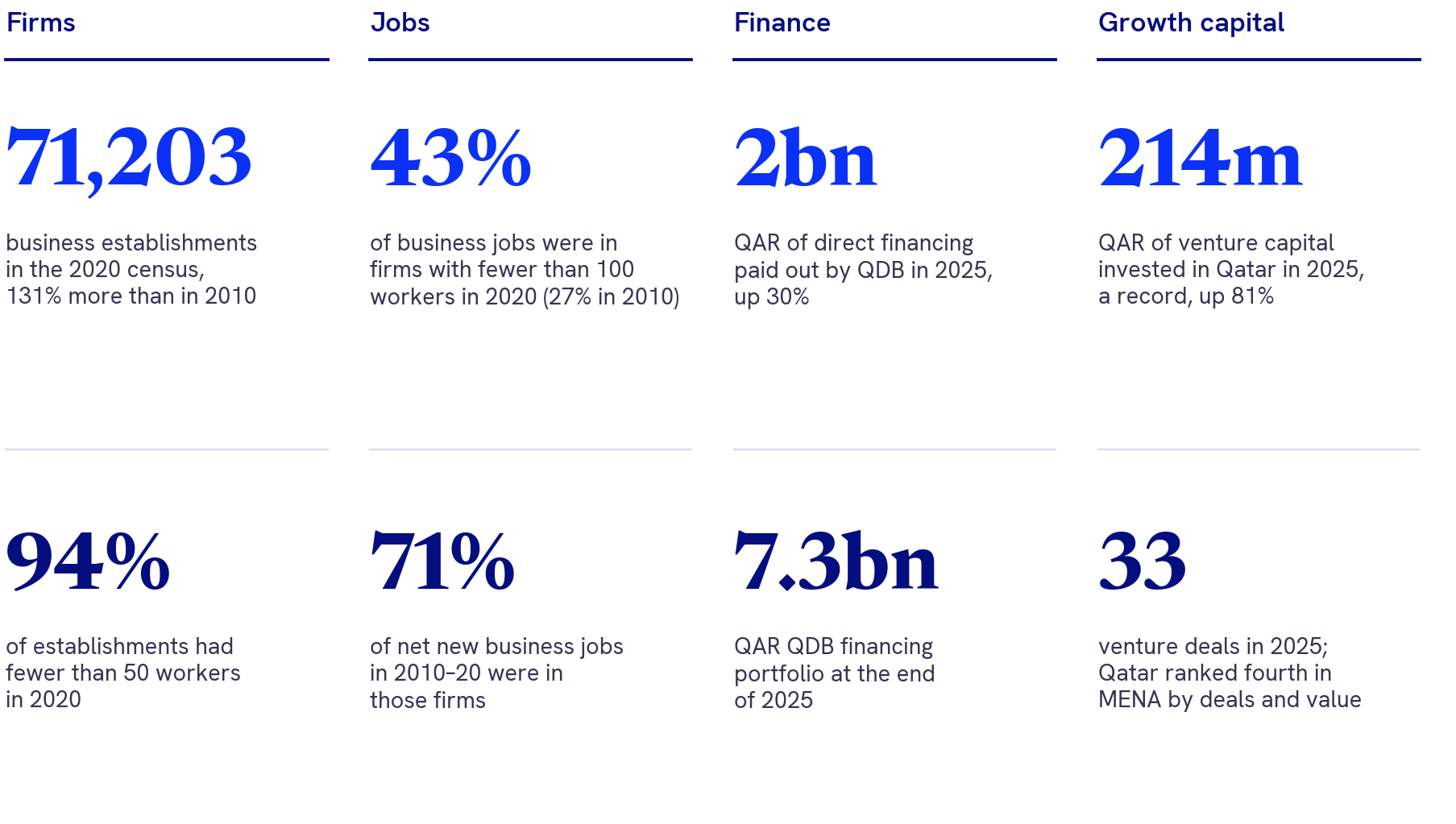
Note: Census figures count business establishments (single places of business) by number of workers. QDB and venture capital figures are for 2025.
Source: NPC, censuses 2010 and 2020; QDB, as reported by Qatar Tribune, January 5 and February 2, 2026; Reeve Hayward analysis
More of these firms are drawing on development finance and risk capital. Qatar Development Bank (QDB) paid out 30% more in direct financing in 2025, venture investment reached a record, and on 9 November 2026 Qatar Central Bank (QCB) let banks lend against card and electronic-payment revenues.2 The Third National Development Strategy (NDS3) aims for 7% of commercial credit to go to SMEs by 2030.3
The question for 2030 is how to turn a broad base of small firms into more growing, bankable medium-sized companies. This report covers the definition, numbers, jobs, economic weight, finance and support of micro, small and medium enterprises (mSMEs), where Qatar stands against its 2030 targets, and what could help (see sidebar, “About the research”).
What counts as an mSME: One national definition since 2018
Qatar has used a single definition of small business since 2018. Ministerial Decision 250 of 2018 of the Ministry of Commerce and Industry (MOCI) classifies private, profit-seeking companies by headcount and annual revenue: micro enterprises have up to 10 workers and up to QAR 1 million of revenue; small enterprises have 11 to 50 workers and QAR 1 million to QAR 20 million; and medium enterprises have 51 to 250 workers and QAR 20 million to QAR 100 million (Exhibit 2). Ministries, public bodies and companies in which the state is a shareholder fall outside the definition, but a private firm keeps its status when investors such as venture capital funds or universities hold up to 50% of it.4
Exhibit 2
Qatar classifies mSMEs by workers and revenue, and each band is far wider than the one below it.
National definition of micro, small and medium enterprises, Ministerial Decision 250 of 2018, circle area proportional to the upper limit of each band
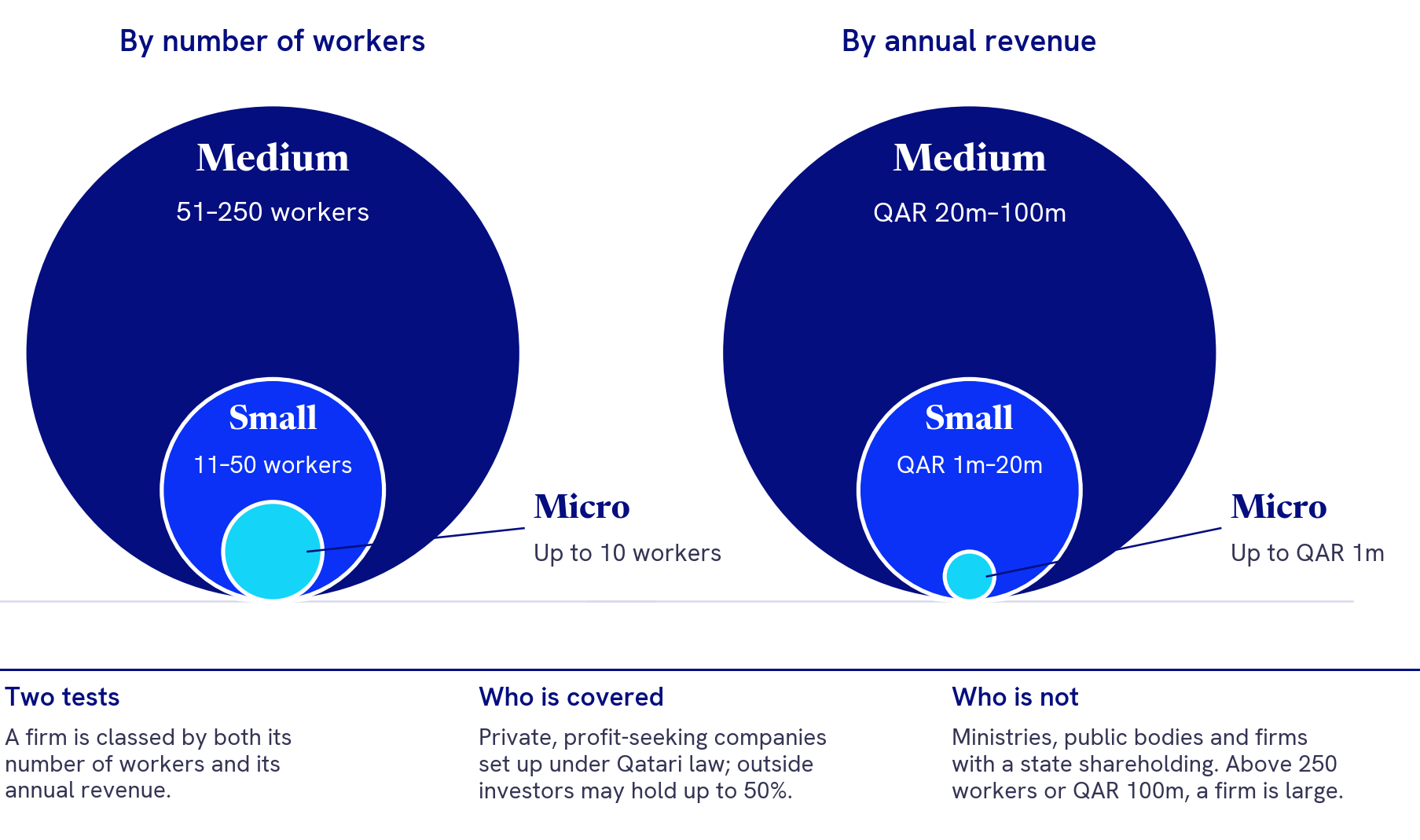
Note: Upper limits are 10, 50 and 250 workers and QAR 1 million, 20 million and 100 million of annual revenue.
Source: Ministry of Commerce and Industry, Decision 250 of 2018, as published by The Peninsula; Reeve Hayward analysis
The definition is the key to support. Under the government tender rules, a public body may limit tenders worth less than QAR 5 million to micro, small or medium firms, and micro and small firms pay half the classification fee.5
Neighbors draw the lines differently. Saudi Arabia’s General Authority for Statistics counts micro establishments as those with one to five employees, small as six to 49 and medium as 50 to 249, lower headcount bands than Qatar’s (Exhibit 3).6 Shares of “SMEs” across the Gulf therefore describe different groups of firms, a point that matters for any comparison.
Exhibit 3
Qatar defines mSMEs by workers and revenue; Saudi Arabia’s statistics use lower headcount bands.
Size bands for micro, small and medium enterprises, Qatar and Saudi Arabia, as of November 2026
| Qatar | Saudi Arabia | |
|---|---|---|
| Micro | Up to 10 workers; revenue up to QAR 1 million | 1–5 employees |
| Small | 11–50 workers; QAR 1 million–20 million | 6–49 employees |
| Medium | 51–250 workers; QAR 20 million–100 million | 50–249 employees |
| Basis | MOCI Decision 250 of 2018 | GASTAT, Small and Medium Establishments Statistics 2024 |
Note: Qatar’s bands are its national definition. Saudi Arabia’s are the employee bands used in its official statistics on small and medium establishments.
Source: Ministry of Commerce and Industry, as published by The Peninsula; General Authority for Statistics, Saudi Arabia; Reeve Hayward analysis
How many there are: 71,203 establishments, most with fewer than ten workers
The 2020 census counted 71,203 business establishments engaging 1,657,346 people; 99% of the establishments, and 96% of the people, were in the private sector.7 Two-thirds of establishments (67.5%) had fewer than 10 workers, and 94% had fewer than 50 (Exhibit 4). Employment is spread the other way. Establishments with fewer than 10 workers engaged 10% of the business workforce and those with 10 to 49 workers 24%, while the 367 establishments with 500 or more workers, 0.5% of the total, engaged 36%.
Exhibit 4
Two-thirds of Qatar’s business establishments have fewer than ten workers, and those with fewer than 50 engage a third of the business workforce.
Business establishments and persons engaged, by number of workers in the establishment, Qatar, December 2020, % of total
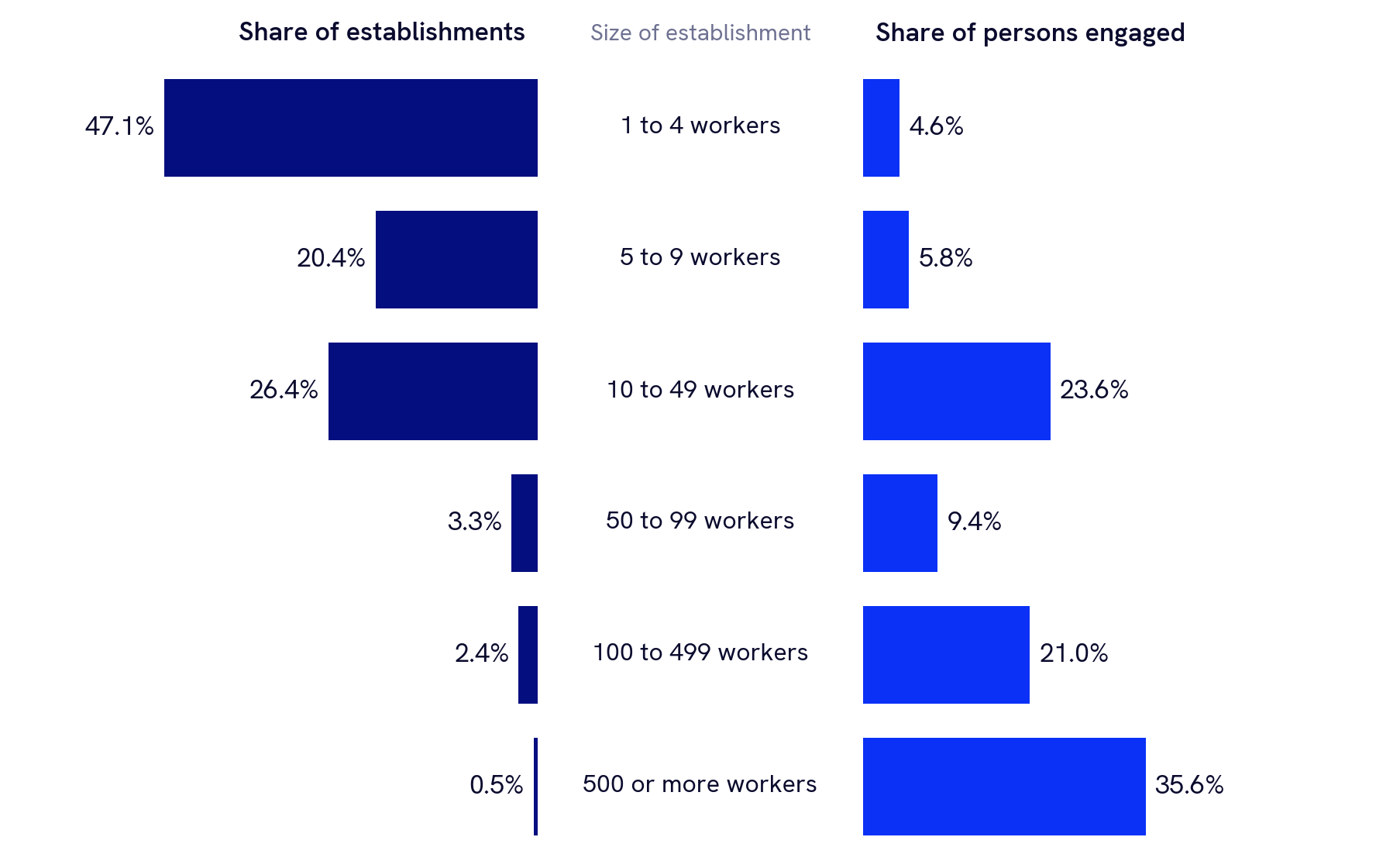
Note: 71,203 establishments; 1,657,346 persons engaged. Business establishments exclude ministries, government departments and diplomatic missions. Figures may not sum to 100% because of rounding.
Source: NPC, General Population, Housing and Establishments Census 2020, Table 156; Reeve Hayward analysis
Administrative data on the national thresholds tell the same story. In March 2019, the Ministry of Labour’s Wage Protection System covered 80,396 entities with 1.78 million workers. Of these, 55,669 had 10 workers or fewer and 20,107 had 11 to 50, so entities that are micro or small by headcount made up 94% of the total and employed 36% of the workers covered.8 Ministers put the share of SMEs among private companies at 98%.9 The NPC’s annual economic surveys, the most recent size data after the census, show the pattern holding in 2022: in the sectors they cover, establishments with fewer than 10 workers made up 63% of establishments and 9% of employees.10 A full update is on its way: the 2025 census is Qatar’s first drawn entirely from administrative records, which should allow more frequent counts by size in future.11
New firms keep arriving. MOCI issued about 28,000 new commercial registrations in 2025, 57% more than in 2024, followed by 6,328 in the first quarter of 2026, up 18.5% on a year earlier, and 6,745 in the second.12 Setting up a company now takes two days, and since 14 September 2026 the new Companies House has registered and licensed firms for the Qatar Financial Centre, Qatar Free Zones, Qatar Science and Technology Park and Media City in one place.13
Where small firms carry the jobs depends on the sector (Exhibit 5). In 2020, establishments with fewer than 50 workers engaged 61% of the people in wholesale and retail trade, 71% in hotels and restaurants, 83% in agriculture and fishing and 93% in other services such as repairs and personal services. In construction, the largest employer with 661,478 people, they engaged 19%, and in health and in utilities fewer than one in five. Manufacturing sits between the two: 90% of its 3,960 establishments had fewer than 50 workers, and they engaged 34% of its workforce.14
Exhibit 5
Small establishments carry most jobs in trade, hospitality and personal services; large ones carry most in construction, health and utilities.
Establishments with fewer than 50 workers: share of establishments and of persons engaged, by main economic activity, Qatar, December 2020, %
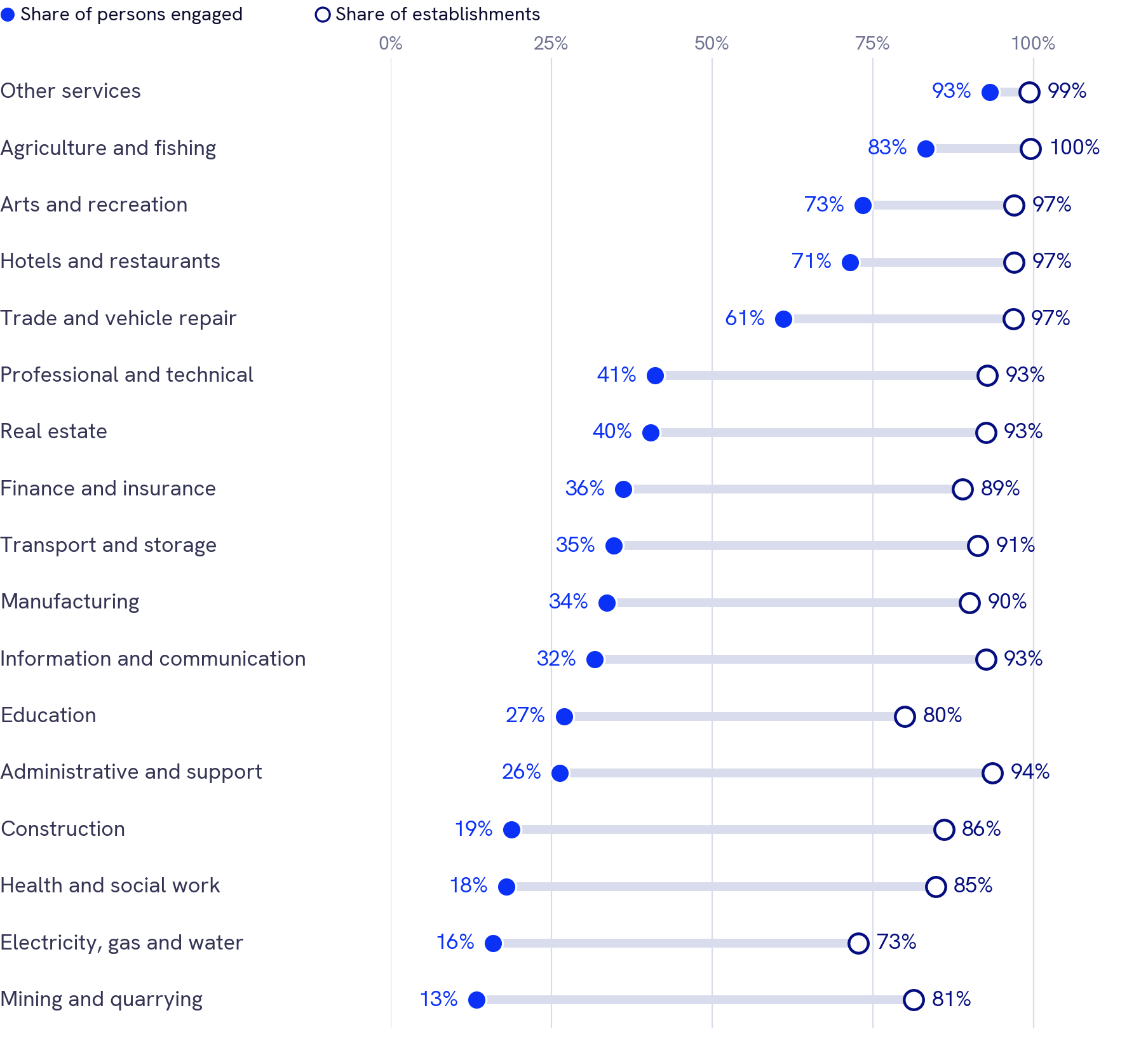
Note: Activities follow ISIC Rev. 4. Other services include repair of household goods and personal services. Utilities are electricity, gas, water and waste.
Source: NPC, General Population, Housing and Establishments Census 2020, Table 151; Reeve Hayward analysis
Who works in them: Firms with fewer than 100 workers created most of the new jobs
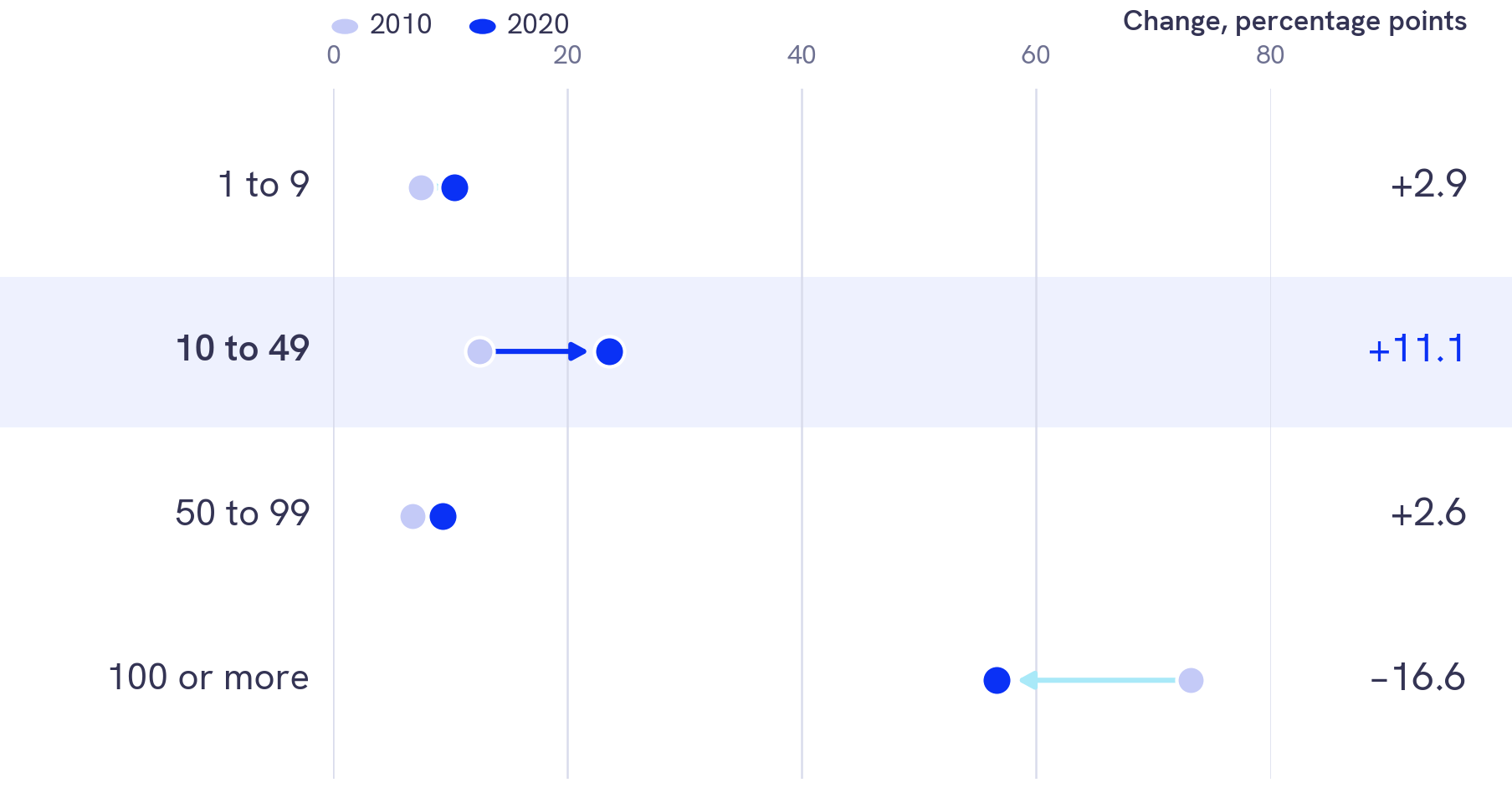
The census series shows smaller firms gaining ground over the decade (Exhibit 6). Between 2010 and 2020, the number of people engaged in establishments with 10 to 49 workers tripled, from 130,164 to 391,125, and their share of business employment rose from 12.5% to 23.6%. Establishments with fewer than 100 workers added 440,840 of the 619,559 net new jobs in business establishments, or 71%, while employment in establishments with 100 or more workers grew 24%, so their share eased from 73% to 57%.15 Because the census counts places of business, a company with several branches can appear as several small establishments; statements that count companies put SMEs’ share of jobs lower, at 15% (MOCI, 2025).
Exhibit 6
Establishments with 10 to 49 workers almost doubled their share of business employment between 2010 and 2020.
Share of persons engaged in business establishments, by number of workers in the establishment, Qatar, 2010 and 2020, % of total; change in percentage points
Note: Census bands; 2020 figures combine the bands 10–34 and 35–49, and 100–499 and 500 or more. Persons engaged: 1,037,787 in 2010 and 1,657,346 in 2020.
Source: NPC, censuses 2010 and 2020 (Table 156); Qatar Open Data Portal; Reeve Hayward analysis
The private sector employs most of Qatar’s workforce. The Labour Force Survey counted 2,355,504 employed people in 2025, and 78.9% of those counted by sector worked for private employers; 2,988 people were unemployed, about 0.1% of the labour force.16 Qataris are a growing part of that picture. In 2024, 10,223 economically active Qataris worked in private companies and 11,454 in mixed companies, together 17.0% of the Qatari workforce; NDS3 aims for more than 20% by 2030.17 The Ministry of Labour’s workforce strategy for 2024–2030 seeks to raise the share from 17% to 20%, creating opportunities for about 15,400 more Qataris.18
Scale lifts output per worker, which is why helping small firms grow matters as much as creating new ones. In 2022, construction establishments with fewer than 50 workers generated QAR 68,016 of value added per worker, 90% of the QAR 75,684 in larger ones, and paid average annual wages of QAR 29,197 against QAR 43,497. In restaurants, establishments with fewer than 10 workers produced QAR 47,289 per worker, 69% of the level in larger restaurants.19
Scale lifts output per worker, which is why helping small firms grow matters as much as creating new ones.
What they add to the economy: About a tenth of GDP, in a non-hydrocarbon economy that keeps growing
The non-hydrocarbon economy, where almost all mSMEs work, has grown from just over half of real GDP in 2013 to almost two-thirds in 2025: 53.6% to 65.4% at constant 2018 prices (Exhibit 7). In real terms it grew 53% over those 12 years, and by 4.4% in 2024 and 4.9% in 2025, above the NDS3 average of 4% a year.20 In 2026, regional developments affecting shipping and exports have weighed on hydrocarbon output, while the non-hydrocarbon economy grew 2.6% year on year in the second quarter, led by real estate, finance and insurance, construction and trade.21
Exhibit 7
The non-hydrocarbon economy has grown from just over half of Qatar’s real GDP in 2013 to almost two-thirds in 2025.
Non-hydrocarbon share of GDP, Qatar, 2013–25, %
| Year | Constant prices | Current prices |
|---|---|---|
| 2013 | 53.6 | 44.3 |
| 2014 | 56.2 | 47.5 |
| 2015 | 58.5 | 62.5 |
| 2016 | 60.1 | 70.3 |
| 2017 | 60.4 | 66.0 |
| 2018 | 61.0 | 61.0 |
| 2019 | 61.9 | 64.3 |
| 2020 | 61.3 | 71.0 |
| 2021 | 62.0 | 63.2 |
| 2022 | 62.9 | 55.7 |
| 2023 | 63.2 | 61.4 |
| 2024 | 64.1 | 62.6 |
| 2025 | 65.4 | 65.1 |
Note: Non-hydrocarbon is GDP outside mining and quarrying (oil and gas). Annual figures are sums of quarters. The share at current prices moves with oil and gas prices. Constant prices are 2018 prices.
Source: National Planning Council, quarterly GDP by economic activity, Qatar Open Data Portal (CC BY 4.0); modified by Reeve Hayward
Official statements put SMEs at about a tenth of the economy: 10% of GDP and 15% of jobs, according to MOCI’s Minister of State for Foreign Trade Affairs in April 2025, and 15% to 17% of non-oil GDP, according to Qatar Chamber in 2022.22 The two figures agree with each other: 15% to 17% of a non-oil economy worth 63% to 65% of GDP is about 10% to 11% of GDP. NDS3 sets a target of 6% average annual growth in SMEs’ contribution to non-hydrocarbon GDP to 2030.23
How they are financed: A 7% credit target, more development finance and record venture capital
Not every small firm needs a bank loan. Many micro firms in trade, personal services and hospitality run with modest fixed assets and short trading cycles, and their owners’ savings and reinvested profits cover most of their needs; bank credit matters most to firms that are adding capacity. NDS3 aims for 7% of commercial credit to go to SMEs by 2030.24 The route to that target runs mainly through small firms that are growing into the medium band, rather than through bank lending to every micro business.
QDB’s own lending grew in 2025. Its direct disbursements rose 30% to QAR 2 billion, and its total financing portfolio reached QAR 7.3 billion, with financing commitments to more than 630 companies.25 In November 2025 it launched TAMKEEN, a single digital application for business funding, alongside a Credit Guarantee Program with an initial QAR 3 billion.26 The QCB rules of 9 November 2026 add a route built on cash flow rather than collateral: banks may lend up to 30% of a firm’s average annual revenue from point-of-sale and verified electronic payments, over two years, with up to six months’ grace.27
Risk capital reached a record in 2025. Venture investment in Qatar rose 81% to QAR 214 million across 33 deals, placing Qatar fourth in the Middle East and North Africa by both deals and value, and private and foreign investors supplied 86% of it.28 QDB’s Startup Qatar Investment Program received more than 5,000 applications from over 65 countries in 2025 and has invested more than QAR 138 million in over 35 companies.29
What supports them: A full life cycle of programs, centered on QDB
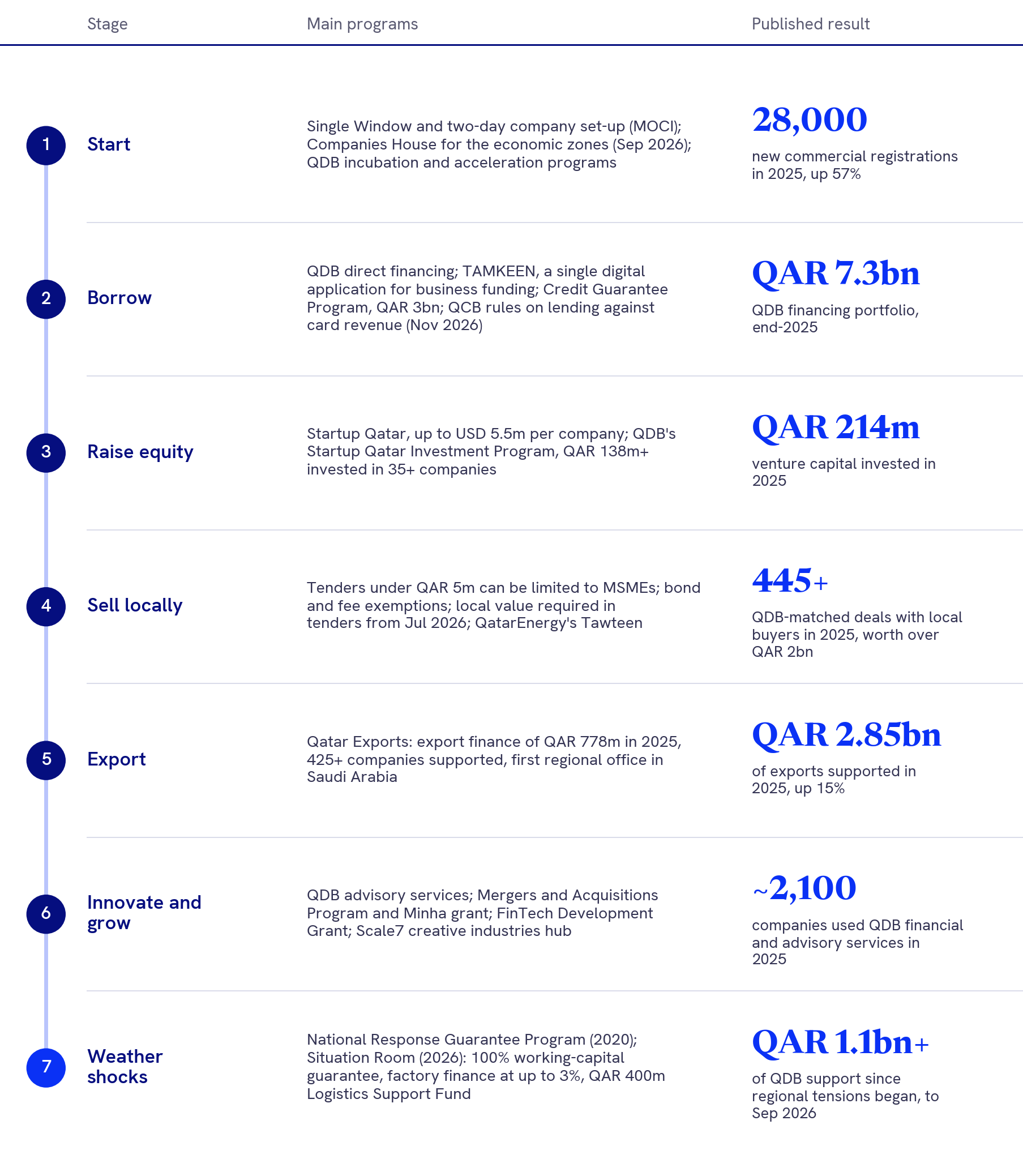
Qatar delivers most of its support for mSMEs through its development bank (Exhibit 8). In 2025, the first year of QDB’s 2025–2030 strategy, nearly 2,100 companies used the bank’s financial and advisory services.30 Around it, MOCI sets the definition and runs licensing, the Ministry of Finance runs public procurement, and Invest Qatar leads Startup Qatar, which offers up to $5.5 million per company.31
Exhibit 8
Qatar’s support for mSMEs covers every stage of a firm’s life, from start-up to exports and shocks.
Main public programs for mSMEs by stage of the business life cycle, Qatar, and one published result for each, as of November 2026
Note: Reeve Hayward selection. Results are as published by each body; QDB’s localisation deals match SMEs with local entities.
Source: MOCI; The Peninsula; Qatar Tribune (QDB releases); Qatar Chamber; Reeve Hayward analysis
Public demand is opening to small firms. Under the tender regulations as amended in 2022, a government body may limit tenders below QAR 5 million to micro, small or medium firms, and micro and small firms pay half the classification fee.32 The Ministry of Finance reports QAR 150 million of bond exemptions, QAR 21 million of fee exemptions and mSME participation in more than 11,500 tenders; local value became a condition of government tenders from July 2026, and the 2026 procurement plan lists 4,464 tenders.33 Large buyers are opening their supply chains too: QatarEnergy runs its Tawteen localisation program, and QDB matched SMEs with local entities in more than 445 deals worth over QAR 2 billion in 2025.34
Exports and hard times are covered as well. QDB’s Qatar Exports supported QAR 2.85 billion of exports in 2025, up 15%, and provided QAR 778 million of export finance; it supported more than 425 companies in 138 markets and opened its first regional office in Saudi Arabia.35 In 2020 the National Response Guarantee Program backed bank loans for salaries and rent for about 4,000 firms.36 Since March 2026, QDB’s Situation Room has answered regional developments with a 100% working-capital guarantee for service firms, factory finance at a profit rate of up to 3% and a QAR 400 million Logistics Support Fund that covers up to 80% of extra shipping costs, and QDB reports more than QAR 1.1 billion of support since regional tensions began.37 Qatar’s model concentrates finance, guarantees, equity and advisory services in one institution, which keeps the offer joined up.
The 2030 targets: Where Qatar stands
Qatar National Vision 2030 calls for a diversified economy with a larger role for the private sector, including support to help small and medium enterprises start and grow, without setting numbers.38 NDS3 turns that aim into measurable targets for 2030, and the ministries’ own plans add more: MOCI’s strategy for 2024–2030 targets 3.4% annual growth in the non-oil economy and $100 billion of foreign direct investment, with support for SMEs among its themes.39
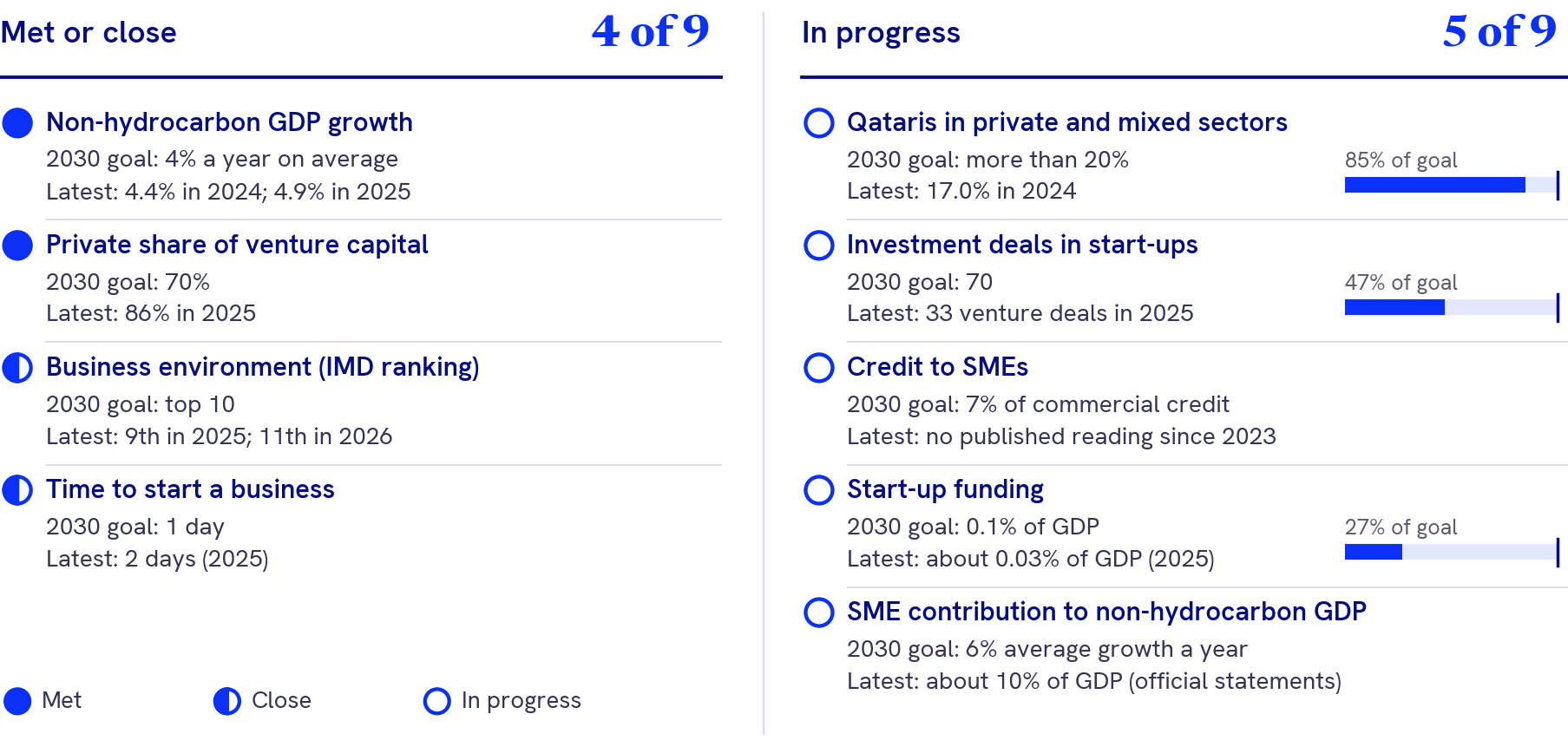
On the targets that bear on mSMEs, Qatar has met or come close to four of nine (Exhibit 9). Non-hydrocarbon growth has beaten the 4% average, private and foreign investors supplied 86% of venture capital against a 70% target, Qatar ranked ninth in the IMD World Competitiveness Ranking in 2025 and fifth in business efficiency, and a company can be set up in two days against a one-day goal.40 The start-up funding, workforce and credit targets are further off. Start-up funding of QAR 214 million in 2025 was about 0.03% of GDP against a goal of 0.1%, and the Qatari share of private-sector jobs stood at 17% against more than 20%. Progress on the 7% credit target and on the SME contribution to non-hydrocarbon GDP will be clearest once a regular published SME series tracks them, one of the moves set out below.
Exhibit 9
Qatar has met or come close to four of its nine NDS3 targets that bear on mSMEs; the credit and funding goals have furthest to go.
NDS3 targets relevant to micro, small and medium enterprises, 2030 goal and latest reading, as of November 2026
Note: Status is Reeve Hayward’s assessment; “close” means within one rank or one day of the goal. Bars show the latest reading as a share of the 2030 goal (Reeve Hayward calculation). Start-up funding is venture capital as a share of 2025 GDP at current prices.
Source: NDS3; NPC; Qatar Open Data Portal (CC BY 4.0); Qatar Tribune; IMD, as reported by NPC and TradeArabia; MOCI; Reeve Hayward analysis
What could help: Seven moves to 2030
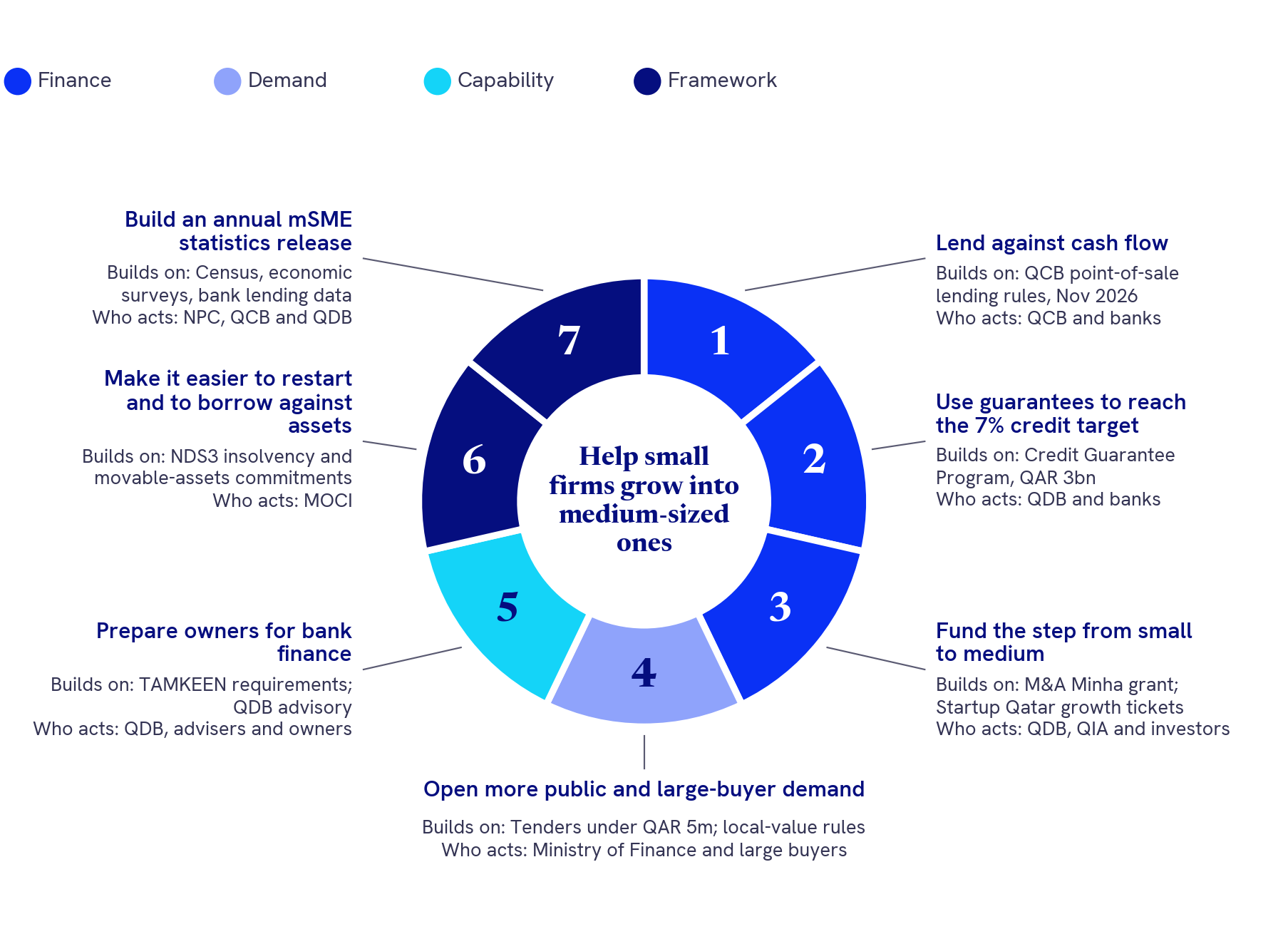
The data point to one priority above the others: helping small firms become medium-sized ones. Firms with 10 to 49 workers tripled their employment in a decade, and larger firms produce more per worker. Seven moves would support that, most of them extensions of programs already in place (Exhibit 10). Three concern finance, one opens more demand from public and large buyers, one prepares owners for bank finance and two strengthen the framework.
Exhibit 10
Seven moves, most of them extensions of programs already in place, would help more small firms grow into medium-sized ones.
Proposed moves to 2030 for micro, small and medium enterprises in Qatar, by area, with the program each builds on and who acts, Reeve Hayward analysis
Note: The moves are Reeve Hayward’s proposals. “Builds on” names the existing program, rule or commitment each move extends.
Source: The Peninsula; Qatar Tribune; NDS3; NPC; Reeve Hayward analysis
For owners, the same evidence suggests a practical sequence: keep audited accounts and cash-flow records that banks and development lenders can use, register for the guarantees and local-value certificates that public buyers now require, and plan expansion with a clear financing case. Lenders often ask for a feasibility study or business plan, which is where feasibility studies and business plans in Qatar help owners turn a growth idea into a bankable application.
The indicators we will follow, in order of the next data point:
- Take-up of the QCB point-of-sale financing rules. The first lending against card and e-payment revenue will show whether cash-flow lending can reach micro firms.
- A regular SME credit series and the Credit Guarantee Program’s results. They would show progress toward the 7% target and the first full year of the new guarantees.
- The Ministry of Labour’s workforce strategy. Progress toward a 20% Qatari share of private-sector jobs will show how far small firms are drawing in national talent.
- The bankruptcy and movable assets laws. Both are NDS3 commitments that would widen what small firms can borrow against.
- Results of the 2025 census. Qatar’s first census drawn from administrative records will show whether firms with fewer than 100 workers have kept their lead in creating jobs since 2020.
Qatar’s mSMEs are already the main engine of new private jobs, they are drawing more development finance and venture capital than before, and they sit inside a support system that reaches from licensing to exports and through regional shocks. What 2030 asks is that more of them grow: 7% of commercial credit, more start-up funding and more Qataris in private firms.
The tools for that are largely in place. Finance that follows cash flow, guarantees, public demand and better data would let the firms that created most of the past decade’s jobs grow into the medium-sized companies that NDS3 needs.
About this report
This report draws on official statistics and publications read on November 9 and 10, 2026: the National Planning Council's censuses of 2010, 2015 and 2020, annual economic surveys, Labour Force Survey and quarterly national accounts on the Qatar Open Data Portal; NDS3; releases of the Ministry of Commerce and Industry and the National Planning Council; Ministry of Labour data published by the ILO; announcements by Qatar Development Bank, Qatar Central Bank and ministries as reported by The Peninsula and Qatar Tribune; Qatar Chamber; and Saudi Arabia's General Authority for Statistics. Census figures describe establishments by number of workers and approximate the national mSME definition by headcount only, and definitions differ across countries. Statements about what could happen are analytical judgments, not forecasts. It is for information only and is not investment advice.
The Research team at Reeve Hayward prepared this report in Doha. To discuss the findings, contact the team at info@reevehayward.com or +974 5577 4811.
Sources
- National Planning Council (NPC), “General Population, Housing and Establishments Census 2020,” final results, Tables 151 and 156, December 2020; NPC, census 2010 and 2015 establishment tables, Qatar Open Data Portal, read November 9, 2026; Reeve Hayward analysis.
- Qatar Tribune, “QDB records exceptional year in empowering private sector,” January 5, 2026; Qatar Tribune, “Qatar VC investments surge 81% to record QR214 mn in 2025: QDB,” February 2, 2026; The Peninsula, “Qatar Central Bank eases access to financing for MSMEs through POS revenues,” November 9, 2026.
- NPC, “Third Qatar National Development Strategy 2024–2030,” January 2024, p. 18.
- The Peninsula, “Ministry highlights decision on unified definition of SMEs,” November 21, 2018.
- The Peninsula, “Qatar to implement local value system in govt tendering,” August 10, 2022.
- General Authority for Statistics (GASTAT), “Small and Medium Establishments Statistics 2024.”
- NPC, Census 2020, Table 156, “Business establishments and persons engaged by employment size and sector,” December 2020.
- International Labour Organization (ILO), “Assessment of the Wage Protection System in Qatar,” June 2019, Table 2 (Ministry of Labour data, March 2019). Government, oil and gas, the Qatar Financial Centre and domestic workers are outside the system.
- Ministry of Commerce and Industry, “Minister of State for Foreign Trade Affairs Participates in the Annual SME Forum in Berlin,” April 13, 2025.
- NPC, annual economic surveys by size of establishment, 2022 (energy and industry, trade, business services, transport, hotels and restaurants), Qatar Open Data Portal; Reeve Hayward analysis.
- The Peninsula, “NPC hosts workshop on Simplified General Census of Population, Housing and Establishments 2025,” May 29, 2025.
- The Peninsula, “Meeting reviews MoCI’s key achievements, qualitative initiatives in fourth quarter of 2025,” February 18, 2026; Ministry of Commerce and Industry, first-quarter 2026 performance review, May 24, 2026, and second-quarter 2026 performance review, September 1, 2026.
- Ministry of Commerce and Industry, third-quarter 2025 performance review, October 29, 2025; Ministry of Commerce and Industry, “H.E. the Minister of Commerce and Industry Launches ‘Companies House’,” September 15, 2026.
- NPC, Census 2020, Table 151, “Business establishments and persons engaged by number of employees and main economic activity”; Reeve Hayward analysis.
- NPC, censuses 2010, 2015 and 2020; Reeve Hayward analysis. The 2020 bands of 10–34 and 35–49 workers, and of 100–499 and 500 or more, are added to match the 2010 bands.
- NPC, Labour Force Sample Survey 2025, tables on the Qatar Open Data Portal (employed persons by sector exclude those temporarily absent from work); Reeve Hayward analysis.
- NPC, Labour Force Survey 2024, economically active Qatari population by sector; NDS3, p. 22; Reeve Hayward analysis.
- The Peninsula, “Enhancing national talent” (editorial), November 5, 2026.
- NPC, annual economic surveys: “Main economic indicators by size of establishment, building and construction” and “Economic indicators in hotels and restaurants by activity,” 2022, Qatar Open Data Portal.
- NPC, quarterly gross domestic product by economic activity at constant 2018 prices and at current prices, Qatar Open Data Portal (CC BY 4.0), read November 10, 2026; annual figures are sums of quarters; NDS3, p. 19; Reeve Hayward analysis.
- NPC, “Qatar’s Non-Hydrocarbon GDP Grows by 2.6% YoY in Q2 2026,” September 30, 2026.
- Ministry of Commerce and Industry, April 13, 2025; Qatar Chamber, statement by its chairman on SMEs, July 18, 2022.
- NDS3, p. 19.
- NDS3, p. 18.
- Qatar Tribune, January 5, 2026.
- Qatar Tribune, “QDB introduces unified digital platform for business funding,” November 4, 2025.
- The Peninsula, November 9, 2026.
- Qatar Tribune, “Qatar VC investments surge 81% to record QR214 mn in 2025: QDB,” February 2, 2026.
- Qatar Tribune, January 5, 2026.
- Qatar Tribune, January 5, 2026.
- The Peninsula, “Qatar prioritises AI, advanced manufacturing and sustainability in 2026 investment drive,” March 15, 2026.
- The Peninsula, August 10, 2022.
- The Peninsula, October 7, 20 and 21, 2025 (Government Procurement Plan Forum 2026).
- Qatar Tribune, January 5, 2026.
- Qatar Tribune, January 5, 2026; Ministry of Commerce and Industry, “H.E. Minister of State for Foreign Trade Affairs Visits Qatar Exports Office in Riyadh,” February 25, 2025.
- Qatar Tribune, “QDB waives NRGP loans, launches zero-fee financing programme,” December 3, 2024.
- Qatar Tribune, “QDB launches two programmes to support private sector, factory stability,” May 21, 2026; Qatar Tribune, “QDB raises logistics support for Qatar factories to QR400 million,” October 15, 2026; Qatar Chamber, “Qatar Chamber Hosts Meeting with Industrialists, Exporters and QDB to Discuss Challenges,” September 24, 2026.
- General Secretariat for Development Planning, “Qatar National Vision 2030,” July 2008, as published by the National Planning Council.
- NDS3, pp. 15–22; Ministry of Commerce and Industry, “H.E. Prime Minister and Minister of Foreign Affairs Launches Ministry of Commerce and Industry Strategy and Qatar National Manufacturing Strategy 2024–2030,” January 9, 2025.
- NPC, quarterly GDP, Qatar Open Data Portal (growth); Qatar Tribune, February 2, 2026 (venture capital); NPC, “Qatar among top ten countries in Global Competitiveness Report 2025,” June 17, 2025; TradeArabia, “UAE stays world’s fifth most competitive economy, first in economic performance,” June 18, 2026; Ministry of Commerce and Industry, October 29, 2025.
To discuss what this means for your business, speak with our team. Initial conversations are confidential and without obligation.
Speak with our team


